


Most guidance about everyday movement and cancer risk assumes you can simply add exercise to your week. Yet a day holds 1,440 minutes and not one more. Every extra minute of movement has to be taken from something else. It comes out of sleeping, sitting or standing still.
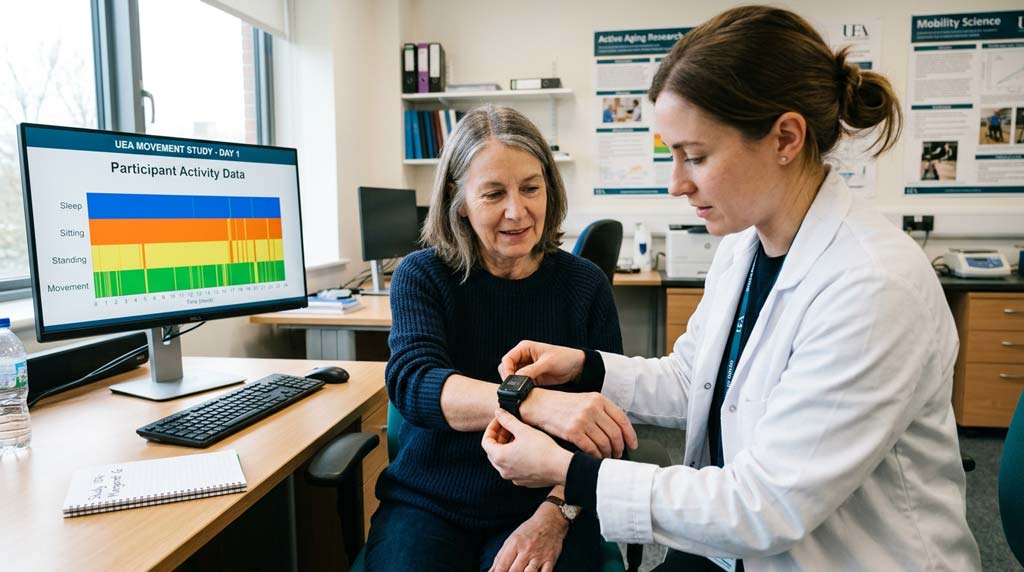
A study published in BMC Medicine built its entire method around that constraint. It followed 59,218 UK adults who wore a wrist sensor for a week. Cancer diagnoses were then tracked for a median of eight years. Rather than ranking people by exercise, the researchers asked what each minute was spent doing.
That distinction matters because movement guidance speaks almost entirely in terms of intensity. The World Health Organization recommends 150 to 300 minutes of moderate activity weekly. Anyone unable to reach that threshold is offered very little else. Large numbers of adults worldwide fall short of it.
Cancer supplies the reason to care about any of this. There were an estimated 20 million new diagnoses worldwide in 2022. Prevention research keeps returning to behaviour rather than biology. Physical inactivity sits among the most modifiable risk factors identified so far.
The evidence leads to a less obvious conclusion: a minute does not have the same value at every time of day. Its value depends partly on the behaviour it replaces and how scarce that behaviour already is. That changes the question around everyday movement and cancer risk from simply how much effort we make to how we distribute and exchange our time.
How This Study Measured Everyday Movement and Cancer Risk
Trust in a health finding depends on how it was measured. Here it was done by machine rather than memory. Participants in the UK Biobank accelerometry sub-study wore an Axivity AX3 device on the dominant wrist. It recorded 100 readings every second for seven days.
A valid day required at least sixteen hours of wear. Each person also had to supply three valid days, including one weekend day. That second rule matters, because weekends and weekdays rarely resemble each other.
Questionnaires would have produced a softer picture. People misjudge how long they sit and overstate how hard they move. Software then sorted each minute into categories, using classifiers tested in laboratories and in ordinary life. Sleep was identified separately by an algorithm validated against sleep diaries and overnight monitoring.
The unusual step came next. The same week was described twice, in full. One version sorted every minute by posture: asleep, sitting, standing, moving. The other sorted the identical minutes by effort: asleep, sedentary, light, moderate, vigorous.
Two descriptions produce two sets of options. Posture speaks to people who cannot raise their heart rate. Intensity speaks to people who can. Almost all previous work on everyday movement and cancer risk has used only the second view.
The outcome measured was not cancer in general. Thirteen specific sites were combined into a single composite, chosen because leisure-time activity has been linked to them. Bladder, colon, breast, lung, liver and kidney appear on that list. So do rectal, endometrial, head and neck cancers. Myeloma, myeloid leukaemia, gastric cardia and oesophageal adenocarcinoma complete it.
Then comes the method that gives the study its shape. Compositional analysis treats the day as a single whole rather than a collection of separate habits. Because the total is fixed, it can only ever describe trades. Add fifteen minutes somewhere and fifteen minutes must leave elsewhere.
So every figure produced about everyday movement and cancer risk here is a swap, never an addition. The models also allowed for people dying of other causes first. Age, sex, education, smoking, alcohol, diet, family history, heart disease and medication use were adjusted for. Body weight was deliberately left out of the main model, for reasons that return later.
The Average Day Hidden Inside These Numbers
Before any finding makes sense, the shape of an ordinary day has to be visible. The participants averaged 61.7 years of age, and 55 per cent were women. Their measured week produced figures most people would not predict about themselves.
Sorted by posture, the average day held eleven hours and thirteen minutes of sitting. Sleep took seven hours thirty-nine minutes. Standing accounted for four hours seventeen minutes. Moving, at any pace at all, came to fifty-one minutes. Long sitting on this scale has already been tracked against mortality in large adult samples.
Sorted by effort, the same day looked thinner still. Light activity filled five hours and three minutes. Moderate activity reached twenty-eight minutes. Vigorous activity, meaning effort hard enough to leave you breathless, lasted three.
Three minutes is the number worth holding on to. That is about a fifth of one per cent of a day. Every percentage attached to vigorous effort in research on everyday movement and cancer risk is a percentage of that.
Comparing the two groups sharpens the point. People later diagnosed with cancer had recorded 30 per cent less vigorous activity at the start. That sounds enormous until the arithmetic arrives. Thirty per cent of three minutes is under a minute a day.
The same group had also moved 11 per cent less and stood 1.7 per cent less. Moderate activity ran 13 per cent lower. Sedentary time was 1.6 per cent higher. Sleep showed no meaningful difference at all. Device studies covering whole days report comparable patterns for heart and metabolic health.
None of the gaps behind everyday movement and cancer risk in this study are large. The differences are small because the behaviours themselves are small. Sitting is the one exception, and it is the only part of the day with real room to give. Treating those hours as a single system rather than separate habits is now standard in this field.
Why Standing and Moving Shaped Everyday Movement and Cancer Risk
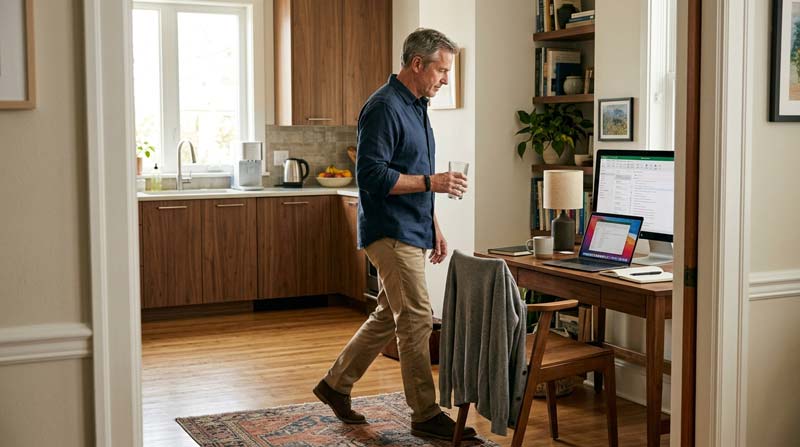
Standing is not exercise. No guideline mentions it, no tracker celebrates it, and nobody counts it. That is exactly why its appearance in these results deserves attention.
The posture analysis found more time moving or standing tracked with lower cancer risk. More time sitting tracked with higher risk. Sleep sat outside the pattern altogether. Sedentary behaviour has been examined this way many times before.
Then the researchers ran the trades. Each swap holds every other behaviour steady at the sample average. The figures are hazard ratios, which compare risk between groups across the follow-up period. A ratio of 0.98 means a 2% lower risk.
- Fifteen Minutes of Moving: Taken from sitting, this carried a hazard ratio of 0.98. Taken from sleep, the figure was identical. Moving is the smallest waking behaviour in the day, so fifteen minutes represents a large proportional increase.
- Thirty Minutes of Standing: Replacing sleep produced a hazard ratio of 0.97. Replacing sitting produced 0.98. Standing needed double the time of moving for a comparable shift, which fits its much larger daily total.
- Thirty Minutes Lost From Moving: Reversing the trade cost more than the gain was worth. Moving replaced by sitting carried a hazard ratio of 1.08. Replaced by sleep, it reached 1.07. Standing lost to sitting or sleep sat at 1.03.
That asymmetry looks odd until the proportions are considered. Fifty-one minutes is the whole of an average person’s daily movement. Removing thirty of them removes most of it. The steep part of the curve is where people who barely move already live.
Standing carries the more unusual finding. Occupational sitting has been studied against later cancer for years. Standing has not been studied this way at all. This work reports the first evidence of its kind on shifting time from sitting or sleep into standing.
For anyone weighing everyday movement and cancer risk, that opens an unfamiliar door. Standing asks for no fitness, no equipment and no change of clothes. Posture measured by device has already been linked to metabolic markers, so the idea is not fanciful.
A separate BeSund piece examines how sitting too long raises cancer risk and how short movement breaks can lower it. This study adds the next question: what those breaks should consist of. Stepping shows inverse associations with cancer up to around 5,000 to 7,000 steps daily. Whether standing works in its own right, or only by breaking up long sitting, remains unknown. The data on everyday movement and cancer risk cannot separate the two.
Why Three Minutes of Effort Matched Ninety Minutes of Pottering
The intensity analysis produced the strangest arithmetic in the study.
Three minutes of vigorous activity carried a hazard ratio of 0.96. The figure held whether those minutes came from sleep, sitting, light or moderate activity. Light activity reached a comparable shift only past ninety minutes. At that point it registered 0.92, in place of either sleep or sedentary time.
Set side by side, the exchange looks absurd. Three minutes of one thing sat alongside ninety of another. The light activity figure is in fact the larger reduction. It simply demanded thirty times the minutes to get there.
The explanation lives in the method rather than in biology. Compositional models work on ratios, not raw totals. Adding three minutes to a three-minute behaviour doubles it. Adding ninety minutes to a five-hour behaviour changes it by less than a third.
So scarcity, not virtue, sets the price. A minute is worth most where there is almost none of it already. Read across the whole study, an exchange rate appears. Three minutes of hard effort, fifteen of moving and thirty of standing each shift the needle a little. More than ninety minutes of light activity does similar work more slowly.
That rate is the most useful thing this research offers on everyday movement and cancer risk. It is also why short bursts of vigorous activity have attracted so much attention in people who never exercise.
A second analysis combined moderate and vigorous activity into one measure. That combination held its association in every version of the model. More striking still, risk fell further as the vigorous share within it rose. Earlier work found greater total activity most strongly associated with lower cancer incidence.
Moderate activity on its own behaved inconsistently. The researchers suggest the two intensities may not act through identical routes. Similar patterns appear in cardiovascular research, where the vigorous portion carries additional weight. That ordering shows up well beyond this dataset. Dose-response evidence across large cohorts points the same way for cancer and mortality.
For everyday movement and cancer risk, that changes the practical question. It is not only how much a person moves. It is what proportion of that movement is genuinely hard.
Feasibility then cuts the other way. Ninety minutes of light activity is within reach of almost anyone. Three minutes of breathlessness is not, for people who are older, frail or managing several conditions.
The cheapest option in minutes is the most expensive in capability.
The Biology That Might Explain the Link
Association tells you that two things move together. It does not tell you why. This study measured behaviour, not biology, so every explanation here is borrowed from other research.
The authors put several forward. None is proven by their data, and some rest on firmer ground than others. What follows are the leading candidates for everyday movement and cancer risk, not a closed case.
Inflammation and Insulin Resistance
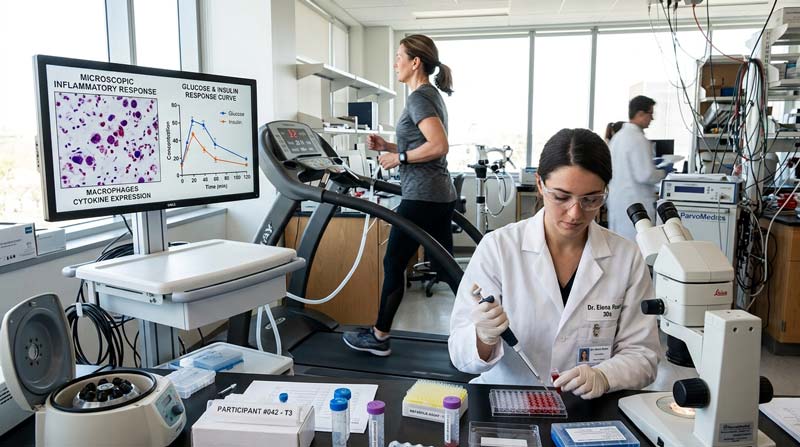
Physical activity appears to reduce chronic inflammation and improve how the body handles insulin, the hormone that regulates blood sugar. Long periods of sitting appear to push both in the opposite direction. These are slow processes, working across years rather than weeks.
Body Fat as the Middleman
Body weight was left out of the main models on purpose. When the researchers added it, the sitting association disappeared completely. That pattern suggests body fat may sit inside the pathway rather than beside it.
Why Vigorous Effort May Differ
Moderate activity alone behaved inconsistently, while its combination with vigorous effort did not. One reading is that harder movement reaches processes gentler movement does not. Evidence for this specific to cancer remains limited, and the authors say so.
Why Light Activity and Standing May Work
Light activity happens in large volumes, so it may act mainly by displacing sitting. The researchers propose the same for standing. Mechanisms tying sedentary behaviour to cancer have been reviewed at length. Those linking standing to cancer have not, and remain unclear.
Sleep is the outlier in all of this. Duration showed no association here, which matches the largest meta-analysis on the question. Yet duration is only one dimension of sleep. Quality, timing and disorders such as sleep apnoea went unmeasured. Any account of everyday movement and cancer risk built on hours slept alone is therefore incomplete.
The Honest Limits Behind the Evidence
Every strong finding deserves an equally strict audit. This one survives better than most, though not everywhere.
Start with the design. This is an observational study, so it can show association and nothing more. Something unmeasured could shape both movement and cancer at the same time.
A subtler point matters just as much. The swaps here are comparisons between different people, not changes inside one person. The paper states this plainly. Nobody in the study cut fifteen minutes from anything. Every figure therefore describes a difference between two lives rather than a forecast for one.
Then the researchers attacked their own results, which is where this gets interesting.
Removing the first year of cancer cases changed little. Removing two years left the posture findings intact. Vigorous activity did not survive that second test. Its association stopped being statistically significant, meaning it could no longer be told apart from chance.
The reason is quietly devastating. Average vigorous activity among those excluded was under a minute a day lower. A finding resting on less than sixty seconds is a fragile finding. Combined moderate-to-vigorous activity, by contrast, held in every version of the analysis.
Adjusting for body mass index removed the sitting association entirely. The authors read that as mediation rather than error. Both readings are available, and these data cannot settle which is right.
Site-specific results were broadly consistent, with one exception. Breast cancer showed nothing, despite being the most common cancer in the sample. That absence sits awkwardly beside everything else and has no explanation here.
E-values put a number on how much hidden confounding would undo a result. For the weakest associations in this study, a confounder with a hazard ratio of 1.12 would be enough. That is an ordinary strength of effect rather than an exotic one.
Finally, the people. Ninety-six per cent were of white ethnic background, and 43 per cent held a degree. Cancer incidence differs by ethnic group in England, so that composition matters. Volunteering for research is itself a form of selection. UK Biobank participants are healthier and more advantaged than the wider population.
None of this cancels what the study found about everyday movement and cancer risk. It sets the findings at their proper size. Some researchers argue risk-factor associations still hold in unrepresentative cohorts. That argument remains contested. So who these figures on everyday movement and cancer risk actually describe stays an open question.
What Everyday Movement and Cancer Risk Mean for Your Day
Effect sizes this small do not rearrange a life. A hazard ratio of 0.98 describes a two per cent difference in risk across a whole population. It is not a figure that demands anything of anyone. Read carefully, the findings on everyday movement and cancer risk concern substitution more than exercise. That is a quieter idea than any headline allows.
What the research offers instead is a wider set of doors. Current guidance names one: reaching a threshold of moderate or vigorous exercise. This study names several, because it modelled posture alongside intensity.
That matters most for the people standing furthest from the guidance. Someone older, unwell or exhausted cannot manufacture three minutes of breathlessness on demand. They can often stand rather than sit. Guidelines covering the whole 24 hours already exist in Canada. Other countries have taken the same route. Australia has published its own version for adults and older adults.
The trade still has to be realistic. Ninety extra minutes of light activity is a great deal of pottering for one day. Three extra minutes of hard effort is a smaller ask in time and a much larger one in capacity. Workplace schemes built on fifteen-minute daily targets have been formally evaluated. Modest goals are not a fantasy. Prevention frameworks continue to place activity among the factors people can actually change.
One distinction is worth keeping straight. This study looked at cancer incidence, meaning cancer appearing in people who did not previously have it. It says nothing about life after a diagnosis. Research on exercise after colon cancer treatment addresses that separate question. Confusing the two would misread both.
A day cannot be extended. It can only be spent differently. This study’s real contribution to everyday movement and cancer risk is a price list for the alternatives.
Eleven hours of the average day were spent sitting. That is where the spare minutes live.
Sources
- Ahmadi MN, Blodgett JM, Atkin AJ, Chan HW, Del Pozo Cruz B, Suorsa K, et al. Relationship of device measured physical activity type and posture with cardiometabolic health markers: pooled dose-response associations from the Prospective Physical Activity, Sitting and Sleep Consortium. Diabetologia. 2024;67(6):1051-65.
- Ahmadi MN, Hamer M, Gill JMR, Murphy M, Sanders JP, Doherty A, et al. Brief bouts of device-measured intermittent lifestyle physical activity and its association with major adverse cardiovascular events and mortality in people who do not exercise: a prospective cohort study. Lancet Public Health. 2023;8(10):e800-10.
- Australian Government Department of Health and Aged Care. Australian 24-hour movement guidelines for adults (18-64 years) and older adults (65+ years). Report. Australia Government Department of Health, Disability and Ageing; 2026.
- Blodgett JM, Ahmadi MN, Atkin AJ, Chastin S, Chan H-W, Suorsa K, et al. Device-measured physical activity and cardiometabolic health: the Prospective Physical Activity, Sitting, and Sleep (ProPASS) consortium. Eur Heart J. 2024;45(6):458-71.
- Bray F, Laversanne M, Sung H, Ferlay J, Siegel RL, Soerjomataram I, Jemal A. Global cancer statistics 2022: GLOBOCAN estimates of incidence and mortality worldwide for 36 cancers in 185 countries. CA: A Cancer J Clin. 2024;74(3):229-63.
- Bull FC, Al-Ansari SS, Biddle S, Borodulin K, Buman MP, Cardon G, et al. World Health Organization 2020 guidelines on physical activity and sedentary behaviour. Br J Sports Med. 2020;54(24):1451-62.
- Delon C, Brown KF, Payne NWS, Kotrotsios Y, Vernon S, Shelton J. Differences in cancer incidence by broad ethnic group in England, 2013-2017. Br J Cancer. 2022;126(12):1765-73.
- Chen Y, Tan F, Wei L, Li X, Lyu Z, Feng X, et al. Sleep duration and the risk of cancer: a systematic review and meta-analysis including dose-response relationship. BMC Cancer. 2018;18(1):1149.
- Ding D, Nguyen B, Nau T, Luo M, del Pozo Cruz B, Dempsey PC, et al. Daily steps and health outcomes in adults: a systematic review and dose-response meta-analysis. Lancet Public Health. 2025;10(8):e668-81.
- Doherty A, Jackson D, Hammerla N, Plotz T, Olivier P, Granat MH, et al. Large Scale Population Assessment of Physical Activity Using Wrist Worn Accelerometers: The UK Biobank Study. PLoS ONE. 2017;12(2):e0169649.
- Chaput JP, Carson V, Gray CE, Tremblay MS. Importance of all movement behaviors in a 24 hour period for overall health. Int J Environ Res Public Health. 2014;11(12):12575-81.
- Dumuid D, Pedisic Z, Palarea-Albaladejo J, Martin-Fernandez JA, Hron K, Olds T. Compositional Data Analysis in Time-Use Epidemiology: What, Why, How. Int J Environ Res Public Health. 2020;17(7):2220.
- Friedenreich CM, Ryder-Burbidge C, McNeil J. Physical activity, obesity and sedentary behavior in cancer etiology: epidemiologic evidence and biologic mechanisms. Mol Oncol. 2021;15(3):790-800.
- Garcia L, Pearce M, Abbas A, Mok A, Strain T, Ali S, et al. Non-occupational physical activity and risk of cardiovascular disease, cancer and mortality outcomes: a dose-response meta-analysis of large prospective studies. Br J Sports Med. 2023;57(15):979.
- Hojman P, Gehl J, Christensen JF, Pedersen BK. Molecular Mechanisms Linking Exercise to Cancer Prevention and Treatment. Cell Metab. 2018;27(1):10-21.
- Hyde ET, Evenson KR, Howard AG, Parada H Jr., Di C, LaMonte MJ, et al. Sitting time and risk of cancer incidence and cancer mortality in postmenopausal women: the Women’s Health Accelerometry Collaboration. Cancer Causes Control. 2025;36(11):1417-30.
- Ihira H, Sawada N, Yamaji T, Goto A, Shimazu T, Kikuchi H, et al. Occupational sitting time and subsequent risk of cancer: The Japan Public Health Center-based Prospective Study. Cancer Sci. 2020;111(3):974-84.
- Lynch BM. Sedentary Behavior and Cancer: A Systematic Review of the Literature and Proposed Biological Mechanisms. Cancer Epidemiol Biomarkers Prev. 2010;19(11):2691-709.
- McTiernan A, Friedenreich CM, Katzmarzyk PT, Powell KE, Macko R, Buchner D, et al. Physical Activity in Cancer Prevention and Survival: A Systematic Review. Med Sci Sports Exerc. 2019;51(6):1252-61.
- Moore SC, Lee IM, Weiderpass E, Campbell PT, Sampson JN, Kitahara CM, et al. Association of Leisure-Time Physical Activity With Risk of 26 Types of Cancer in 1.44 Million Adults. JAMA Intern Med. 2016;176(6):816-25.
- Ross R, Chaput JP, Giangregorio LM, Janssen I, Saunders TJ, Kho ME, et al. Canadian 24-Hour Movement Guidelines for Adults aged 18-64 years and Adults aged 65 years or older: an integration of physical activity, sedentary behaviour, and sleep. Appl Physiol Nutr Metab. 2020;45(10):S57-102.
- Schoeler T, Speed D, Porcu E, Pirastu N, Pingault J-B, Kutalik Z. Participation bias in the UK Biobank distorts genetic associations and downstream analyses. Nat Hum Behav. 2023;7(7):1216-27.
- Shreves AH, Small SR, Walmsley R, Chan S, Saint-Maurice PF, Moore SC, et al. Amount and intensity of daily total physical activity, step count and risk of incident cancer in the UK Biobank. Br J Sports Med. 2025;59(12):839-47.
- Singh B, Ferguson T, Deev A, Deev A, Maher CA. Evaluation of the 15 Minute Challenge: A Workplace Health and Wellbeing Program. Healthcare (Basel). 2024;12(13):1255.
- Stamatakis E, Gale J, Bauman A, Ekelund U, Hamer M, Ding D. Sitting Time, Physical Activity, and Risk of Mortality in Adults. J Am Coll Cardiol. 2019;73(16):2062-72.
- Stamatakis E, Ahmadi MN, Friedenreich CM, Blodgett JM, Koster A, Holtermann A, et al. Vigorous Intermittent Lifestyle Physical Activity and Cancer Incidence Among Nonexercising Adults: The UK Biobank Accelerometry Study. JAMA Oncol. 2023;9(9):1255-9.
- Stamatakis E, Owen KB, Shepherd L, Drayton B, Hamer M, Bauman AE. Is Cohort Representativeness Passe? Poststratified Associations of Lifestyle Risk Factors with Mortality in the UK Biobank. Epidemiology. 2021;32(2):179-88.
- Strain T, Flaxman S, Guthold R, Semenova E, Cowan M, Riley LM, et al. National, regional, and global trends in insufficient physical activity among adults from 2000 to 2022: a pooled analysis of 507 population-based surveys with 5.7 million participants. Lancet Global Health. 2024;12(8):e1232-43.
- van Hees VT, Sabia S, Jones SE, Wood AR, Anderson KN, Kivimaki M, et al. Estimating sleep parameters using an accelerometer without sleep diary. Sci Rep. 2018;8(1):12975.
- VanderWeele TJ, Ding P. Sensitivity Analysis in Observational Research: Introducing the E-Value. Ann Intern Med. 2017;167(4):268-74.
- Yang L, Courneya KS, Friedenreich CM. The Physical Activity and Cancer Control (PACC) framework: update on the evidence, guidelines, and future research priorities. Br J Cancer. 2024;131(6):957-69.