


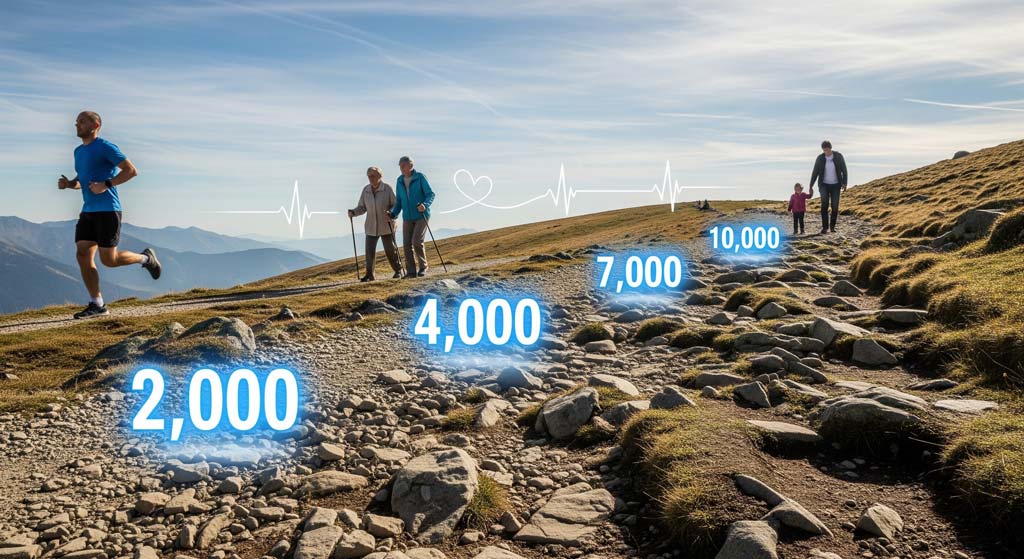
How many steps a day you need to protect your health isn’t what most fitness apps tell you. While millions chase the mythical 10,000-step target, the largest systematic review ever conducted has analysed data from over 160,000 people across 57 studies to answer this question definitively.
The findings challenge everything we thought we knew about daily walking targets. Different health conditions respond to step counts in dramatically different ways. Your heart disease risk follows an entirely different pattern than your cancer risk. Your age fundamentally changes how your body responds to daily steps. Even the device measuring your steps influences the results.
This isn’t another study suggesting modest improvements. The research reveals that specific step counts can reduce your risk of dying from heart disease by 47%, cut dementia risk by 38%, and slash depression risk by 22%. Yet these protective benefits don’t all peak at the same number.
Most remarkably, the research shows that even how many steps a day you manage at relatively low levels creates substantial protection. Walking just 4,000 steps daily compared to 2,000 steps reduces all-cause mortality risk by 36%. This means every additional stride genuinely matters for your health.
What follows in this text reveals why 7,000 steps emerges as a practical sweet spot across multiple health conditions, why your age changes the equation entirely, and how even modest step increases deliver profound health returns.
We’ll explore what this means for cancer prevention, heart health, brain protection, and mental well-being. Most importantly, you’ll discover precisely how many steps your body needs based on what you’re trying to protect.
How Many Steps a Day According to the Largest Study Ever
Understanding how many steps a day provides optimal health benefits requires examining the research methodology. This systematic review represents the most comprehensive analysis of daily steps and health outcomes ever conducted. The research team reviewed 57 studies spanning 35 cohorts, creating an unprecedented database of evidence.
The scope staggers the imagination. Researchers analysed data from 161,176 participants for mortality outcomes alone, with additional cohorts studying cardiovascular disease, cancer, diabetes, cognitive function, mental health, physical function, and falls. Unlike previous reviews focusing primarily on death rates, this investigation examined eight distinct health outcomes.
The question of how many steps a day are needed across different health conditions finally receives definitive answers.
Key findings that reshape our understanding:
- 7,000 steps provides substantial protection across most health conditions compared to 2,000 steps daily
- Different health conditions follow different step-response patterns – some linear, others curved
- Age fundamentally alters the relationship between steps and health benefits
- Device type influences results, with accelerometers and pedometers showing different patterns
- Even modest step counts deliver significant benefits well below traditional targets
The research quality exceeded typical standards. Physical activity has numerous health benefits, including lowering cardiovascular disease risk, diabetes, some cancers, and premature mortality. Most studies scored highly on quality assessment, with 42% achieving the maximum 9 points and 79% scoring 7 or above.
Perhaps most significantly, the evidence certainty reached moderate levels for most outcomes. This represents strong confidence in the findings, particularly given that observational studies typically start with low certainty ratings. Globally, insufficient physical activity accounts for up to 8% of non-communicable diseases.
Why 7,000 Steps Protects Against Eight Different Health Conditions
The 7,000-step threshold didn’t emerge arbitrarily. Mathematical modelling revealed this number provides clinically meaningful improvements across the broadest range of health outcomes whilst remaining achievable for most adults.
Compared to taking just 2,000 steps daily, reaching 7,000 steps delivers remarkable protection. All-cause mortality risk drops by 47%. Cardiovascular disease incidence falls by 25%. Cancer mortality decreases by 37%. Dementia risk plummets by 38%. Depression risk reduces by 22%.
These aren’t marginal improvements. A 47% reduction in dying from any cause represents substantial protection. The 38% dementia risk reduction could translate to years of preserved cognitive function.
Step counts capture ambulatory (walking-based) activities across intensity, bouts, and domains, making them a promising supplementary metric for physical activity recommendations.
The mathematical models revealed why 7,000 steps work so effectively. For most health conditions, benefits accelerate rapidly up to this point, then plateau or increase more gradually beyond it. This creates an optimal balance between effort and reward.
Public health guidelines have a crucial role in translating research into actionable recommendations. The question of how many steps a day provides maximum benefit across multiple conditions finds its answer at this threshold.
However, our previous analysis of 5,000 steps and the 10,000-step myth showed that even modest targets provide significant benefits. The current research confirms this pattern whilst extending our understanding across multiple health conditions.
The beauty of 7,000 steps lies in its practical achievability. Most adults can incorporate this level of activity into daily routines without dramatic lifestyle changes.
Daily step counts are an easily measurable and understandable metric that can be tracked using pedometers, accelerometers, smartwatches, and other activity trackers. People consistently ask how many steps a day they should aim for, and 7,000 provides a science-backed answer.
How Many Steps a Day Based on What You Want to Prevent
Your body responds differently to daily steps depending on which health condition you’re trying to prevent. This personalised approach transforms how we think about step targets.
Heart Health
Cardiovascular disease follows a curved pattern with clear inflexion points. For younger adults, cardiovascular benefits don’t plateau until around 7,800 steps. Older adults see maximum benefits around 5,400 steps daily. Cardiovascular mortality shows the strongest response, with a 47% risk reduction at 7,000 steps compared to 2,000 steps.
Cancer Protection
Cancer presents a mixed picture. Cancer incidence follows a straight line relationship, meaning every additional step provides proportional benefits without plateauing. However, cancer mortality shows a curved response with maximum benefits around 4,800 steps. Physical activity has been consistently linked with lower cancer risk across multiple cancer types.
Brain Health
Dementia protection follows a curved pattern with benefits accelerating up to 8,800 steps daily. The 38% risk reduction at 7,000 steps compared to 2,000 steps represents one of the strongest protective effects found.
This could translate to years of preserved cognitive function and independence. Regular physical activity has been linked to improved cognitive function and reduced risk of cognitive decline.
Mental well-being
Depression shows a linear relationship with steps, meaning every additional step provides proportional mental health benefits. Walking 7,000 steps daily reduces depression risk by 22% compared to 2,000 steps. This straight-line relationship suggests there’s no upper limit to the mental health benefits of walking. How many steps a day you manage directly correlates with mental health improvements.
Diabetes Prevention
Type 2 diabetes follows a linear pattern, with steady risk reductions as step counts increase. Walking 7,000 steps daily provides a 14% risk reduction compared to 2,000 steps. While this appears modest, diabetes prevention compounds over decades. The economic burden of physical inactivity includes billions in healthcare expenditures annually.
Fall Prevention
Falls present a unique pattern in older adults. Benefits plateau around 8,800 steps, but the research suggests potential increased fall risk beyond 6,000 steps in specific populations. This highlights the importance of individualised approaches for older adults. How many steps a day older adults should target requires careful consideration of mobility and fall risk.
Why Your Age Changes the Number You Need
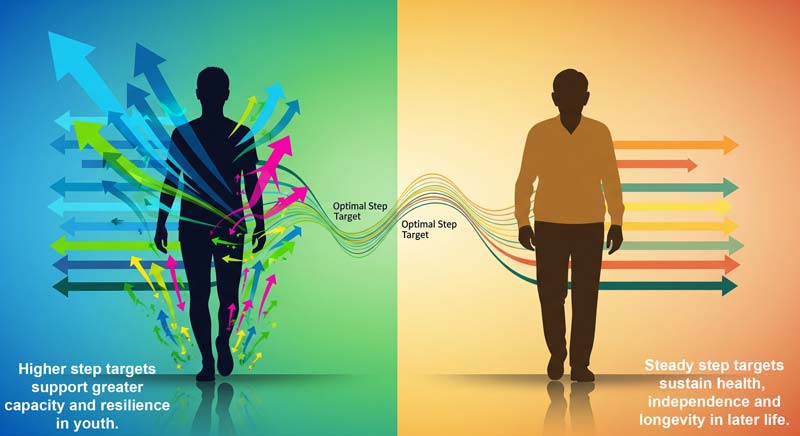
Age fundamentally alters how your body responds to daily steps. The research reveals that younger and older adults follow completely different patterns, suggesting one-size-fits-all recommendations miss crucial nuances.
Younger Adults (Under 65 Years)
For younger adults, the relationship between steps and health follows curved patterns with higher inflexion points. All-cause mortality benefits don’t plateau until around 5,400 steps. Cardiovascular disease protection continues accelerating up to 7,800 steps daily.
This suggests younger bodies can effectively utilise higher step counts for additional health benefits. The physiological explanation lies in superior cardiovascular capacity, muscle function, and recovery ability.
Younger adults can handle higher activity volumes whilst continuing to gain proportional benefits. National trends show concerning stagnation or worsening physical activity levels in many countries.
Older Adults (65 Years and Above)
Older adults show fundamentally different response patterns. All-cause mortality follows a linear relationship without clear plateaus, meaning every additional step provides benefits regardless of current activity level. However, cardiovascular disease benefits plateau much earlier, around 5,400 steps.
This linear relationship in older adults suggests that accumulated health deficits make every step increasingly valuable. The body’s reduced physiological reserves mean modest increases in activity yield disproportionate health benefits. Determining how many steps a day matters more for older adults because baseline activity levels are typically lower.
Practical Implications
These age-related differences shouldn’t necessarily drive different recommendations. Several factors complicate direct age comparisons. First, baseline health risks differ dramatically between age groups, making statistical comparisons challenging. Second, chronological age may matter less than functional capacity or frailty status.
The research suggests focusing on gradual increases from current activity levels rather than rigid age-based targets. For older adults or people with chronic health conditions, lower step counts would still provide beneficial outcomes.
The key lies in progressive improvement tailored to individual circumstances rather than universal targets when considering how many steps a day to recommend.
Even 4,000 Steps Beats Doing Almost Nothing
The most encouraging finding challenges the perfectionist mindset that pervades fitness culture. The systematic review demonstrates that even modest step counts deliver substantial health benefits compared to sedentary behaviour.
Walking just 4,000 steps daily compared to 2,000 steps reduces all-cause mortality risk by 36%. This represents massive protection for a relatively small increase in daily activity. For every additional 500 steps taken, there’s a 7% reduction in cardiovascular disease death risk. Doubling that to an extra 1,000 steps correlates with a 15% reduction in dying from all causes.
These incremental benefits underscore that every step genuinely counts for health outcomes. The mathematical relationship shows consistent improvements across the entire range studied, from very low to very high step counts. Even walking less than 5,000 steps daily, traditionally deemed sedentary, provides meaningful health protection.
The message that every step counts should be emphasised as a core public health message, regardless of specific quantitative targets. This approach aligns with moderate-intensity to vigorous-intensity physical activity recommendations that focus on any amount of activity providing benefits. The question of how many steps a day you currently manage matters less than increasing from your current baseline.
For people starting from very low activity levels, the relative improvements are actually greatest. Moving from 2,000 to 4,000 steps provides proportionally larger benefits than moving from 8,000 to 10,000 steps. This creates an accessible entry point for inactive individuals who might feel overwhelmed by traditional step targets.
The research eliminates excuses whilst providing realistic hope. You don’t need expensive equipment, gym memberships, or dramatic lifestyle overhauls. Walking represents the most accessible form of physical activity, requiring no special training or equipment, whilst delivering substantial health returns.
When people ask how many steps a day they should start with, the answer is simple: more than you’re currently doing.
Sources
- Bassett, D. R. Jr., Toth, L. P., LaMunion, S. R., et al. Step counting: a review of measurement considerations and health-related applications. Sports Med. 2017; 47:1303–1315.
- Bull FC, Al-Ansari SS, Biddle S, Borodulin K, Buman MP, Cardon G, Carty C, Chaput JP, Chastin S, Chou R, Dempsey PC, DiPietro L, Ekelund U, Firth J, Friedenreich CM, Garcia L, Gichu M, Jago R, Katzmarzyk PT, Lambert E, Leitzmann M, Milton K, Ortega FB, Ranasinghe C, Stamatakis E, Tiedemann A, Troiano RP, van der Ploeg HP, Wari V, Willumsen JF. World Health Organization 2020 guidelines on physical activity and sedentary behaviour. Br J Sports Med. 2020 Dec;54(24):1451-1462.
- Ding, Ding & Nguyễn, Bình & Nau, Tracy & Luo, Mengyun & del Pozo Cruz, Borja & Dempsey, Paddy & Munn, Zachary & Jefferis, Barbara & Sherrington, Cathie & Calleja, Elizabeth & Chong, Kar Hau & Davis, Rochelle & Francois, Monique & Tiedemann, Anne & Biddle, Stuart & Okely, Anthony & Bauman, Adrian & Ekelund, Ulf & Clare, Philip & Owen, Katherine. (2025). Daily steps and health outcomes in adults: a systematic review and dose-response meta-analysis. The Lancet Public Health, Volume 10, Issue 8, e668 – e681.
- Ding, D., Lawson, K. D., Kolbe-Alexander, T. L., et al. The economic burden of physical inactivity: a global analysis of major non-communicable diseases. Lancet. 2016; 388:1311–1324.
- Ding, D., Mutrie, N., Bauman, A., et al. Physical activity guidelines 2020: comprehensive and inclusive recommendations to activate populations. Lancet. 2020; 396:1780–1782.
- Hall, K. S., Hyde, E. T., Bassett, D. R., et al. Systematic review of the prospective association of daily step counts with risk of mortality, cardiovascular disease, and dysglycemia. Int J Behav Nutr Phys Act. 2020; 17:78.
- Katzmarzyk, P. T., Friedenreich, C., Shiroma, E. J., et al. Physical inactivity and non-communicable disease burden in low-income, middle-income and high-income countries. Br J Sports Med. 2022; 56:101–106.
- Kraus, W. E., Janz, K. F., Powell, K. E., et al. Daily step counts for measuring physical activity exposure and its relation to health. Med Sci Sports Exerc. 2019; 51:1206–1212.
- Rojer, A. G. M., Ramsey, K. A., Amaral Gomes, E. S., et al. Objectively assessed physical activity and sedentary behavior and global cognitive function in older adults: a systematic review. Mech Ageing Dev. 2021; 198:111524.
- Stamatakis, E., Ahmadi, M., Murphy, M. H., et al. Journey of a thousand miles: from ‘Manpo-Kei’ to the first steps-based physical activity recommendations. Br J Sports Med. 2023; 57:1227–1228.
- Strain, T., Flaxman, S., Guthold, R., et al. National, regional, and global trends in insufficient physical activity among adults from 2000 to 2022: a pooled analysis of 507 population-based surveys with 5.7 million participants. Lancet Glob Health. 2024; 12:e1232–e1243.
- Tudor-Locke, C., Bassett, D. R. Jr. How many steps/day are enough? Preliminary pedometer indices for public health. Sports Med. 2004; 34:1–8.
- Tudor-Locke, C., Craig, C. L., Aoyagi, Y., et al. How many steps/day are enough? For older adults and special populations. Int J Behav Nutr Phys Act. 2011; 8:80.
- US Department of Health and Human Services. Physical activity guidelines for Americans. US Department of Health and Human Services, 2018.