


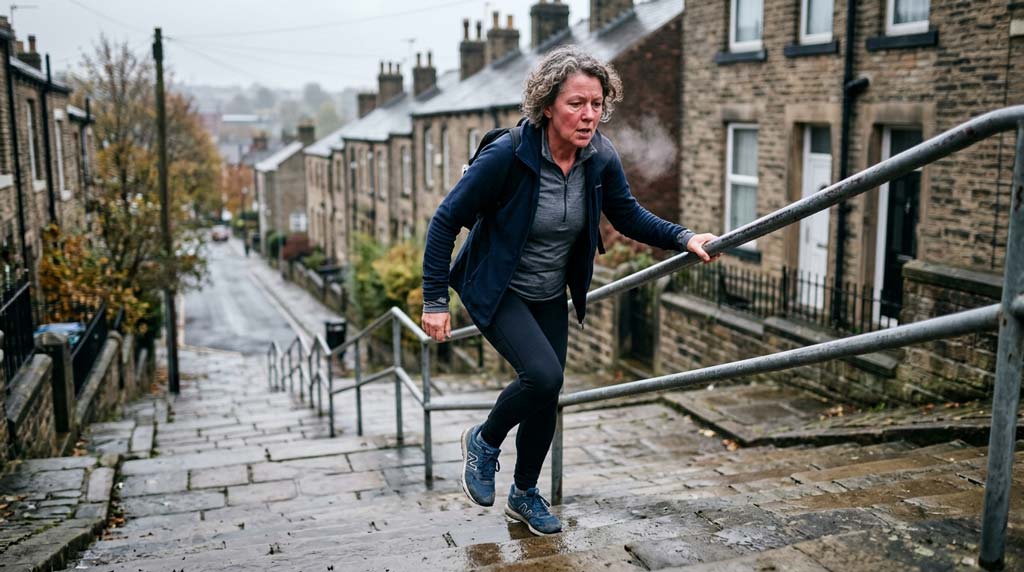
A small amount of vigorous exercise may be the most undervalued medicine of our time.
For twenty years, the public health message has stayed the same. One hundred and fifty minutes of moderate movement a week, a bit of strength work, and you are covered. That framing gave everyone the same prescription. It also quietly missed a truth that a new investigation in the European Heart Journal has now forced into the open.
A new study published in the European Heart Journal found that a small amount of vigorous activity may be linked to a lower risk of eight different chronic diseases. The team followed 472,138 adults. Roughly 96,000 wore wrist accelerometers that recorded every movement at 1-second intervals. The rest, over 375,000 people, reported their habits through a questionnaire.
The researchers tracked them for up to fifteen years. The outcome list was brutal in its honesty. Heart attacks, strokes, and heart failure. Atrial fibrillation is an irregular heart rhythm. Type 2 diabetes. Immune-mediated inflammatory diseases, a group that includes rheumatoid arthritis, lupus, psoriasis, and inflammatory bowel disease. Fatty liver disease. Long-term lung conditions. Chronic kidney disease. Dementia. And death from any cause.
The finding turns the old guideline on its head. For the same total weekly activity, people whose movement involved some vigorous effort had a dramatically lower risk of each of those diseases. Not modestly lower. In some cases, cut nearly by two-thirds.
Dementia risk fell by 63 per cent. Type 2 diabetes by 60 per cent. Fatty liver by 48 per cent. The trio of heart attack, stroke, and heart failure fell by 31 per cent. Death from any cause dropped by 46 per cent.
These reductions appeared at a threshold most readers would call laughably low. Just over four per cent of the week’s activity needed to be vigorous. For most people, that is a small amount of vigorous exercise tucked inside an otherwise ordinary week.
Here is the quieter finding, the one that will keep scientists busy for years. Some diseases respond almost exclusively to intensity. Volume, meaning total time spent moving, barely touches the dial for them. Immune-mediated inflammatory disease is the starkest example. Others need both ingredients working together. The biology, it turns out, was never one-size-fits-all.
Four questions follow. Who was actually studied, and why do the numbers deserve the benefit of the doubt? What does the four per cent threshold look like on a real Tuesday? Why do some diseases respond to intensity alone while others require both levers? And how does any of this translate to a person who last ran two years ago and has a full inbox?
What the Study Tracked Across 472,000 Adults
Big studies lie well. Small ones lie loudly and get caught. This one does neither, because its size and its method make lying difficult.
The UK Biobank is the data engine behind most of what we now know about ageing in the 21st century. Between 2006 and 2010, it recruited over half a million adults aged 40 to 69 across the United Kingdom. Each one gave blood, answered long questionnaires, and agreed to have their medical records tracked for decades. The scale matters because rare outcomes, like early dementia, only surface when you have enough bodies and enough time.
Between 2013 and 2015, a random subset of that cohort received an Axivity AX3 accelerometer in the mail. The device is the size of a watch and sits on the wrist for seven days straight. It samples movement a hundred times a second. Washing the dishes, running for a bus, folding laundry, and climbing the stairs with shopping. Every second is logged.
This sensitivity changes the quality of the data. Questionnaires ask people what they remember doing. Memory flatters us. Accelerometers do not. When researchers compare the two methods side by side, questionnaire answers inflate vigorous minutes and underestimate the constant background drizzle of light movement throughout the day. Both are useful. Only one is honest.
This investigation used both, separately:
- The device-measured group: 96,408 adults who wore wrist accelerometers, with an average age of 61.9 years, 56 per cent women, and a median follow-up of nearly 9 years.
- The questionnaire-measured group: 375,730 adults who self-reported their activity, with an average age of 56.2 years, 52 per cent women, and a median follow-up of over 14 years.
Two mirrors on the same truth. One captures what people actually did. The other captures what they believed they did. Where the two agree, the finding is strong. Where they diverge, the device usually wins, and the authors are transparent about why.
Nearly every analysis controlled for the obvious confounders. Age, sex, ethnicity, education, deprivation, smoking, alcohol, diet quality, sleep, medication use, body mass index, blood pressure, cholesterol, kidney function, and a frailty score. A second model then layered on medications that might already be modifying risk. A small amount of vigorous exercise shifted the needle even after all of that adjustment.
One detail matters more than the rest. For each disease, anyone who already had the condition at the start was excluded from that analysis. The study is not asking whether exercise helps people who are already ill. It is asking whether people who move differently become ill less often. That is a different, harder, more useful question.
Because when 472,000 people answer that question in the same direction, a small amount of vigorous exercise stops looking like advice and starts looking like evidence.

The 4% Threshold Where a Small Amount of Vigorous Exercise Changes Everything
Vigorous activity is what stops you from talking in full sentences. You can still speak, but in short bursts between breaths. For a reasonably fit 50-year-old, that might mean a brisk uphill walk or chasing a child across a park. For someone deconditioned, walking at a normal pace can already hit it. Intensity is relative to the body doing the work.
The study quantified this precisely. Across the 96,408 device-measured adults, the average week held around 9,500 metabolic-equivalent minutes of activity. Vigorous effort made up only a sliver of that.
For 15 per cent of the group, none of it was vigorous. For another 42 per cent, vigorous effort accounted for less than 2 per cent of weekly activity. Only 18 per cent crossed the 4 per cent mark.
That four per cent line is where the body starts behaving differently. Below it, the risk curves for major diseases sit high and flat. Cross it, and they drop. Hard. Cross it, and a small amount of vigorous exercise becomes a measurable public health asset.
Compared with adults who did zero vigorous movement, those above the four per cent mark showed the following reductions in disease risk over the study years:
- Dementia risk fell by 63 per cent. This is the steepest drop on the board, and it held even after adjusting for age, education, and frailty. For a disease with no cure, any intervention this strong deserves attention.
- Type 2 diabetes risk fell by 60 per cent. Vigorous effort recruits muscle fibres that light walking never engages. Those fibres pull glucose out of the blood with unusual aggression.
- Fatty liver disease risk fell by 48 per cent. This is the metabolic condition spreading fastest through middle-aged populations. It rarely hurts until it hurts a lot.
- Chronic respiratory disease risk fell by 44 per cent. Breathless work trains the lungs and the muscles around them in ways gentle walking cannot match.
- Chronic kidney disease risk fell by 41 per cent. The kidney is a blood-flow organ. Whatever protects arteries tends to protect kidneys, too.
- The risk of immune-mediated inflammatory disease fell by 39 per cent. A grouping that includes rheumatoid arthritis, lupus, psoriasis, and inflammatory bowel disease.
- Major adverse cardiovascular events fell by 31 per cent. Heart attack, stroke, and heart failure are combined into a single endpoint.
- Atrial fibrillation risk fell by 29 per cent. The irregular rhythm that ushers many older adults into the hospital for the first time.
- Death from any cause fell by 46 per cent. The bluntest possible measure, and the one that closes most arguments.
These figures come from the primary adjusted model, which controlled for total activity volume among many other factors. The risk reductions do not come from doing more. They come from doing some of it harder.
A separate line of research had already pointed this direction. Even 15 to 20 minutes of vigorous effort a week, spread however it fell, was linked to significantly lower mortality.
Another large cohort of over 400,000 adults in a North American population showed the same shape. And recent work comparing movement intensities found that one minute of vigorous activity confers benefits similar to four to nine minutes of moderate activity, or close to an hour of light activity.
The plateau is worth sitting with. For heart events, dementia, immune disease, and mortality, risk stopped falling at around four to five per cent vigorous share. More did not keep giving more.
A small amount of vigorous exercise does most of the work. More, in those cases, adds nothing. For diabetes, kidney, liver, and lung conditions, the curve continued to bend downward past 5%. Different diseases, different ceilings. The why of that split is where the real story lives.
The Three-Tier Disease Pattern Most Reports Missed
This is the question no headline has asked. If vigorous effort lowers the risk of eight very different diseases, does it lower them for the same reason? Or is something stranger happening beneath the surface?
The researchers tested it. They compared two levers. How much of each disease could be prevented by raising vigorous share? How much could be prevented by raising total activity volume? The measure has a mouthful of a name. Population preventable fraction. It asks: if everyone shifted to a healthier level, how much of this disease would vanish from the population?
The answers split the eight diseases into three distinct camps. The chart below clearly shows the split.
Once you see the pattern, you cannot unsee it. One camp responds almost only to intensity. Another responds to intensity far more than volume, but volume still matters. The third responds to both, roughly equally.
Tier One: Intensity is the whole game
One disease grouping stands alone. Immune-mediated inflammatory disease. Rheumatoid arthritis. Lupus. Psoriasis. Inflammatory bowel disease. These are conditions where the immune system turns on the body it was built to protect.
Here, the numbers are stark. Raising vigorous share could prevent roughly one in five cases. Raising the total volume of walking and light movement could prevent one in a hundred. A ratio of twenty to one. Light movement, no matter how much, barely touches the biology.
Something about high effort specifically rewires how immune cells communicate. A small amount of vigorous exercise, from this reading, may be one of the few behavioural levers that reach inflammatory disease at all.
Tier Two: Intensity leads, volume follows
The second camp holds four conditions. Major adverse cardiovascular events (the composite of heart attack, stroke, and heart failure). Atrial fibrillation. Chronic respiratory disease. Dementia.
For all four, vigorous shares did 2 to 4 times as much work as total volume. Take dementia. Raising vigorous share could prevent close to a third of cases. Raising volume could prevent around one in twelve. Both matter. But intensity leads.
The pattern makes biological sense. These are diseases of the heart, brain, and lungs. All three respond to high physiological demand in ways that gentle loads cannot replicate. Brief, breathless effort seems to be the signal they were built to respond to.
Tier Three: Both ingredients matter
The third camp holds the metabolic conditions and the mortality endpoint. Type 2 diabetes. Fatty liver disease. Chronic kidney disease. Death from any cause.
Here are the ratios close up. Vigorous exercise could prevent 22-31% of these conditions. Volume could prevent 14-18 per cent. The gap exists, but it narrows. Both levers matter, though intensity still leads on points.
This is the tier where the old guideline works best. Volume gives energy expenditure. Intensity gives metabolic stress. For a liver, a kidney, or a pancreas, the sum is greater than either part alone.
The three tiers change how we should talk about exercise. One prescription does not fit all diseases, because one biology does not either. For inflammatory disease, a small amount of vigorous exercise does almost all of the preventive work available. For cardiovascular and neurological conditions, it does most of it. For metabolic disease, it pulls its weight alongside total movement.
And all of this comes from the same week, the same body, the same adult trying to stay well. It is the distribution of effort within that week that decides which organ gets the strongest signal.
Why Intensity Triggers What Volume Alone Cannot
Something different happens in the body at high effort. Not more of what happens at low effort. Different.
Think of two water taps. One runs slowly for twenty minutes and fills a bath. The other blasts for thirty seconds and shatters limescale off the inside of the pipe. Both use water. Only one changes the plumbing. Volume fills the tank. Intensity reworks the system.
The study cannot directly isolate mechanisms. What it can do is point out which organ systems respond and how strongly, then line those patterns up with what biologists already know about exercise at high effort. Four mechanisms stand out. None of them requires a gym.
- Nitric oxide and the inner lining of your arteries. Arteries are lined by a single-cell layer called the endothelium. When it ages badly, plaques form, and blood pressure climbs. Vigorous effort drives unusually high blood flow through the arteries. That flow stretches the endothelium, which releases nitric oxide (a molecule that relaxes and widens blood vessels). Low-effort walking releases some. Breathless work releases considerably more. Over months, the vessel stays more elastic. This is why the heart-event reductions in this study look the way they do.
- Brain-derived neurotrophic factor, or BDNF. BDNF is a protein that supports the survival and growth of brain cells, particularly in the hippocampus, the area central to memory. High-intensity efforts cause BDNF to surge in the bloodstream, often within minutes of finishing. Gentle activity produces smaller, slower rises. Across years, this may be one reason the dementia reduction in this study is the steepest of any outcome. The brain is listening to how hard you breathe.
- The immune reset at high effort. Vigorous exercise appears to alter which immune cells circulate and what they do. Different cell populations enter the bloodstream. Inflammatory signalling shifts. In one line of work, researchers traced the cellular origin of circulating DNA. They found that intense exercise altered the mix in ways that lower-intensity work did not. This helps explain why rheumatoid arthritis, psoriasis, and similar conditions respond so strongly to intensity specifically.
- The muscle signalling cascade. Inside working muscle, high effort activates two tiny molecular switches called AMPK and PGC-1-alpha. They govern how many mitochondria (the cells’ energy factories) your muscles build and how well those factories run. Brief, intense intervals activate these switches more powerfully than long, easy sessions. New mitochondria mean better glucose handling, better fat oxidation, and more metabolic room before something breaks. This is likely the bridge to type 2 diabetes, fatty liver, and kidney disease.
Four systems. Four different signals. One shared trigger: effort high enough to push the body out of its comfort zone.
A small amount of vigorous exercise, repeated across weeks, means each of these cascades fires regularly. Light movement keeps you alive. Vigorous movement tells multiple organ systems to adapt.
This is also why the old guidelines, written when accurate measurement was expensive, treated moderate and vigorous activity as interchangeable units of time. They are not. A small amount of vigorous exercise carries a denser biological signal than its minute count suggests.
How to Add a Small Amount of Vigorous Exercise to Your Day
The research is one thing. Wednesday morning is another. What does all of this actually mean for a person who works a desk job, has children or ageing parents, and last ran for a bus three years ago?
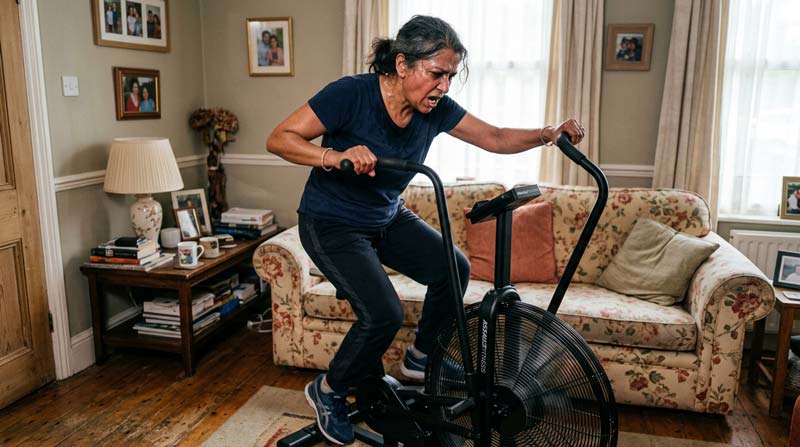
Start with what vigorous means. It is not a number on a treadmill. It is a conversation test. If you can still speak in full sentences, you are not there yet. If you can manage only three or four words between breaths, you are. This threshold is personal. For someone deconditioned, a brisk walk uphill hits it. For someone already fit, they may need to take two steps at a time on a staircase.
A small amount of vigorous exercise does not need an hour. It can live inside an activity that was happening anyway, reshaped slightly. The practical question is not whether to add time to your week. It is whether to change the texture of the time you already spend moving.
If your life has no spare minutes
This is most people. The lever here is texture, not duration. Take the stairs at a pace that forces you to pause and breathe. Walk the last five minutes of your commute fast enough that you arrive slightly warm.
Carry the shopping home in one trip, quickly. The study’s four per cent threshold translates to around fifteen minutes of vigorous effort spread across a week. Three short bursts a day, each of a minute or two, gets you there.
The biology does not care whether it came from a gym session or a rushed walk to catch a train. Recent work on incidental activity confirms the signal registers either way. What matters is that the effort is real, not that it has a name.
If you are older or less mobile
Vigorous is relative. For a 75-year-old who has not exercised in a decade, standing up from a low chair six times in a row can qualify. Walking to the end of the driveway at a purposeful pace can qualify. A chair-based routine that raises breathing and heart rate can qualify.
This group also deserves an honest caveat. Very high-intensity work is not for everyone, and existing conditions should be discussed with a clinician first. The study found consistent benefit across age, sex, body mass, and frailty levels. Older adults are not excluded from this finding; they are included.
If you already exercise regularly
You are the group most likely to be leaving benefits on the table, because steady aerobic work, done comfortably, does not hit the same biological switches. Inserting even one or two breathless minutes into an otherwise moderate session appears to do the heavy lifting.
There is a fair question here about overdoing it, particularly around atrial fibrillation. Earlier work in endurance athletes with extremely high training volumes did show some elevated arrhythmia risk. This investigation examined middle-aged adults in the general population, in which vigorous activity was low by athletic standards. Within that band, atrial fibrillation risk was consistently lower, not higher.
The concern applies to the top end of the sport performance world, not to someone adding a breathless minute to their lunchtime walk.
What this looks like by Friday
One person waits for a kettle and does thirty seconds of fast stair climbs. Another turns their dog walk into a route with two hills instead of one. A third sets a ten-minute block after dinner for a quicker-than-comfortable walk.
None of these demands Lycra or a membership fee. It demands a small rearrangement of what is already happening.
A small amount of vigorous exercise, done this way, provides protection across eight major disease categories and against reduced life expectancy. The cost is brief, several times a week. The study suggests that this is one of the least expensive health care options available to a modern adult.
The old guideline asked for 150 minutes a week. That advice still stands, and most adults still do not hit it. The new insight does not replace it. It adds a line of small print that has been missing. Some of that time, even a tiny slice of it, needs to be hard enough to change the conversation you could have while doing it.
Sources
- Abdulla J, Nielsen JR. Is the risk of atrial fibrillation higher in athletes than in the general population? A systematic review and meta-analysis. Europace. 2009;11:1156–9.
- Ahmadi MN, Hamer M, Gill JMR, Murphy M, Sanders JP, Doherty A, Shepherd LT, Cistulli PA, Simpson AJ, Koster A, Holtermann A, Stamatakis E. Brief bouts of device-measured intermittent lifestyle physical activity and its association with major adverse cardiovascular events and mortality in people who do not exercise: a prospective cohort study. Lancet Public Health. 2023;8:e800–e810.
- Ahmadi MN, Clare PJ, Katzmarzyk PT, Del Pozo Cruz B, Lee IM, Stamatakis E. Vigorous physical activity, incident heart disease, and cancer: how little is enough? Eur Heart J. 2022;43:4801–14.
- Biswas RK, Ahmadi MN, Bauman A, Milton K, Koemel NA, Stamatakis E. Wearable device-based health equivalence of different physical activity intensities against mortality, cardiometabolic disease, and cancer. Nat Commun. 2025;16:8315.
- Doherty A, Jackson D, Hammerla N, Plötz T, Olivier P, Granat M, White T, van Hees VT, Trenell MI, Owen CG, Preece SJ, Gillions R, Sheard S, Peakman T, Collins R, Wareham NJ. Large scale population assessment of physical activity using wrist worn accelerometers: the UK Biobank Study. PLoS One. 2017;12:e0169649.
- Ekelund U, Tarp J, Ding D, Sanchez-Lastra MA, Dalene KE, Anderssen SA, Hansen BH, Lee IM. Deaths potentially averted by small changes in physical activity and sedentary time: an individual participant data meta-analysis of prospective cohort studies. Lancet. 2026;407:339–49.
- Fernández-Rodríguez R, Álvarez-Bueno C, Martínez-Ortega IA, Martínez-Vizcaíno V, Mesas AE, Notario-Pacheco B. Immediate effect of high-intensity exercise on brain-derived neurotrophic factor in healthy young adults: a systematic review and meta-analysis. J Sport Health Sci. 2022;11:367–75.
- Gebel K, Ding D, Chey T, Stamatakis E, Brown WJ, Bauman AE. Effect of moderate to vigorous physical activity on all-cause mortality in middle-aged and older Australians. JAMA Intern Med. 2015;175:970–7.
- Gibala MJ, McGee SL, Garnham AP, Howlett KF, Snow RJ, Hargreaves M. Brief intense interval exercise activates AMPK and p38 MAPK signaling and increases the expression of PGC-1alpha in human skeletal muscle. J Appl Physiol (1985). 2009;106:929–34.
- Lager C, Rizzuto D, Ars J, Boström AM, Calderón-Larrañaga A, Welmer AK. Associations between device-measured physical activity patterns and 8-year incidence of cardiovascular events in well-functioning older adults: variations by age. Eur J Prev Cardiol. 12 July 2025.
- Rodrigues KB, Weng Z, Graham ZA, Lavin K, McAdam J, Tuggle SC, Peoples BM, Seay RS, Plott TJ, Smith SA, Nelson T, Bamman MM, Broderick TJ, Khodadadi H. Exercise intensity and training alter the innate immune cell type and chromosomal origins of circulating cell-free DNA in humans. Proc Natl Acad Sci U S A. 2025;122:e2406954122.
- Strain T, Wijndaele K, Dempsey PC, Sharp SJ, Pearce M, Jeon J, Lindsay T, Wareham N, Brage S. Wearable-device-measured physical activity and future health risk. Nat Med. 2020;26:1385–91.
- Stamatakis E, Biswas RK, Koemel NA, Sabag A, Pulsford R, Atkin AJ, Doherty A, Thøgersen-Ntoumani C, Lemes IR, Ahmadi MN, Del Pozo Cruz B, Hamer M. Dose response of incidental physical activity against cardiovascular events and mortality. Circulation. 2025;151:1063–75.
- Stamatakis E, Ahmadi M, Biswas RK, Del Pozo Cruz B, Thøgersen-Ntoumani C, Murphy MH, Holtermann A, Koster A, Hamer M. Device-measured vigorous intermittent lifestyle physical activity (VILPA) and major adverse cardiovascular events: evidence of sex differences. Br J Sports Med. 2025;59:316–24.
- Stamatakis E, Ahmadi MN, Gill JMR, Thøgersen-Ntoumani C, Gibala MJ, Doherty A, Hamer M. Association of wearable device-measured vigorous intermittent lifestyle physical activity with mortality. Nat Med. 2022;28:2521–9.
- Sudlow C, Gallacher J, Allen N, Beral V, Burton P, Danesh J, Downey P, Elliott P, Green J, Landray M, Liu B, Matthews P, Ong G, Pell J, Silman A, Young A, Sprosen T, Peakman T, Collins R. UK Biobank: an open access resource for identifying the causes of a wide range of complex diseases of middle and old age. PLoS Med. 2015;12:e1001779.
- Tjønna AE, Lee SJ, Rognmo Ø, Stølen TO, Bye A, Haram PM, Loennechen JP, Al-Share QY, Skogvoll E, Slørdahl SA, Kemi OJ, Najjar SM, Wisløff U. Aerobic interval training versus continuous moderate exercise as a treatment for the metabolic syndrome: a pilot study. Circulation. 2008;118:346–54.
- Wang Y, Nie J, Ferrari G, Rey-Lopez JP, Rezende LFM. Association of physical activity intensity with mortality: a National Cohort Study of 403 681 US adults. JAMA Intern Med. 2021;181:203–11.
- Zare N, Bishop DJ, Levinger I, Febbraio MA, Broatch JR. Exercise intensity matters: a review on evaluating the effects of aerobic exercise intensity on muscle-derived neuroprotective myokines. Alzheimers Dement (N Y). 2025;11:e70056.