


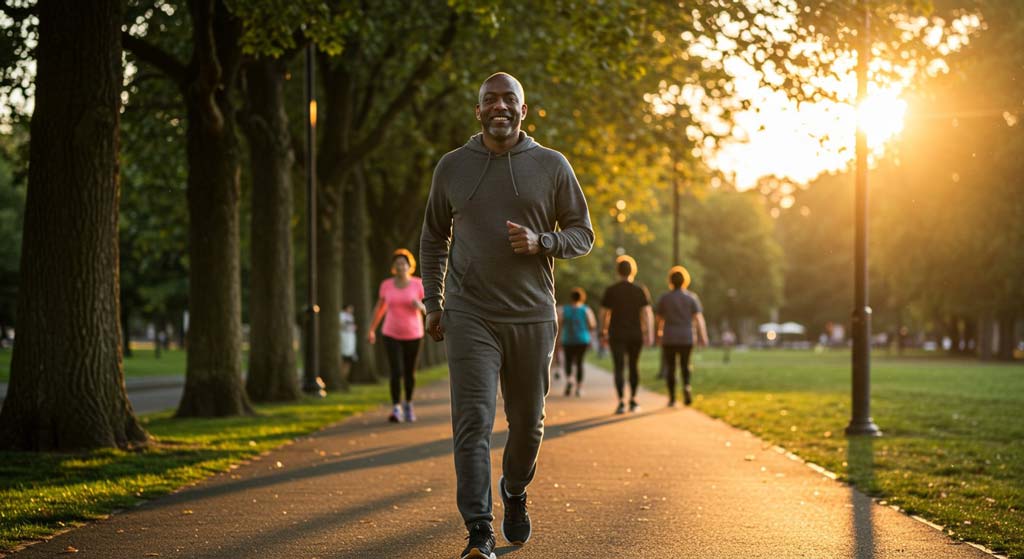
Exercise after colon cancer treatment can cut your risk of dying by 37%, according to groundbreaking research that followed 889 patients for nearly eight years. The requirement involves just 45-60 minutes of brisk walking three to four times per week. A simple movement that could add years to your life.
The CHALLENGE trial represents the first definitive proof that structured physical activity genuinely improves survival outcomes for colon cancer patients who have completed chemotherapy. Published in the New England Journal of Medicine, this research transforms exercise after colon cancer treatment from hopeful advice into medical evidence.
Cancer survivors often face a terrifying question: “What can I actually do to stop this coming back?” Surgery removes the tumour. Chemotherapy targets remaining cancer cells. But then what? This study provides a concrete answer. Movement matters. Your daily choices after treatment can influence whether cancer returns.
The research reveals something remarkable about human resilience. Patients who exercised showed 28% fewer cases of cancer recurrence or new cancers developing. Their 5-year disease-free survival reached 80.3% compared to 73.9% for those receiving standard health advice alone. The differences prove substantial and meaningful.
This post examines exactly what this exercise programme involved, why the numbers matter so much, how movement changes your body’s ability to fight cancer, and what these findings mean for anyone navigating life after colon cancer treatment. The science is robust. The implications are profound. The choice is yours.
What Exercise After Colon Cancer Treatment Actually Involves
The exercise programme that saved lives wasn’t complicated. Patients aimed to increase their weekly physical activity by 10 MET-hours (metabolic equivalent task hours) – roughly equivalent to 2.5 hours of brisk walking spread across three or four sessions. No gym membership is required. No special equipment is needed.
The structured approach unfolded across three distinct phases over three years. Phase one lasted six months, with bi-weekly face-to-face coaching sessions combined with supervised exercise sessions. Patients attended 83% of mandatory behavioural support meetings and 79% of required exercise sessions. This intensive start helped establish sustainable habits.
Exercise after colon cancer treatment in phase two shifted to monthly contact over six months. Adherence dropped to 68% for behavioural support but remained substantial at 54% for supervised sessions. The final 24 months involved monthly check-ins, maintaining 63% adherence to support sessions. These figures demonstrate that sustained engagement is possible even as intensity decreases.
The chart below illustrates how patient adherence rates and activity progress from baseline.
Months 1-6
Months 7-12
Months 13-36
11.5
21.5+
The exercise group achieved remarkable consistency. They maintained their increased activity levels throughout the entire three-year intervention, averaging 23-25 MET-hours per week compared to 15-17 MET-hours in the control group. This represented adding approximately 1.5 to 2.25 hours of moderate walking weekly, a manageable commitment with extraordinary returns.
Patients could choose their preferred activities. Brisk walking proved the most popular, but swimming, cycling, and dancing all counted. The key was achieving moderate intensity, feeling slightly breathless but still able to hold a conversation. This flexibility meant exercise after colon cancer treatment could fit into real lives with real constraints.
Cardiorespiratory fitness improved significantly. The exercise group showed predicted maximum oxygen consumption increases of 1.3 to 2.7 ml per kilogram per minute compared to controls. Their 6-minute walk distance improved by 13 to 30 metres. These objective measures confirm that patients genuinely became fitter, not just more active on paper.
The Numbers That Matter: Survival Rates and Recurrence
Raw survival statistics tell the most compelling story. After eight years of follow-up, 90.3% of exercise participants remained alive compared to 83.2% of those receiving health education alone. This 7.1 percentage point difference represents a 37% reduction in death risk, comparable to many standard cancer drug treatments.
Disease-free survival showed equally impressive results. The cancer returned, new cancers developed, or death occurred in 93 exercise participants versus 131 control group members. The annual event rate dropped from 5.4% in the control group to 3.7% in the exercise group, a 28% relative risk reduction.
The survival comparison shown in the chart below demonstrates the sustained benefits that developed over time.
Benefits appear
Benefits continue
Liver metastases occurred in 3.6% of exercise participants compared to 6.5% of controls. New primary cancers developed in just 5.2% of the exercise group versus 9.7% of controls. Breast cancer appeared in only 0.4% of exercising women compared to 2.7% of controls. These reductions across multiple cancer types suggest exercise after colon cancer treatment provides broad protective effects.
The survival curves began separating after one year and continued diverging throughout the decade-long follow-up. This pattern indicates cumulative benefits that compound over time. Early intervention creates advantages that persist and grow.
No significant differences emerged in deaths without cancer recurrence (1.3% versus 1.8%). This finding confirms that exercise specifically prevented cancer-related events rather than improving general health outcomes. The protective effect targeted the precise concern that terrifies cancer survivors most: their disease returning.
Exercise after colon cancer treatment delivered benefits that matched or exceeded many approved pharmaceutical interventions. The magnitude of survival improvement rivals treatments costing thousands of pounds and carrying significant side effects. The movement achieved this through natural biological mechanisms without chemical intervention.
Why Exercise After Colon Cancer Treatment Works In Your Body
Exercise triggers multiple biological changes that create hostile environments for cancer cells. Physical activity increases fluid shear stress in blood vessels, which can damage circulating cancer cells before they establish new tumours. Enhanced immune surveillance helps the body identify and eliminate cancer cells more effectively.
Metabolic improvements play crucial roles. Exercise after colon cancer treatment enhances insulin (a hormone that regulates blood sugar) sensitivity, reducing levels of insulin and insulin-like growth factors that promote cancer cell proliferation. Cancer cells often require more glucose (blood sugar) than normal cells. Improved glucose regulation through exercise may starve potential tumours of their preferred fuel source.
Inflammation reduction represents another key mechanism. Chronic inflammation creates conditions that favour cancer development and progression. Regular physical activity reduces inflammatory markers throughout the body. This anti-inflammatory effect may prevent dormant cancer cells from reactivating and forming detectable tumours.
The exercise intervention improved cardiorespiratory fitness without reducing body weight or waist circumference. This finding suggests that weight loss doesn’t explain the observed cancer protection. Instead, the benefits likely stem from improved cardiovascular function, enhanced immune system performance, and favourable metabolic changes.
Muscle contraction during exercise releases myokines (proteins that act as messengers between muscles and other organs). These proteins communicate with different organs and tissues. Some myokines demonstrate anti-cancer properties in laboratory studies. Regular exercise after colon cancer treatment may create sustained myokine release that helps maintain cancer surveillance and suppression.
Blood flow improvements ensure better oxygen and nutrient delivery to healthy tissues while potentially disrupting the abnormal blood vessel networks that tumours require for growth. Enhanced circulation also improves the delivery of immune cells to areas where cancer cells might attempt to establish themselves.

What This Means for Your Recovery Journey
These findings fundamentally change conversations between cancer survivors and their medical teams. Exercise after colon cancer treatment now represents evidence-based medicine, not lifestyle suggestions. The research provides clear targets: aim for 45-60 minutes of moderate activity, three to four times weekly, starting within six months of completing chemotherapy.
Healthcare systems face challenges in implementing these programmes. The study participants received structured support that most cancer centres don’t currently provide. However, the basic prescription remains accessible. Walking groups, swimming sessions, or cycling clubs can provide social support while meeting activity targets.
The three-year timeframe highlights the importance of sustained commitment. Short-term exercise programmes likely won’t deliver the same survival benefits. Exercise after colon cancer treatment requires viewing physical activity as ongoing therapy rather than a temporary intervention. The protective effects developed gradually and accumulated over time.
Individual adaptation remains essential. The study excluded patients already exercising more than 150 minutes weekly, focusing on those who were relatively inactive. More active survivors may need different approaches to achieve additional benefits. Starting gradually and building intensity allows safe progression regardless of current fitness levels.
The musculoskeletal adverse event rate (18.5% in the exercise group versus 11.5% in controls) remained manageable. Most exercise-related injuries were minor and temporary. This safety profile compares favourably to many medical interventions. The benefits clearly outweighed the risks for the vast majority of participants.
Healthcare providers should discuss these findings with all suitable colon cancer survivors. The evidence now supports prescribing exercise with the same confidence used for recommending chemotherapy or radiation therapy. Movement has earned its place in the standard of care.
Sources
- Amirsasan R, Akbarzadeh M, Akbarzadeh S. Exercise and colorectal cancer: prevention and molecular mechanisms. Cancer Cell Int 2022;22:247-247.
- Courneya KS, Vardy JL, O’Callaghan CJ, Gill S, Friedenreich CM, Wong RKS, Dhillon HM, Coyle V, Chua NS, Jonker DJ, Beale PJ, Haider K, Tang PA, Bonaventura T, Wong R, Lim HJ, Burge ME, Hubay S, Sanatani M, Campbell KL, Arthuso FZ, Turner J, Meyer RM, Brundage M, O’Brien P, Tu D, Booth CM; CHALLENGE Investigators. Structured Exercise after Adjuvant Chemotherapy for Colon Cancer. N Engl J Med. 2025 Jun 1.
- Courneya KS, Vardy JL, O’Callaghan CJ, et al. Effects of a structured exercise program on physical activity and fitness in colon cancer survivors: one year feasibility results from the CHALLENGE trial. Cancer Epidemiol Biomarkers Prev 2016;25:969-977.
- Kodama S, Saito K, Tanaka S, et al. Cardiorespiratory fitness as a quantitative predictor of all-cause mortality and cardiovascular events in healthy men and women: a meta-analysis. JAMA 2009;301:2024-2035.
- Markozannes G, Becerra-Tomás N, Cariolou M, et al. Post-diagnosis physical activity and sedentary behaviour and colorectal cancer prognosis: a Global Cancer Update Programme (CUP Global) systematic literature review and meta-analysis. Int J Cancer 2024;155:426-444.
- Wang Y, Jin B, Paxton RJ, et al. The effects of exercise on insulin, glucose, IGF-axis and CRP in cancer survivors: meta-analysis and meta-regression of randomised controlled trials. Eur J Cancer Care (Engl) 2020;29(1):e13186-e13186.