


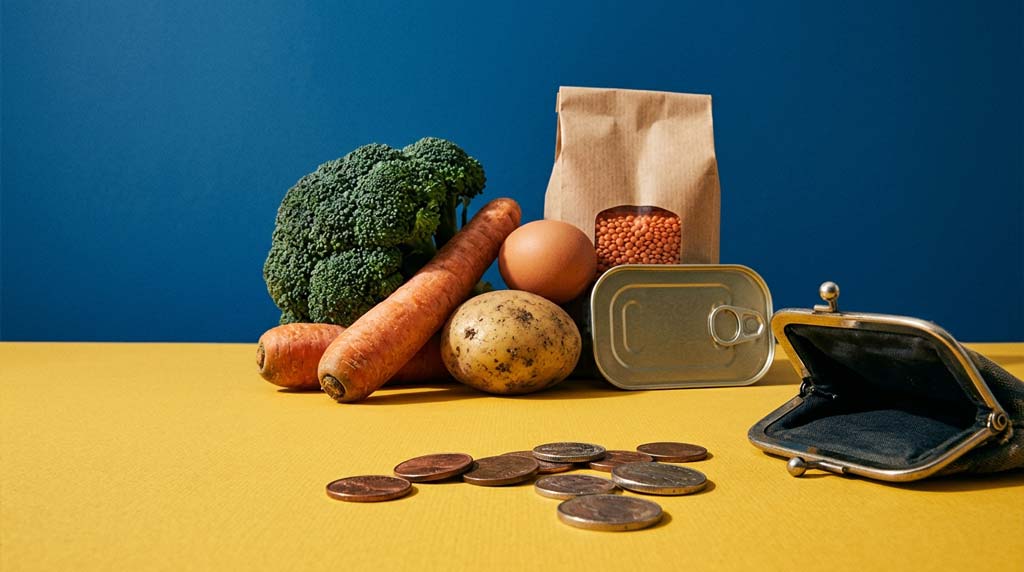
Cost is one of the most commonly cited barriers to eating more healthy food. People shopping on very little money tend to describe the problem in practical terms. Staples sold as cheap aren’t always cheap locally, and fresh produce can go off before it’s eaten. Bulk buying needs money upfront, while cooking from scratch takes time.
There are two possible answers to this:
- One says healthy food is simply too expensive.
- The other says to buy basic staples and cook.
Both are partially true, and neither works for every household.
Groups with lower socioeconomic position (a combined measure of income, education and occupation) tend to eat lower-quality diets. They also have higher rates of obesity, type 2 diabetes and cardiovascular disease. Income, along with education, social cohesion, gender empowerment, and inequality, shapes diet quality.
Access adds another layer. In one rural US community where 54% of residents struggled to access healthy foods, the top barriers to a Mediterranean-style diet were habit, access and cost.
Food price research gives a clearer picture than either answer alone. Much depends on how price is measured, which foods are compared and what a household can realistically use. What stands up is a set of feasible choices, unlike the cheapest diet an app can design.
Why does healthy food feel so expensive
Measured by calories, healthier diets usually cost more. Foods with a high energy density (many calories per gram) supply calories at the lowest cost. They include fats, oils, added sugars and refined grains. Lean meat, fish, vegetables, and fruit sit at the other end as the most expensive energy sources. The same pattern has been found in France, the United States, Australia and the Netherlands.
In French price data, fruit and vegetables cost a median of 0.82 euros per 100 kcal (kilocalories, the unit of food energy). Refined starches cost 0.14 euros per 100 kcal, and added fats just 0.06 euros. So, calorie for calorie, healthy food starts at a disadvantage.
Across 27 studies from 10 countries, the healthiest diet patterns cost about $1.48 more per person per day than the least healthy. The figure is in 2011 international dollars (a comparison unit equal to the US dollar), or roughly $550 a year. Because it compares the extremes of diet quality, it represents the largest likely gap. Most of the prices also came from supermarkets in high-income countries, so the figure measures a trade-off and says nothing about today’s shopping bill.
Much of the argument over the cost of healthy eating comes down to measurement. Price per calorie can mislead because fruit and vegetables are relatively low in calories. Measured per serving, the extra cost of healthy food often shrinks to a few cents. In the 27-study analysis, healthier grains cost just $0.03 more per serving. Meat and protein foods showed the largest gap, at $0.29.
A tight budget also dictates what ends up in the basket. Researchers tested this with diet models (computer calculations that build diets within set limits). Once researchers imposed a cost limit, the diets contained less fruit, vegetables, meat, and fish, and far more fats, sweets, and refined grains. Those modelled diets closely resembled the real diets of lower-income groups. That suggests many unhealthy food choices linked to poverty may follow directly from economic constraints.
Which everyday foods give you more for your money
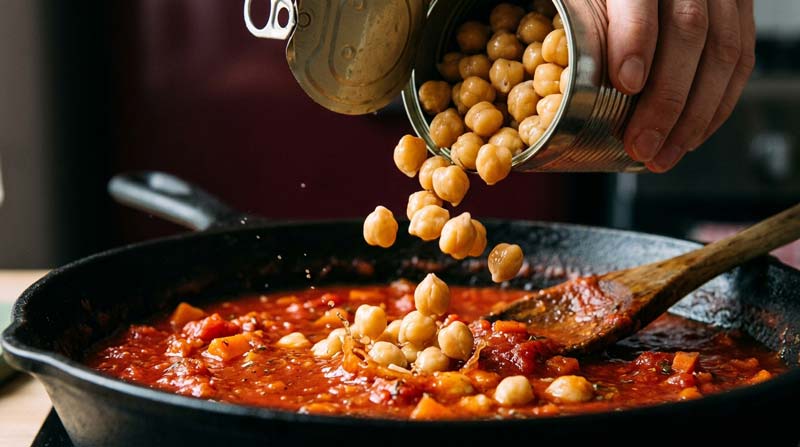
Pulses (dried beans, lentils, chickpeas, and peas), nuts, oils, and whole-grain cereals repeatedly offer strong nutritional value for the price. So do milk, eggs, poultry, organ meats such as liver, and canned sardines. None of these is a premium product, and much of the best-value healthy food sits on ordinary shelves.
A good nutrient-to-price ratio isn’t the same as a low shelf price, though. In one Australian comparison, recommended legumes (beans, peas and lentils), canned fish and margarine cost 30% more than less healthy options.
Beans are often seen as a cheap protein or a meat substitute. Like other vegetables, though, they are rich in fibre, vitamins and minerals, including iron and zinc. Eating pulses is linked with improvements in blood lipids (fats in the blood), blood sugar control and inflammation. A cup of canned baked beans holds about 18 g of fibre. A cup of brown rice holds 4 g.
Fear of wind puts many people off. In two eight-week trials where adults ate half a cup of beans a day, about half reported more wind in the first week with pinto beans. By the second week, that had fallen to 6%. Across the studies, at least 70% of those affected felt it had eased by the second or third week.
For vegetables, value depends on what you measure. In a US analysis of nutrients per unit of cost, potatoes, carrots, broccoli, and tomato juices and soups scored highest. Dark green and deep yellow vegetables, including sweet potatoes, led on nutrient density (vitamins and minerals delivered with little added fat, sugar or salt). Those rankings used US prices, though. Food prices vary widely between similar items, so a list of the cheapest healthy foods in one country may not hold in another.
The same eating style can sit at either end of the price range. A Mediterranean-style diet can be expensive, built on seafood and scampi, or cheap, built on rice, lentils and beans.
Dietitians suggest starting by adding about a cup of legumes to classic recipes:
- kidney beans in spaghetti bolognese or minestrone soup
- lentils in salads, soups and stews
- chickpeas in casseroles
- legumes used as a spread
A cheap healthy food only saves money if it actually gets eaten. Researchers have also suggested that a similar but healthier way of eating may be easier to sustain than a very different one. That suggestion hasn’t been tested.
Can cheaper healthy food be just as nutritious
Branded foods in one UK study cost up to four times as much as cheaper products with similar nutritional content. The study covered canned tomatoes, orange juice, potatoes, sausages and sliced bread. Switching to own-label versions (a supermarket’s own brand) cut costs without affecting nutritional quality. A French study of 220 products across 17 categories found a different result: national brands were about 2.5 times the price and had higher nutritional quality.
Price alone is an unreliable guide to quality. Within a single category, such as corn flakes, sale price showed no systematic link with fat, salt or sugar content. A national food council has twice concluded that existing data don’t allow differences in nutritional value to be read from price differences. So a premium label on healthy food doesn’t, by itself, show that the product inside is better.
Frozen and canned produce involves a similar trade-off. In a US comparison, processed and frozen fruit and vegetables provided comparable nutrition at the lowest cost. Some processed foods were less nutritious than fresh, though, and fresh fruit tended to beat canned fruit on nutrients. Guidance on five servings a day counts fresh, frozen or dried fruit, and fresh, frozen or canned vegetables without added fat or salt. Neither form wins on every measure, and local prices determine which is cheaper.
Better nutrition and lower spending can go together. In US data, Hispanic adults ate higher-quality diets than non-Hispanic adults while spending less. Two conditions make that possible. The food budget must exceed the minimum needed to meet nutritional recommendations, and people must choose foods for their nutrient-to-price ratio.
Whether switching to healthy food raises household spending is still unresolved. In Spain, people who adopted a Mediterranean diet of their own accord spent more on food. By contrast, women in Canada encouraged to follow a Mediterranean-style pattern didn’t report spending more. Lower-income families in the UK and Denmark found dietary interventions harder to follow because they cost more.

When saving money still is not enough
French modelling put the minimum cost of a nutritionally adequate diet at about 3.5 euros per day. Below that level, the model produced no solution. People using food aid in France, meanwhile, had an estimated average food budget of 2.5 euros a day. Both figures come from research published in 2010 and 2011, and they show a limit under the study’s conditions.
Even at that minimum, the diet worked only with zero food waste, tap water to drink, cooking skills, and no meals out at all. Removing every constraint tied to normal eating habits and culture pushed the cost below 1.5 euros a day. The resulting diet contained only oil, pasta, potatoes, a little wheat germ, carrots, radishes, milk, liver and herring. Food also marks cultural and social identity, so dietary advice must be culturally acceptable to work.
Studies in the UK, Canada, Ireland and Australia have compared the price of a balanced basket of food with the food budgets of people in poverty. All reached the same overall conclusion: people in poverty could not afford a balanced, healthy diet. In Ireland, a balanced diet of unbranded foods cost 40% of the income of an older person living alone. For a single-parent household with one child, the figure rose to 80%.
In Australia, following national food guidelines would take 40% of the income of people on a state living allowance, against the 25% considered acceptable. That estimate already used the cheapest own-label versions of healthy food.
Practical barriers sit alongside the money. Reviews of healthier eating patterns repeatedly identify time constraints, limited cooking skills, food access and ingrained habits as obstacles. Several nutrient-dense foods are available cheaply but aren’t always palatable or culturally acceptable to people on low incomes.
Choosing foods that are culturally familiar, locally available, and nutritionally similar to recommended options may improve adherence to a healthier pattern. Above the minimum budget, the evidence supports ordinary staples, own-label products, and frozen or canned healthy foods that households will actually eat. Below it, the French model found no combination of foods that met nutritional needs, however carefully chosen.
Buying healthy food on a tight budget first requires a budget that covers an adequate diet. Above that line, it rests on knowing where nutritional value sits and building it into meals a household already eats, within its time, kitchen and tastes. Below the line, the gap is one of income, and better shopping cannot close it.
Sources
- Carlson, Andrea, and Elizabeth Frazão. Are Healthy Foods Really More Expensive? It depends on How You Measure the Price, EIB-96, U.S. Department of Agriculture, Economic Research Service, May 2012.
- Cooper S, Nelson M. Economy line foods from four supermarkets and brand name equivalents: a comparison of their nutrient contents and costs. J Hum Nutr Diet. 2003;16:339-347.
- Darmon N, Drewnowski A. Does social class predict diet quality? Am J Clin Nutr. 2008;87:1107-1117.
- Darmon N, Drewnowski A. Contribution of food prices and diet cost to socioeconomic disparities in diet quality and health: A systematic review and analysis. Nutr Rev. 2015;73:643–660.
- Darmon N, Ferguson EL, Briend A. A cost constraint alone has adverse effects on food selection and nutrient density: an analysis of human diets by linear programming. J Nutr. 2002;132:3764-3771.
- Drewnowski A. New metrics of affordable nutrition: which vegetables provide most nutrients for least cost? J Acad Nutr Diet. 2013;113:1182-1187.
- Ferreira, H., Vasconcelos, M., Gil, A.M. & Pinto, E. (2021) Benefits of pulse consumption on metabolism and health: A systematic review of randomized controlled trials. Critical Reviews in Food Science and Nutrition, 61(1), 85–96.
- Friel S, Walsh O, McCarthy D. The irony of a rich country: issues of financial access to and availability of healthy food in the Republic of Ireland. J Epidemiol Community Health. 2006;60:1013-1019.
- Goulet J, Lamarche B, Lemieux S. A nutritional intervention promoting a Mediterranean food pattern does not affect total daily dietary cost in North American women in free-living conditions. J Nutr. 2008;138(1):54-59.
- Hardin-Fanning F. Adherence to a Mediterranean diet in a rural Appalachian food desert. Rural Remote Health. 2013;13:2293.
- Kettings C, Sinclair AJ, Voevodin M. A healthy diet consistent with Australian health recommendations is too expensive for welfare-dependent families. Aust N Z J Public Health. 2009;33:566-572.
- Maillot M, Darmon N, Darmon M, et al. Nutrient-dense food groups have high energy costs: an econometric approach to nutrient profiling. J Nutr. 2007;137:1815-1820.
- Maillot M, Darmon N, Drewnowski A. Are the lowest-cost healthful food plans culturally and socially acceptable? Public Health Nutr. 2010;13:1178-1185.
- Maillot M, Ferguson EL, Drewnowski A, et al. Nutrient profiling can help identify foods of good nutritional quality for their price: a validation study with linear programming. J Nutr. 2008;138:1107-1113.
- Miller SR, Knudson WA. Nutrition and cost comparisons of select canned, frozen, and fresh fruits and vegetables. Am J Lifestyle Med. 2014;8:430-437.
- Nelson M, Dick K, Holmes B. Food budget standards and dietary adequacy in low-income families. Proc Nutr Soc. 2002;61:569-577.
- Rao M, Afshin A, Singh G, Mozaffarian D. Do healthier foods and diet patterns cost more than less healthy options? A systematic review and meta-analysis. BMJ Open. 2013 Dec 5;3(12):e004277.
- Rehm CD, Monsivais P, Drewnowski A. The quality and monetary value of diets consumed by adults in the United States. Am J Clin Nutr. 2011;94:1333-1339.
- Winham DM, Hutchins AM. Perceptions of flatulence from bean consumption among adults in 3 feeding studies. Nutr J. 2011 Nov 21;10:128.