


Reformer Pilates promises weight loss, strength, flexibility and freedom from pain, yet the research behind it remains strikingly inconsistent.
Those promises did not come from marketing alone. They reflect what people genuinely want when they book a first class. Women in particular come to it for aesthetic reasons, including slimming, staying in shape and easing muscle pain.
Popularity has climbed steadily for two decades. The findings, however, have refused to settle. Some trials report clear gains. Others report almost nothing at all.
Underneath that disagreement sits a question that sounds simple but isn’t. Is the machine doing something a mat cannot? Or is it changing how the same movements reach the body?
For a long time nobody could answer that. The two forms had never been compared in a high-quality trial. Researchers were left assuming rather than knowing.
The assumption has always favoured the machine. It provides more mechanical resistance and a wider range of movement, so it was expected to outperform floor work. Expectation is not evidence. The distance between the two is where most of the confusion lives.
Part of the trouble is the word itself. Pilates is a broad label covering practices that differ from one another. They vary in external support, in how load is progressed, and in the feedback the body receives. Two classes can share a name and still deliver genuinely different exercise.
Systematic reviews normally settle arguments like this. They gather everything published on a question and appraise it. When several reviews of the same question disagree, the effect on an ordinary reader is confusion.
The research adds one further complication. Studies looking specifically at the machine remain limited. Many focus on body measurements rather than broader health. Meanwhile, the claims made in studios have grown steadily broader.
What follows separates two piles of evidence that usually get mixed together. One pile tests Pilates in general. The other tests the machine. Keeping them apart changes the answer to nearly every question worth asking about reformer Pilates. It also shows which promises hold, which depend on who you are, and which remain untested.
What Is Reformer Pilates
Strip away the studio lighting and the machine is a straightforward piece of engineering.
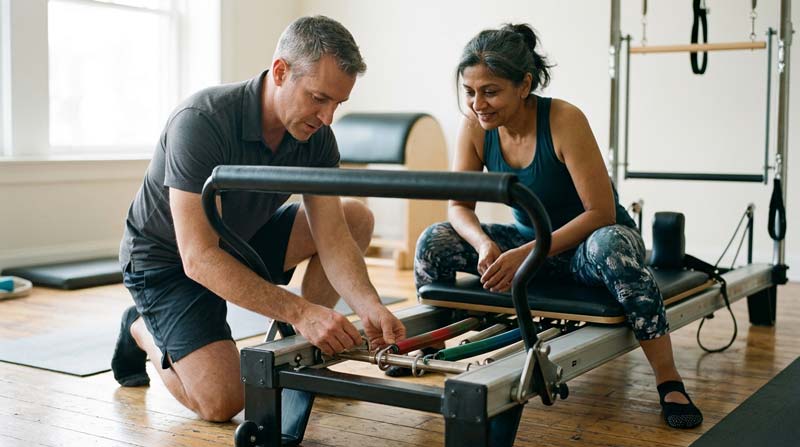
A sliding platform, known as the carriage, runs along a wood or metal frame. Springs connect that carriage to the frame. Ropes, pulleys and an adjustable foot bar complete the arrangement.
The springs are colour-coded, and the colours are not decorative. A standard setup carries three red springs, one blue and one white. Red supplies 0.22 kg of resistance per centimetre, blue 0.11 and white 0.06. Many common exercises use a single red spring, which gives moderate resistance.
Everything else is arranged around the person using it. The foot bar is raised, lowered, or moved outside the frame entirely, depending on the movement. The headrest supports the neck in line with the spine. The shoulder rest either holds the shoulders in position or becomes something to push against.
That adjustability is the whole point. Exercises can be performed lying down, sitting or standing, because the springs supply controlled resistance in each position.
The method itself splits into two branches. Mat work uses body weight on the floor, sometimes with small balls or rings. Equipment work uses apparatus, and reformer Pilates is only one form. The Cadillac, the Ladder Barrel and the Step Chair belong to the same family.
The design has an origin that explains a great deal about it.
Joseph Hubertus Pilates was born near Dusseldorf in 1880, to a prize-winning gymnast father and a naturopath mother. He was a bullied child with asthma and a weak body. As a teenager, he taught himself anatomy from medical books, then took up wrestling and gymnastics.
He moved to England in 1912. There he boxed professionally, performed in a circus and trained officers at Scotland Yard.
Then the First World War began, and he was interned as a German national. He was first held in Lancaster, where he trained fellow inmates and developed the method he called Contrology. Later he was moved to the Isle of Man.
There he was given the job of training injured inmates who could not leave their beds. So he started attaching springs to the hospital bed frames.
That is where the machine comes from. Not a gymnasium invention, but a hospital bed rebuilt so that someone lying down could still work against resistance. Every reformer in every studio descends from that ward.
He returned to Germany in 1918 and began training dancers, gaining rapid acclaim. In 1925 he moved to the United States, partly to keep Contrology away from the German army. There he opened a studio in Manhattan.
The name the method carries today was not his. Contrology became widely known as Pilates only in the 1980s. Followers who had become respected teachers took it there. He had died in 1967, disappointed that his philosophy had not spread further.
The method rests on principles rather than on machines. Different sources count them differently. Six are commonly listed: concentration, control, centring, fluidity, precision and breath. Others count eight, adding strength and relaxation to the list.
Teaching usually begins with centring. That means contracting the deep abdominal muscles, the pelvic floor and the small muscles beside the spine, while breathing out. Practitioners call this the powerhouse.
These principles describe how the method intends to work. Intention and outcome are separate things, and the research treats them separately.
One further point is worth knowing before weighing any claim. Not everything that resembles this method counts as such. Exercises described as motor control training or lumbar stabilisation do not qualify. Pilates includes features that those approaches lack.
Mat and apparatus work share the same principles of control, precision, breathing and body awareness. That shared foundation is why they are so often grouped together. The apparatus, however, is a clinically meaningful difference rather than a cosmetic one.
The repertoire is large enough to absorb almost anyone. Reformer Pilates draws on more than fifty exercises at varying levels of difficulty. Programmes can therefore be built around age, ability and complaint. An introductory class might include bridging, footwork, arm work lying down, side kick, feet in straps and a roll-up.
How the Reformer Changes the Exercise
Most people assume the springs are the difficulty. Take some off, and the work should get easier. That is exactly backwards.
Spring choice doesn’t just decide how much weight you push. It also decides how still the carriage stays underneath you. With every spring attached, the carriage locks and cannot move at all. A single red spring gives moderate resistance and a moderately unstable surface. A single white spring gives the least resistance and the least stable surface of the three.
An unsteady surface demands more muscle activity to hold balance and posture. So lowering the resistance raises the demand on the middle of the body.
The trunk muscles do not wait for movement to arrive. They fire roughly 30 milliseconds before it begins, making postural adjustments in advance. Working on ground that shifts trains that response directly, along with balance and the body’s sense of its own position.
This is why spring settings work as a dose rather than a comfort setting. Heavier springs are used for strengthening and stabilising work. Lighter springs are used for stretching. In practice, the setting is regulated person by person. It responds to what someone reports about pain or fatigue. It also responds to whether the therapist sees the movement performed properly.
The spring does something even more interesting. It changes which muscle runs the movement.
Take a standing hip abduction. One foot rests on the platform while the other pushes the carriage away. Under heavy tension, the muscle on the side of the hip works around three and a half times harder. Under light tension, the inner thigh works around six times harder.
The rest of the body responds accordingly. Heavy springs keep the trunk and pelvis noticeably steadier, and the leg travels through a smaller range. Light springs allow more range and more even movement between the legs, but the trunk holds position less well.
Effort can also migrate downwards. Lowering the spring during a bridge-style hip roll increases work in the thigh and hamstring. The effect reaches beyond the abdomen. The front thigh pushes the platform away while the hamstring pulls it back.
Then there is a feature the mat cannot reproduce. The springs keep working when you stop.
During a roll-up on the machine, spring tension continues pulling upwards at the bottom of the movement. The person is unlikely to relax fully. That counterforce simply doesn’t exist when you perform the same exercise on the floor.
Springs are only one variable. Body position matters, because reducing the size of the supporting base raises trunk muscle activity. Standing work with a narrow base adds a balance challenge that lying or seated work never provides.
Range of motion and tempo matter too, and both can be controlled precisely. In one measured protocol, five repetitions of a standing side split took 40 seconds. Each repetition combined moving phases of eight and three seconds with a one-second hold.
Load itself is altered by two things. The spring colour chosen matters, and so does how far that spring stretches. Intensity can then be defined by repetitions, perceived effort and rest, in the same way a gym programme would be.
Progression is earned rather than scheduled. Repetitions increase only when the movement can be performed correctly. Pain, fatigue or compensation elsewhere in the body stops progression. Where an exercise cannot be adjusted to suit someone, it is dropped, and the session moves on.
All of which leads to an awkward truth about reformer Pilates research and about studio timetables alike. There is no standard dose.
Pilates protocols used with back pain have run from 15 to 60 minutes. Frequencies have ranged from once to seven times a week. Programmes have lasted from ten days to twelve months. Some used equipment, some used mats, some added homework.
In older adults, programmes have run from four to twenty-four weeks, most commonly twelve. Sessions ranged from one to three each week. Among people carrying extra weight, 86% of studies ran for twelve weeks or less.
Two sessions can therefore carry the same name and deliver genuinely different training. Treatment effects depend on dose, session length, supervision, progression, adherence and home practice. Change any of those, and you change what reformer Pilates actually is on the day.
What Reformer Pilates Can Improve
Begin with the outcome most people are paying for. The answer is more interesting than a straight yes or no.
Strength, And the Ceiling Nobody Mentions
Muscle effort can be expressed as a percentage of the most a muscle can produce while holding a contraction. Researchers call that maximum voluntary isometric contraction. Above roughly 60% of that maximum, muscles build strength. Around 30% is enough for basic conditioning and rehabilitation.
Across three basic reformer exercises, tested at three different spring settings, the highest average core muscle activity reached 27%.
That single figure settles a long argument. Adjusting spring resistance contributes more to core stability and muscular endurance than it does to strength itself.
The increases are still real, and some are large. Freeing the carriage from a locked position raised front abdominal activity by 28% during a bridge-style hip roll. During the knee-off, it rose by 62%. During the elephant, it rose by 228%, more than tripling the work. Deep waist muscle activity rose by 66% in that same movement.
Those are single sessions measured in a laboratory. Training across weeks produces a different kind of evidence.
Reformer Pilates three times a week for eight weeks was tested in overweight and obese women. They gained significantly more than women who did nothing. Grip strength improved on both sides. So did trunk flexor endurance, back endurance and endurance holding a side bridge on each side.
The effect sizes were large for upper limb strength and for every endurance measure recorded.
Grip strength has improved in postmenopausal women. Trunk and lower-body strength improved in middle-aged adults. Back strength, leg strength and upper limb strength have improved in sedentary women. Twice-weekly practice has improved endurance in the trunk flexors and in both the arms and legs.
Longer practice appears to change the muscles themselves. Ultrasound scanning after a year of Pilates found thicker deep abdominal muscles. The small muscles beside the spine also thickened.
Balance, Mobility and Flexibility
Pooling four trials covering 516 older adults, Pilates significantly improved side-to-side postural stability compared with no exercise. The benefit held with eyes open and with eyes closed.
How far someone can reach while standing also improved, and fear of falling dropped significantly.
Walking changed, though modestly. Distance covered in six minutes rose by around 30 metres after mat work with accessories. Walking speed rose by 0.13 metres per second after a programme that used the machine.
Twelve weeks of Pilates improved lower limb strength, static and dynamic balance, and functional mobility.
Flexibility improves, but the evidence for it is thinner than for strength or balance. Sit-and-reach scores improved after eight weeks of apparatus work in postmenopausal women. Grip strength, sit-ups, and single-leg standing with eyes closed also improved. Wider reviews credit the method with improved range of motion in the spine and in the peripheral joints.
Pain, And What It Costs People
This is where reformer Pilates holds its strongest ground.
Fifty-four women had musculoskeletal pain lasting at least six months. They were randomised to six weeks of twice-weekly training, or to no exercise. Worst pain, least pain, average pain and current pain all fell significantly in the exercise group.
What happened next matters more than the pain scores. Pain interfered less with general activity, mood, walking and work. It also interfered less with relationships, sleep and the enjoyment of life. Every one of those improved.
Something changed in how the women related to their pain, too. They used more active coping strategies, meaning they carried on with activity rather than withdrawing. Fear of movement improved. So did fatigue and sleep quality.
The largest finding of all sits in the back pain literature. A network of 45 randomised trials examined adults with long-term non-specific low back pain. Equipment-based Pilates produced the largest favourable estimate for self-reported disability. It was one of only two treatments in that network supported by moderate-confidence evidence.
That is the strongest result available for the apparatus, and it deserves its weight.
A plausible mechanism underlies it. Deep stabilising muscles such as the transversus abdominis are inhibited in people with long-term back pain. A Pilates protocol run over eight weeks restored activation timing and extension strength. Those measures reached the level of healthy participants, while pain scores fell.
Body Composition
Eight weeks, three sessions a week, in women with a body mass index of 25 or above. Body weight, body mass index and body fat percentage all fell further than in women who did nothing. Muscle mass rose further.
Twice-weekly practice over nine weeks in healthy adults reduced body fat percentage. Muscle ratio and body mass index also improved. Similar changes have been reported in obese women training two to three times a week.
Fourteen studies covering 582 people carrying extra weight were pooled. Pilates improved body weight, body mass index, body fat and waist size. Lean body mass did not improve. Neither did markers of bone metabolism.
That gap between falling fat and unchanged lean mass is worth holding on to.
Mood, Posture and How People See Themselves
Over eight weeks, depression and anxiety scores improved significantly more with the machine than with no exercise. Both showed medium effect sizes.
Eight weeks of apparatus work also lowered depression scores in postmenopausal women. Alongside it, muscle tone fell measurably in the outer waist muscles and in the long muscles of the lower back.
Posture has been measured directly. Twenty-two desk-based office workers were scored on a standard postural rating scale. Scoring occurred before and after eight weeks of twice-weekly sessions. The group average moved from 33.8 to 47.9, a large effect, shifting them from middling alignment towards good.
Body appreciation rose in the same group. Social appearance anxiety, meaning the discomfort people feel when their appearance is judged by others, fell substantially.
Posture carries weight beyond the physical. Alignment acts as a visible signal of how someone regards their own body. Distorted posture can therefore heighten worry about how others read appearance.
Blood Pressure and The Vascular Question
Postmenopausal women with raised blood pressure did eight weeks of apparatus work. Systolic pressure, diastolic pressure and mean arterial pressure all fell. The falls were between 4% and 5%.
Four randomised trials and seven comparative studies in people with high blood pressure were pooled. Pilates reduced systolic pressure by 4.76 mmHg and diastolic pressure by 3.43 mmHg.
A twelve-week equipment-based programme has also improved cardiovascular function in middle-aged obese women. The responsiveness of blood vessel linings improved too. Mat work in obese young women with raised blood pressure improved systolic pressure and arterial stiffness. Arterial stiffness means how rigid the arteries have become.
The method is not cardiovascular exercise. It may still raise cardiorespiratory fitness in adults who were previously inactive. That is a narrower claim than it first appears.
How Reformer Pilates Compares With Other Training
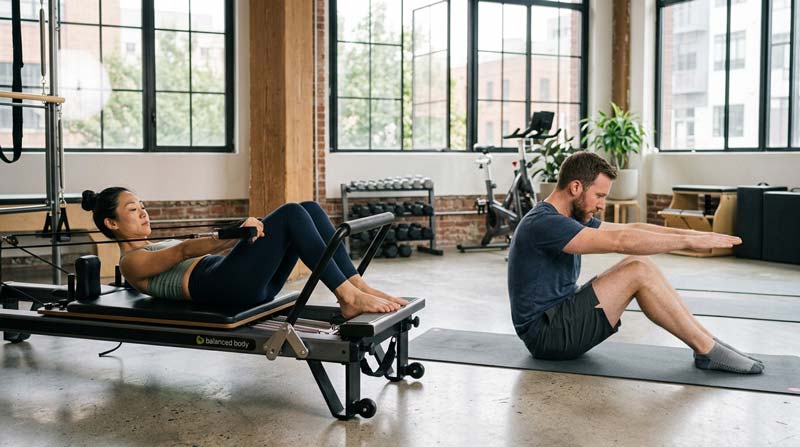
Only one study has placed the two forms of Pilates directly against each other. It measured physical and technical performance together.
Amateur male footballers were split into three groups for eight weeks. One added machine sessions, one added mat sessions, and one carried on with team training alone.
The machine group won on four measures. These were single-leg hop distance on both legs, an agility test, and a passing test.
On everything else, the two were indistinguishable. Jump height, standing broad jump, balance on either leg and flexibility showed no difference. Neither did the three sprint distances, dribbling speed or most passing measures.
So the advantage was real but narrow. It appeared on roughly a quarter of the measures tested.
The group that only trained with their team improved on nothing across those eight weeks. Both forms of Pilates beat doing neither, which is a different finding from one beating the other.
That pattern repeats wherever the comparison has been made.
Mat and apparatus work were compared in older women averaging 65 years of age. Both improved upper- and lower-limb strength, aerobic endurance, flexibility, and agility. No significant differences appeared between them.
Prop-based Pilates uses an elastic band and a gym ball. Compared against apparatus Pilates in postmenopausal women, it produced no significant difference on any measure. Body composition, blood pressure, mental health and physical fitness all behaved the same way.
Even abdominal pressure behaved similarly. Five matched pairs of movements were tested on the mat and on the machine. Only the roll-up differed, generating more cumulative pressure on the apparatus.
Sometimes the mat simply wins. One trial followed community-dwelling older adults. A traditional mat programme with accessories improved balance more than the equipment-based programme did. Training aimed at specific tasks has also improved balance more than Pilates alone.
A related finding unsettles another common assumption. Working harder on the apparatus does not reliably produce better results.
One hundred and sixty-eight people with long-term back pain were randomised to high-intensity or low-intensity Pilates. The difference in pain at the end was 0.4 points. A change worth having starts at 1.4. Disability showed no meaningful difference either.
The pattern held at six months and at twelve months. Yet the high-intensity group performed substantially more total work. Against conventional resistance training, the comparison is structural rather than statistical.
Load on the apparatus depends on how far the springs stretch, which makes precise progression difficult. A weight stack lets a trainer set a percentage of maximum strength and raise it week by week. Springs do not offer that arithmetic.
The method’s inventor was explicit about this. He wrote that Contrology was never designed to produce bulging muscles. He described the aim as a supple body rather than a heavily muscled one.
Guidelines still recommend muscle-strengthening activity twice a week for people carrying extra weight. Pilates may be considered one resistance-based way to meet it. That is a considered placement rather than a promotion.
The position is clearer on aerobic training. Reformer Pilates is a less severe form of exercise than aerobic training, dance-based training, or high-intensity interval work. Different modes carry different established effects. Regular jogging improves metabolic risk factors. Interval training significantly reduces body weight and body fat.
Combined aerobic and resistance training remains the most effective approach for cardiometabolic health. It is also time-consuming, with high dropout and low adherence among the people it is most often prescribed to. Pilates has been compared directly with aerobic training in overweight and obese people. Both improved anxiety, depression and quality of life.
Then there is the ranking that matters most. Set against control for disability in long-term non-specific back pain, equipment-based Pilates came out on top. Stabilisation exercise with motor control followed, then stabilisation exercise, then soft tissue manipulation, then mat Pilates.
The gaps between them were small. The evidence does not support declaring exercise categorically superior to manual therapy for that outcome. Supervision matters too. Unsupervised home exercise appears less effective than supervised sessions for short-term pain and disability.
Cost belongs in this comparison as well. Equipment-based reformer Pilates is more expensive than mat work, both for the person attending and for the clinic providing it.
Where the Evidence Is Weak
Five systematic reviews examined Pilates for long-term low back pain. They reached five different conclusions:
- One found it reduced both pain and disability.
- One found it reduced pain but not disability.
- One found it ineffective for both.
- One judged the evidence inconclusive.
- The fifth concluded that any benefit depended entirely on what Pilates had been compared against.
That spread is not the sign of five careless reviews. It reflects how little there was to review. The entire published review literature on Pilates for back pain rests on ten primary studies. Only two of those ten appeared in all five reviews.
Here is the part that matters most for anyone reading about the machine. Of those ten studies, only two used specialised Pilates equipment. The rest were mat work.
The pattern holds elsewhere. Across fourteen Pilates protocols studied in people carrying extra weight, twelve were floor-based mat work and two used apparatus. So much of what gets said about reformer Pilates is drawn from research conducted on the floor.
Quality is the next problem. The primary studies behind those reviews comprised four randomised controlled trials, five pseudo-randomised trials and one case series. Small samples, differences between groups at the start, high drop-out, unblinded assessors and missing analyses run through them.
Every one of the five reviews lacked a proper assessment of publication bias and a statement about conflicts of interest. Two chose to exclude unpublished work, which tends to inflate apparent benefit, because unpublished results are more often disappointing.
Definitions slipped as well. Some reviews aiming at long-term back pain included people whose pain was recent. One counted a study in which treatment involved yoga and physiotherapy alongside Pilates.
Several specific claims deserve testing directly.
- Large weight loss: Body composition results split. Eight weeks of Pilates, whether prop-based or apparatus-based, produced no change at all in body composition in postmenopausal women. Two months of mat work in 47 healthy adults produced none either. A review of seven body composition studies found methodological flaws. Measurement was not standardised, and nobody controlled what participants ate.
- Long and lean muscles: Nothing in this body of research measures muscle length or shape. Pooled results across fourteen studies found no improvement in lean body mass. The claim has never been tested, which is a different thing from being disproved.
- Cardiovascular protection: Maximal oxygen uptake means the most oxygen the body can use during hard effort. It did not improve after eight weeks of either form of Pilates. The intensity sits below the level needed to train the heart and lungs. The same failure appeared in twelve-week programmes. Blood pressure alone is a limited measure of vascular health.
- Posture correction: The posture study had no comparison group, so the improvement cannot be separated from other influences. It also used a single group measured before and after. Six of the 28 people recruited could not attend regularly and were excluded from the results.
- Rehabilitation and falls: Only two of twelve randomised trials in older adults recorded how many falls happened. Neither found a significant difference. Side-to-side stability improved. Front-to-back stability did not. Balance and gait, scored on a walking index, showed no significant difference against control groups.
- Mental health: Sleep quality did not improve significantly in one trial of the machine, falling just short of the threshold. A separate review found no discernible effect on sleep in postmenopausal women or in healthy women over 40. Across studies in people carrying extra weight, only one examined mental health outcomes at all.
Measurement carries its own limits. Surface electrodes cannot see the deepest core muscles. Readings from the small muscles beside the spine are indirect, because other muscles lie over them. Establishing what the deepest stabilisers do requires fine wire electrodes inserted into the tissue.
The women tested were experienced practitioners in their twenties and thirties. Findings from experienced women do not automatically transfer to beginners, men, or older adults. Not every muscle responded to instability either. Deep waist activity failed to rise during two of the three movements tested.
Then there is the difference between a result that is real and a result that is felt.
Six weeks of reformer Pilates was tested in women with chronic pain. Improvements were statistically significant across pain, coping, beliefs, fear of movement, fatigue and sleep. Measured against thresholds for a change a patient would actually notice, only pain intensity and fatigue qualified.
Even the strongest finding carries qualifications. The network analysis that placed equipment-based Pilates at the top for disability showed very high variability between trials. Only 31% of the comparisons were judged at low risk of bias.
Ranking position and credibility are not the same thing. Treatments with similar scores can rest on very different quality of evidence. Mat Pilates in that same network rested on very low confidence evidence.
Pregnancy shows the same shape of promise and shortfall. Pooled results found no significant effect on body mass index, body weight, mode of delivery, cholesterol or newborn weight. Only three of eleven trials were judged at low risk of bias, and none assessed what the women ate.
Almost all of this research is short. Among studies in people carrying extra weight, 86% ran for twelve weeks or less, leaving anything beyond that unexamined. Those studies did not record adverse events, which makes real-world safety impossible to judge from them.
Who May Benefit and Who Should Take Care
The people who take up Pilates are not a random sample of the population. Profiling work found mostly physically inactive middle-aged women. They came first for fitness, posture and flexibility, and second for pain and disability. Many already carried some discomfort of their own.
That profile explains a good deal about who the method suits. For beginners, the most useful finding is also the least discussed. Experience changes what the body actually does during the exercise.
Experienced practitioners held a high level of activation in the deep abdominal muscles during a drawing-in movement. People without experience reached only half that level, and none of them reached the target at all.
So the same class delivers different training to two people standing side by side. Studio training is recommended for beginners, people with existing complaints, and competitive athletes. The machine has to be taught before it can be used properly.
The apparatus suits people carrying extra weight for practical reasons. It provides a low-load form of exercise that is gentler on the joints. It also costs less than many other non-invasive options. Excess weight limits activity and weakens muscle, so a lower-load entry point has obvious value.
Older adults are the other group with an obvious case. Between the ages of 25 and 75, muscle power declines by 49% and muscle strength by 33%. Between 60 and 85, daily steps and walking speed fall by 75%. Falls per number of steps taken rise by 800%.
Against that background, small improvements in balance and confidence carry real weight. Even so, low impact does not mean risk-free. One falls prevention trial followed community-dwelling older people. Two of the falls recorded happened during the Pilates classes themselves, amounting to 10% of the total.
The exclusion lists across this research are consistent enough to be useful on their own. Pregnancy keeps people out of most supervised programmes. So do serious spinal problems such as fractures, tumours, infections or inflammatory disorders. Serious neurological impairment excludes people as well.
So do nerve root involvement, osteoporosis, and surgery of the spine or lower limbs within the previous six months. Some programmes also exclude uncontrolled high blood pressure, uncontrolled diabetes, cardiovascular disease, herniated discs, severe scoliosis and rheumatic disorders.
A readiness questionnaire is the accepted minimum before anyone starts. It screens for heart problems, blood pressure problems and bone or joint problems that exercise could worsen. A single positive answer means medical clearance first.
The machine itself needs to be checked before use. A qualified instructor should confirm that no spring is damaged. Every spring should be securely attached, and the machine itself should be stable.
The load figures are reassuring. Core activity during basic reformer exercises stays below 30% of maximum. So the work may be a safe option for people with spinal disorders and back pain. The same factor that limits strength gains also makes the machine gentle.
Side effects are real but modest, and they track with how hard the training is pushed. Of 168 people with long-term back pain, 15% reported adverse effects over six weeks. Of those 25 people, 22 were in the high-intensity group. Dizziness was the most common. Eight people reported worsening pain, six of them in the high-intensity group.
Delivery matters as much as dose. In one trial, an experienced, certified physiotherapist applied reformer Pilates individually. In that controlled clinical setting, no adverse events occurred. In clinical programmes, one therapist typically supervises one participant, with no more than three training at a time.
Pelvic floor concerns deserve a straight answer. Twenty-two introductory exercises were tested on the mat and the machine. None loaded the abdomen more than standing up from a chair. Clinicians do not restrict that movement after surgery.
Group averages hide individuals, though. Between 6% and 25% of women exceeded their own sit-to-stand pressure threshold. That happened during 10 of the 22 exercises. A quarter exceeded it during the roll-up on the machine. Body size tracked with the pressure generated, and greater experience was associated with lower pressure.
Pregnancy is a genuine split in the evidence. Pilates during pregnancy has been described as safe and feasible. Reported effects include shorter labour, better immediate newborn condition, and less labour pain. Yet pregnant women are excluded from most general clinical programmes. The trials that did include them screened out anyone with contraindications to exercise.
Desk-based workers have a specific case. Long hours seated, poor office furniture, stress and low activity all affect posture and the musculoskeletal system. Controlled movement systems using the apparatus have been described as accessible and sustainable for this group.
Attendance is the quiet obstacle. In one six-week programme, three women were removed for irregular attendance. In another, 51 of 170 participants discontinued. The main reason given was a schedule clash rather than the exercise itself. Lack of time is the most widely documented barrier to exercise among adults.
Supervision appears to help. Dropout was low across Pilates research in people carrying extra weight. Some 86% of studies reported rates between 0% and 14%. Of those studies, 93% delivered supervised training.
Which leaves the question of where the machine belongs in an ordinary week. The evidence supports a specific and useful place rather than a central one. Reformer Pilates shows its strongest evidence for long-standing pain and disability. It also performs well for balance and confidence among older adults, as well as muscular endurance and control. It can serve as one route to the twice-weekly muscle-strengthening activity that guidelines recommend.
It does not train the heart and lungs. It does not load muscle the way a weight stack does. It has never been shown to change the shape of a muscle. Nor has it been tested beyond a few months in most populations.
The founders of the mind-body methods understood this better than the modern marketing does. They advocated their exercises as an addition to other sport and daily activity, not as a replacement for either.
Sources
- Aladro-Gonzalvo AR, Araya-Vargas GA, Machado-Diaz M, Salazar-Rojas W. Pilates-based exercise for persistent, non specific low back pain and associated functional disability: A meta-analysis with meta-regression. J Bodyw Mov Ther. 2012.
- American College of Sports Medicine, Liguori G, Feito Y, Fountaine C, Roy BA. ACSM’s Guidelines for Exercise Testing and Prescription. 11th ed. Philadelphia: Wolters Kluwer Health; 2021.
- Barbosa AC, Vieira ER, Silva AF, Coelho AC, Martins FM, Fonseca DS, Barbosa MA, Bordachar D. Pilates experience vs. muscle activation during abdominal drawing-in maneuver. J Bodyw Mov Ther. 2018;22:467-470.
- Barker AL, Talevski J, Bohensky MA, Brand CA, Cameron PA, Morello RT. Feasibility of Pilates exercise to decrease falls risk: a pilot randomized controlled trial in community-dwelling older people. Clin Rehabil. 2016;30:984-96.
- Batrakoulis A. Psychophysiological Adaptations to Pilates Training in Overweight and Obese Individuals: A Topical Review. Diseases. 2022;10(4):71.
- Coelho ACS, Dourado JF, Lima POP. High-intensity and low-intensity Pilates have similar effects on pain and disability in people with chronic non-specific low back pain: a randomised trial. J Physiother. 2025;71(2):100-107.
- Coleman TJ, Nygaard IE, Holder DN, Egger MJ, Hitchcock R. Intra-abdominal pressure during Pilates: unlikely to cause pelvic floor harm. Int Urogynecol J. 2015;26(8):1123-30.
- da Luz MA Jr, Costa LO, Fuhro FF, Manzoni AC, de Oliveira NT, Cabral CM. Effectiveness of mat Pilates or equipment-based Pilates in patients with chronic non-specific low back pain: a protocol of a randomised controlled trial. BMC Musculoskelet Disord. 2013;14:16.
- da Silva LD, Shiel A, McIntosh C. Pilates Reducing Falls Risk Factors in Healthy Older Adults: A Systematic Review and Meta-Analysis. Front Med (Lausanne). 2021;8:708883.
- Denham-Jones L, Gaskell L, Spence N, Pigott T. A systematic review of the effectiveness of pilates on pain, disability, physical function, and quality of life in older adults with chronic musculoskeletal conditions. Musculoskelet Care. 2022;20(1):10-30.
- Gokalp O, Kirmizigil B. Effects of reformer pilates on body composition, strength, and psychosomatic factors in overweight and obese women: a randomized controlled trial. Sci Rep. 2025;15(1):23602.
- Gonzalez-Devesa D, Varela S, Diz-Gomez JC, Ayan-Perez C. The efficacy of pilates method in patients with hypertension: Systematic review and meta-analysis. J Hum Hypertens. 2024;38:200-11.
- Hoffman J, Gabel CP. The origins of Western mind-body exercise methods. Phys Ther Rev. 2015;20(5-6):315-324.
- Josephs S, Pratt ML, Calk Meadows E, Thurmond S, Wagner A. The effectiveness of Pilates on balance and falls in community dwelling older adults. J Bodyw Mov Ther. 2016;20:815-23.
- Kaner G, Ayer C. The effect of a weight-loss diet in women doing reformer pilates: A 12-week evaluation. J Contemp Med. 2022;12:19-26.
- Kim HJ, Sung JH, Ryu JK, Jung HC, Wang J. Effect of Reformer Spring Resistance Modifications on Core Muscle Activity During Basic Core Muscle Exercises. Healthcare (Basel). 2024;12(23):2447.
- Knockaloe Charitable Trust (n.d.) ‘Joseph Pilates’. Knockaloe: Visitor Centre and Internment Camp (Accessed: 22 August 2026).
- Lee K. Motion Analysis of Core Stabilization Exercise in Women: Kinematics and Electromyographic Analysis. Sports (Basel). 2023;11(3):66.
- Li Y, Lu H, Zhang L, Ren Y, Dai X, Lin L. Pilates exercise in pregnancy: a systematic review and meta-analysis. BMC Sports Sci Med Rehabil. 2025;17(1):20.
- Lim K, Sun Y, Choi JH, Lee E, Park HY. Effects of 8-week prop Pilates or apparatus Pilates on body composition, blood pressure, mechanical properties of core muscles, mental health, and physical fitness in postmenopausal women. Phys Act Nutr. 2026;30(1):32-41.
- Merrithew Spring Resistance Chart. (accessed 22 August 2026).
- Mueller D, Redkva PE, Fernando de Borba E, Barbosa SC, Krause MP, Gregorio da Silva S. Effect of mat vs. apparatus pilates training on the functional capacity of elderly women. J Bodyw Mov Ther. 2021;25:80-6.
- Robles-Garcia M, Gonzalez JLS, Sanchez-Sanchez JL, Calderon-Diez L, Santos Del Rey M, Martin-Vallejo J. Comparative Effects of Therapeutic Exercise and Manual Therapy Techniques on Self-Reported Disability in Chronic Non-Specific Low Back Pain: A Network Meta-Analysis. J Clin Med. 2026;15(12):4809.
- Sahan N, Ulug N, Ozeren A. Effects of reformer pilates on pain, psychological factors, and sleep in chronic musculoskeletal pain: a randomized controlled trial. BMC Psychol. 2025;13(1):836.
- Tastan Z, Genc N, Demirli A, Guvendi B, Agaoglu C, Duman Y, Aslan B, Gurgen S. The effects of reformer pilates on postural alignment, body appreciation and social appearance anxiety in office workers. BMC Sports Sci Med Rehabil. 2025;17(1):280.
- Wells C, Kolt GS, Bialocerkowski A. Defining Pilates exercise: A systematic review. Complement Ther Med. 2012;20:253-262.
- Wells C, Kolt GS, Marshall P, Hill B, Bialocerkowski A. Effectiveness of Pilates exercise in treating people with chronic low back pain: a systematic review of systematic reviews. BMC Med Res Methodol. 2013;13:7.
- Yilmaz O, Kaplan T, Batalik L. Randomised controlled study on the effects of pilates exercises in soccer: Comparing mat and reformer methods on physical and technical performance. PLoS One. 2025;20(5):e0324129.