


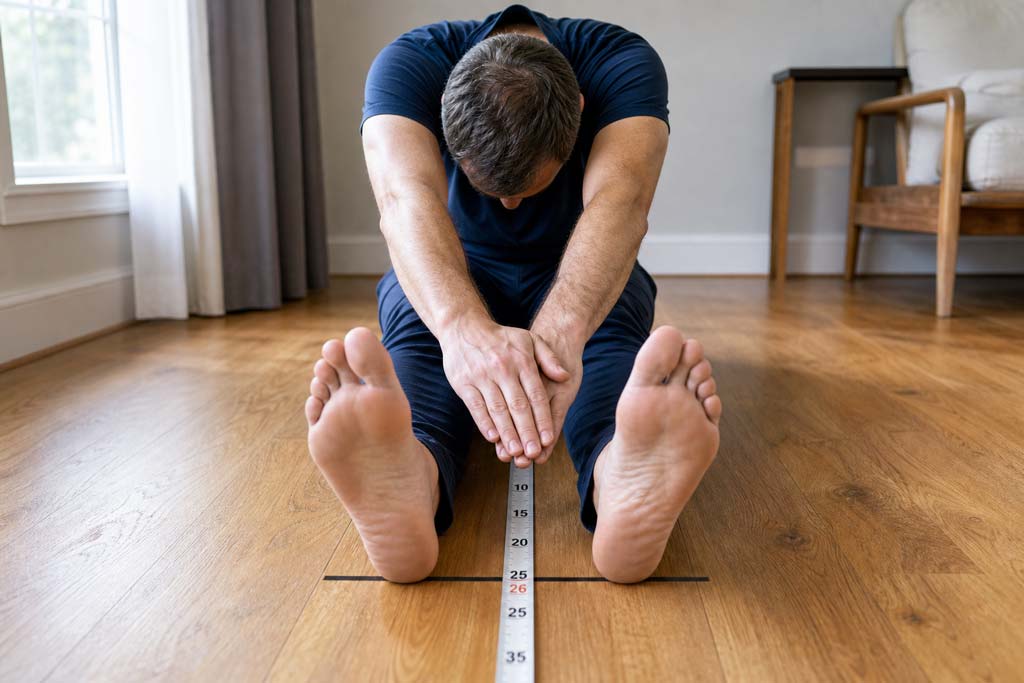
The attempt to touch your toes became a formal fitness test in 1952, and it never left.
Seventy years later, it still appears in most health-related fitness batteries used around the world. Its place there rests on a belief rather than a proof. Maintaining hamstring and lower back flexibility, the argument runs, may prevent injuries and back problems. It may also reduce postural deviation, walking limitations and the risk of falling.
Those are substantial claims for a number produced by leaning forward.
The test is called the sit-and-reach, and it records a straight line. That line runs from the fingertips to a point level with the feet. No joint angle is measured at any stage.
Two findings in the research sit uncomfortably together. Measured twice, the same person produces almost exactly the same distance. However, the number is a weaker estimate of flexibility than that consistency suggests.
Against direct measurement of the structures involved, every version behaves the same way. It estimates hamstring flexibility moderately. For the lower back, it performs poorly.
One analysis compared reach scores against a direct hamstring measurement. Only around two-thirds of the variation came from the hamstrings themselves. Roughly one part in three came from somewhere else entirely.
That remaining third is not random error, and it is not small. It has names. Those names include the length of your arms compared with your legs. They also include hip muscle strength, head position and the hour of testing.
Whether you can touch your toes is therefore only partly a question about your hamstrings. For the full protocol, the zero-point setting, and the age-banded categories, see our complete sit-and-reach test guide.
In this article, we will examine what that distance genuinely contains. Some of it is muscle. Some of it is architecture you were born with. And some of it changes between breakfast and bedtime, while nothing about you changes at all.
Reaching Forward Is Not the Same as Being Flexible
Flexibility has a definition, and reaching forward does not quite meet it. The term describes the maximum range of motion available at a joint, or across a series of joints. Range of motion is an angle. A reach score is a distance.
Those are different quantities, and converting between them is where the trouble begins.
Watch the movement closely, and most of the forward travel comes from rotation at the hips. Bending of the spine contributes a smaller share. Modelling work has put a figure on it. Spine bend can reasonably be treated as well under a third of the total distance.
At the top of the published scale, a maximum reach of 43.2cm makes that third 14.4cm.
Even so, the score cannot say which part came from where. Regression analysis shows that variation in scores reflects flexibility in both regions together. Neither acts alone.
That combination creates a specific problem. In a composite test, unusually mobile hips can compensate for a stiff trunk. The reverse also holds. Two people can therefore reach the same distance through entirely different distributions of movement.
There is a further complication, and it surprises most people. The reach is not passive.
A straight leg raise depends only on the resistance of relaxed hamstrings. Reaching forward asks for something harder. It also depends on the strength of the hip flexors, meaning the psoas and quadriceps. Those muscles sit at the front of the hip and thigh. They must contract while the hamstrings simultaneously let go.
So before you touch your toes, the muscles at the front of your hip already have work to do. A test named after the back of the leg depends on the front of it as well.
Because the whole body moves, other influences enter the score. Body measurements shift the result, as does flexibility in the shoulders, spine and limbs. Pelvic position contributes too. The tilt of the pelvis at full reach does reflect hamstring extensibility, but only as an estimate of it.
Some researchers have taken the strong position on all this. Since the movement involves the whole body, they argue, fingertip position gives no valid information about extensibility at all.
A weaker version of the objection is better supported. Whether you can touch your toes depends on more than one muscle group. The score reflects that mixture rather than isolating any part of it.
Estimate is the accurate word. And before any muscle lengthens, the proportions of the body have already shaped what that estimate can be.
Why Long Legs and Short Arms Make It Harder to Touch Your Toes
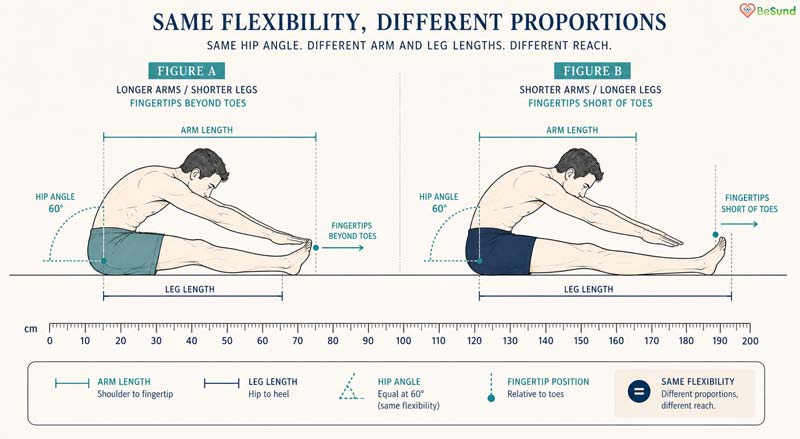
Picture two people with identical hamstrings and identical spines. One has long arms and a short femur. The other has short arms and long legs. Sit them both down, and they will not produce the same number.
Nothing about their muscle tissue explains the gap.
The reason lies in the scale rather than the body. Standard reaching tests use a fixed reference point at the feet. That point does not adjust for variation in arm and leg length. Consequently, people with long arms and short legs obtain a better result. Those with short arms and long legs are placed at a disadvantage.
Proportion matters more here than it first appears. For modelling purposes, the distance from hip to shoulder is roughly 30% of body height. The upper limb accounts for roughly 40%. Arm length is therefore the larger lever. A few centimetres of difference travel straight into the score.
Arm and leg proportion helps decide how easily you touch your toes, independently of muscle.
This is not a theoretical concern. Adolescents whose legs are long relative to their arms perform more poorly on the classic protocol. The penalty is attributable to limb geometry rather than to muscle extensibility. Length proportion between the upper and lower limbs remains one of the main factors affecting how well the test works.
The relationship has been examined directly in student populations. Dedicated measurement research has approached the same question from another angle. Body measurements and flexibility have been studied together for their combined effect on reach performance.
Proportion belongs to a wider category of limits that stretching cannot alter. Your reach is partly a fact about your skeleton, established long before any decision to train was made.
Researchers noticed this and tried to correct for it. One approach fixes the trunk by placing the back and the head against a wall. When the participant then leans forward, fingertip displacement no longer depends on arm and leg length. Another sets the zero point individually for each person before the reach is scored.
Your flexibility is unchanged by any of that. What changes is the number recorded when you try to touch your toes. Whether the corrections improved the measurement has been tested directly, and the answer was not the one anybody expected.
The Correction That Made the Test Worse
The objection was raised long before anyone acted on it. Critics had argued for years that the classic protocol ignored differences in limb length between individuals. They were right. The measurement penalised body proportions that had nothing to do with muscle.
In 1990 a formal alternative appeared. The modified sit-and-reach incorporated a finger-to-box distance, measured before the reaching movement was scored. Each person received an individual starting point, so proportion was accounted for. The logic was sound, and the problem it addressed was genuine.
Other versions followed. Eight distinct protocols can now be identified in the validity literature, and they fall into two families. Some record an end score, meaning the raw point the fingertips reach. Others record a difference score, offsetting that starting measurement against the reach achieved.
Each one asks the same thing. Sit down, touch your toes, and hold the position for a couple of seconds. Only the arithmetic afterwards differs.
Whether difference scores genuinely predicted flexibility better than end scores was posed as a direct question. For a long time, nobody could answer it. Published work on the accuracy of reaching tests produced inconclusive and often conflicting results. Some studies found strong associations. Others found weak ones. Statistical significance appeared in some investigations and vanished in others.
Settling it required pooling the evidence rather than reading studies one at a time. A search across seven electronic databases returned 2,432 results. Ninety were retrieved for detailed evaluation. Thirty-eight met the inclusion criteria, and thirty-four remained usable once duplicated information was removed.
The verdict went against the correction.
Across protocols that incorporate a finger-to-box distance, accuracy for hamstring extensibility was lower rather than higher. The uncorrected end score performed better. In most studies that examined both approaches within the same sample, the traditional protocol came out slightly ahead.
So the classic version, published in 1952 and criticised ever since, still shows the greatest average accuracy of any protocol. Where the purpose is estimating hamstring extensibility, using a modified version does not appear justified. None of the redesigns improved on the original instruction to touch your toes and be measured.
Why the correction failed has not been established. The pooled evidence records the outcome without explaining it. A fix aimed at a real flaw produced a less accurate measurement than the flaw it was built to remove.
Why You Can Touch Your Toes One Day and Not the Next
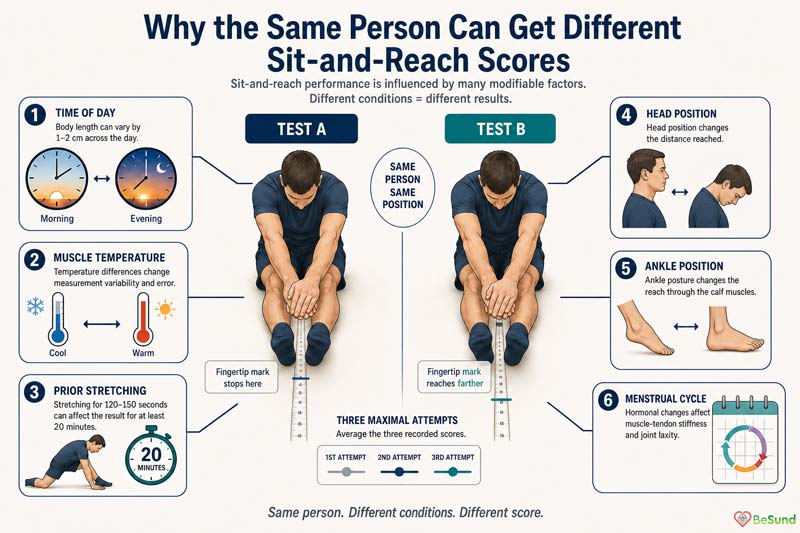
The repeatability of this test is genuine, but it is conditional. It holds when the conditions hold. Change them, and the same body returns a different number.
You may touch your toes on Tuesday and fall short on Thursday, with nothing about your muscle having changed.
Several of those conditions have been studied specifically, because researchers had to control them. A validity study that allowed them to vary would generate noise instead of findings. Their control lists therefore double as a catalogue of everything that moves a reach score without moving flexibility.
- The hour you are tested: Human body length varies by one to two centimetres across a day and night. That is enough to shift a result on its own. Testing at the same time removes it, and testing at different times quietly builds it in.
- Anything you stretched beforehand: Static stretching for 120 to 150 seconds deforms the viscoelastic properties of muscle. The effect lasts at least twenty minutes. Viscoelastic describes how tissue resists being lengthened, then slowly recovers. A stretch finished before you sat down is still present in the measurement.
- How warm the muscle is: Differences in muscle temperature between testing occasions increase both the variability and the error of flexibility measurements. Warm-up routines exist to remove that difference rather than to flatter the score. A cold body and a warm body give two answers to one question.
- Where your head is: Head position during the movement affects the distance achieved. It has been identified as one of the main factors influencing what a reach score actually reflects. Letting the head drop between the arms is written into the protocol for that reason.
- Where your ankle is: Ankle posture changes the reach, partly through the contribution of the gastrocnemius, the large calf muscle. Pointing or flexing the foot is therefore not a neutral choice. A muscle in the calf helps decide a result attributed to the thigh.
- For women, the phase of the cycle: Oestrogen levels across the menstrual cycle significantly affect muscle-tendon stiffness and joint laxity. Stiffness falls around ovulation, compared with the menstrual and follicular phases. Research studies commonly exclude female participants on days 10 to 14 because of it.
One further influence sits inside the test itself. Repeated maximal attempts lengthen the muscle as you make them, so the number of trials taken alters the number recorded. Averaging three attempts, and stretching beforehand, are both efforts to hold that steady.
None of this makes the test unusable. It makes it conditional. Whether you touch your toes at nine in the morning or nine at night is part of the answer. Test the same way, at the same hour, with the same preparation, and comparison becomes possible. The standard protocol and the age-banded categories are set out in our full sit-and-reach test guide.
Change any one of them, though, and part of the result belongs to the day.
The Test Is Least Accurate in the People It Marks Down
There is an uncomfortable asymmetry buried in the accuracy data. The people this test judges most harshly are the people it reads least well.
Consider what that means in practice. Someone who reaches a long way receives a number that tracks their tissue reasonably closely. Someone who falls short receives a number that tracks it noticeably less well. The second person is the one being told they have a problem.
If you cannot touch your toes, the estimate is at its weakest precisely where it matters to you.
The evidence comes from splitting participants by their own flexibility. Researchers use a threshold of 80 degrees on a passive straight leg raise. Below that value, hamstring extensibility is classed as low. At or above it, high.
When accuracy was calculated separately for the two groups, the more flexible group came out ahead. That held for every version of the test examined. A person’s own extensibility therefore alters how well the score reflects it. The effect appears in young adults and in older women alike.
Age produces a comparable pattern. Accuracy in children and adolescents runs lower than in adults. Reaching tests estimate a growing body less reliably than a settled one.
None of this has stopped the test being used to sort people. Published guideline values allow a straightforward classification into short or normal hamstrings. The cut-offs sit at three centimetres for men and five centimetres for women. How well that classification agrees with direct measurement has itself been tested. Agreement reached a level considered acceptable for clinical purposes, and no better than that.
The clearest sign of the limits appears when a reach score is used to predict the direct measurement. Estimate a hamstring angle from a reach distance, and the plausible answers spread very widely. The range covers most of what would be regarded as normal in the first place.
So the test reads you best when you can already touch your toes comfortably. Two people with the same reach can sit at opposite ends of that range. The tape cannot tell which is which.
How Long It Really Takes to Touch Your Toes
Nothing in a reach score changes within a fortnight. On the question of what does work, though, the research is unusually specific.
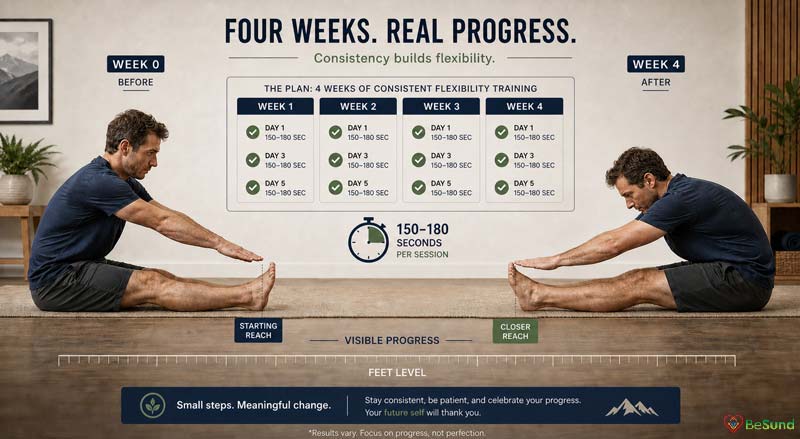
A minimum of four weeks is necessary to improve joint range of motion. Within those weeks, three days per week is the frequency required. The daily dose sits between 150 and 180 seconds, so two and a half to three minutes. That is the whole prescription.
How long it takes to touch your toes is therefore a question with an unusually precise answer.
Both static stretching and dynamic range-of-motion training have been examined for their effect on the hamstrings. The proposed mechanism is not that muscle simply becomes longer. Sustained static stretching deforms the viscoelastic properties of the tissue, meaning the way it resists being lengthened and then recovers.
What separates a temporary change from a lasting one is examined in our guide to hamstring flexibility.
The size of the change is worth stating plainly. Recreationally active young adults completing four weeks of flexibility training improved by between 9.3% and 24.4%. That is roughly a tenth at the low end and a quarter at the high end.
Whether such a change is real depends on the error in the measurement itself. A useful marker is one and a half to two times the typical error. For this test, the conservative version of that marker works out at a change of about a sixth. Anything smaller describes the measurement rather than the person.
Set the two figures beside each other, and the picture is encouraging. Even the lowest reported gain clears the threshold comfortably. Four weeks of consistent work moves you closer to being able to touch your toes. The test can detect a change of that size.
Deciding what counts as acceptable error is ultimately a judgement about purpose. The variability has to be small enough to reveal the change a person is trying to produce.
So the number can move, and the movement can be trusted, provided it was earned over weeks rather than days. What the number cannot do is tell you why it moved. A better score might mean longer hamstrings. It might also mean a warmer room, an earlier hour, or arms that were always going to reach that far. Every one of those readings comes off the same tape measure, and the tape cannot tell them apart.
Sources
- Guidelines for exercise testing and prescription. 9th ed. Baltimore: Lippincott, Williams & Wilkins, 2014:85-8.
- American College of Sports Medicine Position Stand. (1998). The recommended quantity and quality of exercise for developing and maintaining cardiorespiratory and muscular fitness, and flexibility in healthy adults. Medicine & Science in Sports & Exercise, 30, 975-991.
- Atkinson, G., & Nevill, A. M. (1998). Statistical methods for assessing measurement error (reliability) in variables relevant to sports medicine. Sports Medicine, 26, 217-238.
- Ayala F., Sainz de Baranda P., De Ste Croix M., Santonja F. (2011) Criterion-related validity of four clinical tests used to measure hamstring flexibility in professional futsal players. Physical Therapy in Sport 12, 175-181.
- Baltaci G., Tunay V., Besler A., Gerçeker S. (2003) Comparison of three different sit and reach tests for measurement of hamstring flexibility in female university students. British Journal of Sports Medicine 37, 59-61.
- Bandy WD, Irion JM, Briggler M. The effect of static stretch and dynamic range of motion training on the flexibility of the hamstring muscles. J Orthop Sports Phys Ther 1998;27:295-300.
- Bell, D. R., Myrick, M. P., Blackburn, J. T., Shultz, S. J., Guskiewicz, K. M., & Padua, D. A. (2009). The effect of menstrual-cycle phase on hamstring extensibility and muscle stiffness. Journal of Sport Rehabilitation, 18, 553-563.
- Castro-Piñero J., Artero E.G., España-Romero V., Ortega F.B., Sjöström M., Ruiz J.R. (2009) Criterion-related validity of field-based fitness tests in youth: A systematic review. British Journal of Sports Medicine 44, 934-943.
- Castro-Piñero J., Chillón P., Ortega F.B., Montesinos J.L., Sjöström M., Ruiz J.R. (2009) Criterion-related validity of sit-and-reach and modified sit-and-reach test for estimating hamstring flexibility in children and adolescents aged 6-17 years. International Journal of Sports Medicine 30, 658-662.
- Davis, D. S., Quinn, R. O., Whiteman, C. T., Williams, J. D., & Young, C. R. (2008). Concurrent validity of four clinical tests used to measure hamstring flexibility. Journal of Strength and Conditioning Research, 22(2), 583-588.
- Dixon, J., & Keating, J. L. (2000). Variability in straight leg raise measurements. Physiotherapy, 86(7), 361-370.
- Ford, P., & McChesney, J. (2007). Duration of maintained hamstring ROM following termination of three stretching protocols. Journal of Sports Rehabilitation, 16, 18-27.
- Hemmatinezhad, M. A., Afsharnezhad, T., Nateghi, N., & Damirchi, A. (2009). The relationship between limb length with classical and modified back saver sit-and-reach tests in student boys. International Journal of Fitness, 5(1), 69-78.
- Hoeger W.W., Hopkins D.R., Button S., Palmer T.A. (1990) Comparing the sit and reach with the modified sit and reach in measuring flexibility in adolescents. Pediatric Exercise Science 2, 156-162.
- Hopkins, W. G. (2000). Measures of reliability in sports medicine and science. Sports Medicine, 30(1), 1-15.
- Hui S.C., Yuen P.Y., Morrow J.R., Jackson A.W. (1999) Comparison of the criterion-related validity of sit-and-reach tests with and without limb length adjustment in Asian adults. Research Quarterly for Exercise and Sport 70, 401-406.
- Jackson AW, Morrow JR, Brill PA, et al. Relations of sit-up and sit-and-reach tests to low back pain in adults. J Orthop Sports Phys Ther 1998;27:22-8.
- Kawano M.M., Ambar G., Oliveira B.I.R., Boer M.C., Cardoso A.P. R.G., Cardoso J.R. (2010) Influence of the gastrocnemios muscle on the sit-and-reach test assessed by angular kinematic analysis. Revista Brasileña de Fisioterapia 14, 10-15.
- Kendall F.P., McCreary E.K., Provance P.G., Rodgers M.M., Romani W.A. (2005) Muscles: Testing and function with posture and pain. 5th edition Lippincott, Williams, & Wilkins, Baltimore.
- Kreighbaum, E., & Barthels, K.M. (1996). A Qualitative Approach for Studying Human Movement (4th ed.). New York: Macmillan Publ. Co.
- Krishan, K., & Vij, K. (2007). Diurnal variation of stature in three adults and one child. Anthropologist, 9, 113-117.
- Lemmink K.A.P.M., Kemper H.C.G., de Greef M.H.G., Rispens P., Stevens M. (2003) The validity of the sit-and-reach test and the modified sit-and-reach test in middle-aged to older men and women. Research Quarterly for Exercise and Sport 74, 331-336.
- López-Miñarro, P. A., Sainz de Baranda, P., & Rodríguez-García, P. L. (2009). A comparison of the sit-and-reach test and back-saver sit-and-reach test in university students. Journal of Sports Science and Medicine, 8, 116-122.
- López-Miñarro PÁ, Vaquero-Cristóbal R, Muyor JM, Espejo-Antúnez L. VALIDEZ DEL TEST SIT-AND-REACH PARA VALORAR LA EXTENSIBILIDAD ISQUIOSURAL EN MUJERES MAYORES [CRITERION-RELATED VALIDITY OF SIT-AND-REACH TEST AS A MEASURE OF HAMSTRING EXTENSIBILITY IN OLDER WOMEN]. Nutr Hosp. 2015 Jul 1;32(1):312-7.
- McHugh M.P., Kremenic I.J., Fox M. B., Gleim G.W. (1998) The role of mechanical and neural restraints to joint range of motion during passive stretch. Medicine and Science in Sports and Exercise 30, 928-932.
- Power, K., Behm, D., Cahill, F., Carroll, M., & Young, W. (2004). An acute bout of static stretching: effects on force and jumping performance. Medicine & Science in Sports & Exercise, 36(8), 1389-1396.
- Sainz de Baranda, P., & Ayala, F. (2010). Chronic flexibility improvement after 12 week stretching program utilizing the ACSM recommendations: hamstring flexibility. International Journal of Sports Medicine, 31, 1-8.
- Shaulis D, Golding LA, Tandy RD. Reliability of the AAHPERD functional fitness assessment across multiple practice sessions in older men and women. Journal of Aging and Physical Activity 1994;2:273-9.
- Simoneau G. G. (1998) The impact of various anthropometric and flexibility measurements on the sit-and-reach test. Journal of Strength and Conditioning Research 12, 232-237.
- Smith J.F., Miller C.V. (1985) The effect of head position on sit-and-reach performance. Research Quarterly for Exercise and Sport 56, 84-85.
- Wells, K. F., & Dillon, E. K. (1952). The sit-and-reach. A test of back and leg flexibility. Research Quarterly, 23, 115-118.