


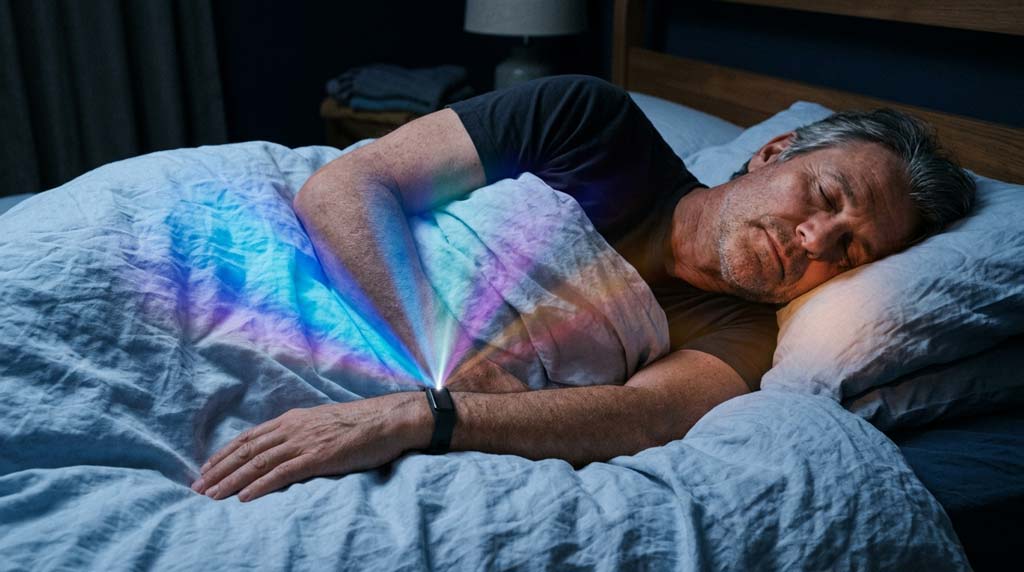
A sleep tracker can split one night into light sleep, deep sleep, REM (rapid eye movement) sleep and time awake. Whether those numbers say anything about health years later has been far harder to establish.
Most large studies of sleep and disease have simply asked people how long they sleep. However, memory makes an unreliable stopwatch. Self-reported sleep often lines up poorly with what a device measures. Questionnaires also reveal little about what happens inside the night. They cannot say how much of it was REM sleep, or how often sleep broke.
Sleep laboratories answer those questions with polysomnography (an overnight recording of the brain’s electrical activity during sleep). Yet its cost and technical demands rule it out for studies involving tens of thousands of people. Instead, wrist-worn accelerometers (sensors that record movement) have become widely used in large studies of middle-aged and older adults. The field still lacked a large study linking wrist-estimated sleep stages to a broad range of later diseases.
A published study in PLOS Medicine set out to fill that gap. Its researchers linked one week of wrist data from 95,559 UK adults with nearly nine years of hospital records. Each of six sleep measures was then tested against 1,049 health conditions, from heart failure to depression.
The results reach across the heart, the brain, metabolism and mental health. At the same time, the study sets out what a wrist cannot see. It also explains how some illnesses may disturb sleep long before diagnosis. Together, the findings show how sleep length, the make-up of the night and its steadiness each carry separate information. They also mark the line between what a sleep tracker reading can reasonably suggest and what it cannot know.
What a Sleep Tracker Worn by 95,000 Adults Revealed
Between 2013 and 2015, 236,519 UK Biobank volunteers wore a wrist sensor for a week. UK Biobank is a long-running health study of about 500,000 adults recruited across England, Scotland and Wales. Of those invited, 103,611 returned usable recordings, and 95,559 passed every quality check.
The sensor, an Axivity AX3 accelerometer, recorded wrist movement 100 times every second, day and night. In effect, each volunteer wore a research-grade sleep tracker for seven days. On average, they were 56 years old when they joined UK Biobank, roughly six years before wearing the sensor. Just over half (56%) were women.
Movement cannot directly show sleep stages. The researchers therefore used SleepNet, a computer model trained to estimate sleep stages from wrist-movement patterns.
Those stages follow a set rhythm. Through the night, the brain cycles through light sleep, deep sleep and REM sleep roughly every 90 minutes. Deep sleep dominates the early cycles and supports physical restoration and growth hormone release. REM sleep grows longer towards morning. During it, the body’s muscles are temporarily paralysed, so you don’t act out dreams. BeSund has written a detailed guide to how the brain controls each of these sleep stages. Humans also devote around a fifth to a quarter of sleep to REM, far more than other primates.
From each week of recordings, the model produced six measures:
- Total sleep time, counted over each 24 hours from noon to noon.
- REM sleep, in minutes.
- Deep sleep, in minutes.
- Light sleep, in minutes.
- Wake after sleep onset (minutes spent awake after first falling asleep), a measure of broken sleep.
- Sleep irregularity (how much total sleep varied from one day to the next).
The typical volunteer slept about six and a half hours in every 24 hours. Most fell asleep between 9pm and 11pm. Of that sleep, about 82 minutes were REM, 103 minutes were deep, and 193 minutes were light. They also spent roughly an hour awake after first dropping off.
They then followed everyone through hospital records for a median (midpoint) of 8.9 years. They grouped diagnoses into 1,049 distinct conditions using an established disease-coding map. They then excluded anyone already diagnosed with a condition from the analysis for that condition. Age, sex, education, deprivation, smoking, alcohol and exercise were all taken into account. So were body weight, screen time, air pollution and night-time noise near the home.
Testing six measures against 1,049 conditions meant more than 6,000 comparisons, and chance alone produces false alarms at that scale. So the researchers applied a Bonferroni correction (a very strict statistical threshold designed to screen out chance findings). Of 370 links found in an initial screen, 156 cleared that stricter bar.
REM sleep accounted for 83 of those 156 links, more than the other five measures combined. Total sleep time accounted for 50. Deep and light sleep each produced seven links, broken sleep six, and irregular sleep three. Those links came from one week of sleep tracker data per person. Yet they reached the heart, lungs, kidneys, skin and mind.
Is Six to Eight Hours of Sleep Enough?
Eighty-six health conditions followed a curve as sleep length changed, with risk lowest somewhere in the middle. For 69 of them, that lowest point fell between six and eight hours of sleep. An earlier analysis pooling 3.8 million people had found a similar curve for heart disease and stroke.
The lowest risk of dementia sat at about 7.5 hours of sleep. For type 2 diabetes it was 7.3 hours, and for chronic kidney disease 7.1 hours. Depression reached its low point earlier, at about 6.6 hours. Meanwhile, twelve conditions had their lowest risk between four and six hours.
After the strict check, sleeping fewer than six hours was linked to higher risk for 24 conditions. Heart failure was 30% more likely, and chronic obstructive pulmonary disease (COPD, a long-term lung condition) was 24% more likely. Type 2 diabetes was 18% more likely.
Narrower bands placed the risk more precisely. Across five sleep-length groups, 41 links to higher risk emerged, compared with six to eight hours. Of those, 37 involved people sleeping under five hours. In that shortest group, dementia risk was about 2.6 times higher. Heart failure was 73% more likely, and Parkinson’s disease about 2.4 times more likely. Repeated falls were 83% more likely, and that link persisted at five to six hours.
These figures compare groups. They show relative risk, meaning how much more often a diagnosis appeared, and say nothing about any single person’s chances. Because the study measured sleep from the wrist, its hours reflect what a sleep tracker counts as sleep. Time spent lying awake in bed does not count.
Short nights also held less of every sleep stage than six-to-eight-hour nights. Sleepers under six hours had about 28 fewer minutes of deep sleep and 26 fewer of REM. The six-to-eight-hour group also had the largest share of REM, at 22% of sleep. Deep sleep, by contrast, stayed close to 27% of sleep in every group.
Short sleepers’ nights were also the least steady. Their sleep length swung by about two hours from day to day, against 79 minutes for the middle group.
Long sleep produced a much shorter list. Beyond eight hours, only depression stayed significant after the strict check, at 60% higher risk. For eight to nine hours specifically, depression risk was 55% higher.
From these curves, the researchers suggest the most favourable range for older adults is six to eight hours. That sits slightly below the seven-to-nine hours commonly recommended. A six-and-a-half-hour sleep tracker reading therefore falls within the window, while a four-and-a-half-hour reading falls where most risk was observed.
The volunteers’ age also shapes that range. With age, REM and deep sleep naturally decline while night-time waking increases. BeSund has written about how sleep requirements change through life stages. That includes why some adults function well on less sleep than others.
Why Good Sleep Is About More Than How Long You Sleep
People with about 48 more minutes of REM sleep a night had a lower risk of 83 conditions. The comparison sets a person near the bottom quarter for REM sleep against one near the top quarter. Those links spanned 12 body systems, from the heart to the brain.
Heart failure risk was 26% lower, and atrial fibrillation (an irregular heart rhythm) 17% lower. Dementia risk was 46% lower, Alzheimer’s disease 31% lower, and multiple sclerosis 52% lower. Earlier studies also linked more REM sleep to a lower risk of atrial fibrillation. Beyond disease risk, REM sleep plays a daily part in memory and emotional regulation.
Deep sleep showed fewer links, seven in all. About 48 extra minutes were linked to an 11% lower risk of type 2 diabetes and a 14% lower risk of depression. Sleep apnoea (repeated pauses in breathing during sleep) was 22% less likely. Parkinson’s disease was 30% less likely.
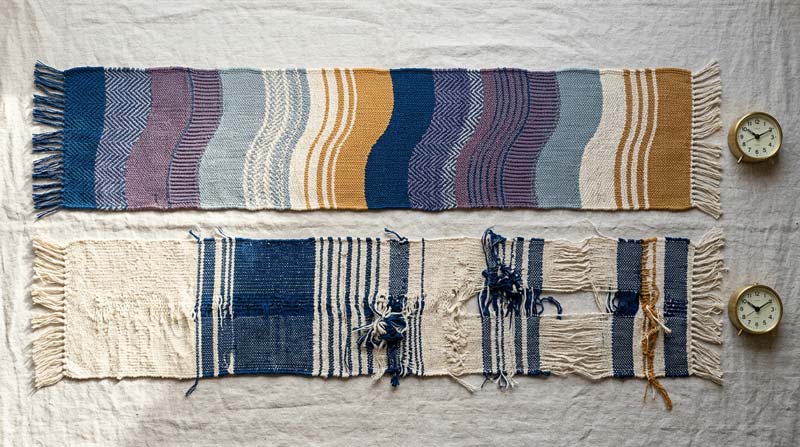
Minutes invite an obvious objection. People who sleep longer simply log more of every stage. So the researchers also measured each stage as a share of total sleep. A larger REM share still went with lower risk of 54 conditions. A larger light-sleep share was associated with higher risk in 28 conditions. A sleep-tracker summary based on total hours alone would miss this layer.
Light sleep produced the most mixed picture. More of it went with 14% lower heart failure risk, yet 31% higher risk of depression. The researchers read these as two different situations. Extra light sleep as part of a longer night tracked with lower risk of heart and metabolic disease. In their reading, a night dominated by light sleep signals poorer quality. That pattern tracked with mental health conditions and musculoskeletal disorders (conditions of the muscles, bones and joints).
Time awake after first falling asleep linked with a different set of conditions. About 44 extra minutes went with a 33% higher risk of drug dependence and a 22% higher risk of alcohol misuse. Osteoarthritis (a long-term joint condition) was 5% more likely. Broken sleep and short sleep are separate problems, and the study measured them separately.
Irregular sleep linked with three conditions, all tied to mental or digestive health. A day-to-day swing of about 93 minutes went with a 26% higher risk of depression and a 23% higher risk of anxiety. Abdominal pain was 13% more likely. All three links held after accounting for total sleep time. Earlier wrist-device research has also tied irregular sleep to type 2 diabetes.
Swings like these appear only across many nights, beyond the reach of a single morning sleep tracker report. BeSund has covered a separate UK Biobank study on regular sleep timing and heart disease. That study measured the consistency of sleep and wake timing, a related but distinct measure. It found higher heart risk with irregular timing, even when hours looked adequate.
What a Sleep Tracker Can and Cannot Measure
Sleep stages are defined by brain activity, which is why laboratories stage sleep with polysomnography. A wrist sensor can’t see the brain. Instead, it infers stages from how, and how much, the arm moves. For measuring sleep length, timing and how broken the night is, wrist devices already have a long research record.
SleepNet learned from more than 1,100 nights in which people wore a wrist sensor during laboratory sleep recordings. They then checked it against several independent groups of people. Even so, it sorts sleep into only three states: awake, REM and non-REM. It then estimates light and deep sleep within that single non-REM block.
The researchers rate its agreement with the laboratory as moderate, typical for movement-based models. Across a night, it counted about 17 minutes too little REM and about 31 minutes too much non-REM sleep. Total sleep differed from the laboratory by about 48 minutes. Sleep efficiency (the share of time in bed spent asleep) differed by about 9%.
The researchers therefore describe their stage figures as movement-based estimates, which may not match the stages the brain passes through. Any sleep tracker that stages sleep from the wrist faces the same basic limit.
from the lab
Those gaps do not automatically undo the findings. The researchers expect the errors to be similar for everyone. If so, the device misjudges exact minutes yet still ranks people by REM in roughly the right order. The disease comparisons depend on those rankings.
Consumer devices bring their own uncertainty. Each sleep tracker brand runs its own private formula. Most have been validated (formally checked for accuracy) only in small groups. They are also worn mostly by younger and middle-aged adults, leaving little large-scale data on older people. As a result, their accuracy in measuring sleep stages remains uncertain.
The study itself rested on a single week of wear. One week may miss longer habits or seasonal shifts. However, repeat recordings in the same cohort proved moderately to highly consistent over time. Measurement errors of this kind also tend to blur real links, making them look weaker than they are.
Could Poor Sleep Be an Early Warning Sign Rather Than a Cause?
Sixty-one of the study’s 156 links failed one extra test. That test set aside anyone diagnosed within two years of wearing the sensor. The main analysis had already excluded diagnoses from the first six months.
Illness seldom begins on the day it is diagnosed. Conditions can develop quietly beforehand, and during that time they may already alter sleep. Poor sleep would then be an early sign of disease, and the direction of cause would run backwards. Researchers call this reverse causation (when an outcome drives the apparent cause).
Other checks moved the results far less:
- Adjusting for diagnosed sleep disorders left 151 of the 156 links standing.
- Adjusting for the season of measurement left 150.
- Accounting for chronic pain, depression, anxiety, high blood pressure, type 2 diabetes and substance use left 131.
- Removing diagnoses made within two years of measurement left 95, about 60% of the original set.
The researchers conclude that early, undiagnosed disease may have shaped some of the sleep patterns they measured. A sleep tracker that registers a change in sleep may therefore be recording part of an illness’s early stage.
The researchers single out one example. Sleeping too much, known as hypersomnia, is a recognised early or accompanying symptom of depression. They judge reverse causation likely for the depression link in long sleepers.
Adjustment has limits of its own. Differences between people that were never measured, known as residual confounding, can still shape results. The researchers also recorded some background details about 5.7 years before sleep was measured.
Cause remains plausible for some links, however. For the links that survived, a shift on a sleep tracker could still reflect cause, early warning or both. For short sleep, the researchers point to an overactive fight-or-flight nervous system, disturbed stress hormones and body-wide inflammation. Those routes echo the biological pathways linking sleep with major diseases, from blood pressure to blood sugar. For long sleep, they suggest disrupted body clocks and less daytime activity.
Separating cause from early warning would take studies that change sleep and follow what happens. The researchers name such studies as the next step.
What This Study Means for Anyone Wearing a Sleep Tracker
The researchers describe their analysis as exploratory, built to generate hypotheses for future studies. Their final summary goes further. It states that sleeping six to eight hours can effectively reduce the risk of multiple diseases. However, their limitations section says this design cannot support causal conclusions.
The volunteers also limit how far the findings travel. Only about 5.5% of people invited to UK Biobank took part. Participants tend to be healthier and better off than the wider population, and most are of White European ancestry. Outcomes came only from hospital admissions, so milder conditions handled by GPs or outpatient clinics went uncounted. Some risks may therefore be underestimated, and the patterns may differ in other countries.
Within those limits, a week of sleep tracker data carried information about later illness in three separate ways. Length carried it, most heavily at the short end. The make-up of the night carried it, even after accounting for length. Steadiness from one day to the next carried it for mental health. That picture fits a sleep-medicine consensus that regularity and continuity count alongside quantity.
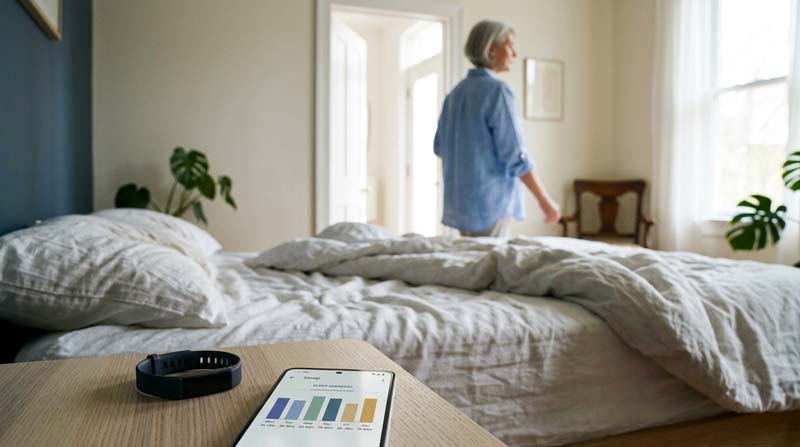
So can a sleep tracker tell whether sleep is good enough? On length and steadiness, wrist devices rest on decades of research use. On stages, even a research-grade wrist reached only moderate agreement with the laboratory. And no device can say whether a change in sleep is cause, consequence or early signal.
The study judged sleep across a week of nights, not from a single morning.
Sources
- Ai S, Zhang J, Zhao G, Wang N, Li G, So H-C, et al. Causal associations of short and long sleep durations with 12 cardiovascular diseases: linear and nonlinear Mendelian randomization analyses in UK Biobank. Eur Heart J. 2021;42(34):3349–57.
- Batty GD, Gale CR, Kivimäki M, Deary IJ, Bell S. Comparison of risk factor associations in UK Biobank against representative, general population based studies with conventional response rates: prospective cohort study and individual participant meta-analysis. BMJ. 2020;368:m131.
- Cappuccio FP, D’Elia L, Strazzullo P, Miller MA. Sleep duration and all-cause mortality: a systematic review and meta-analysis of prospective studies. Sleep. 2010;33(5):585–92.
- Chaput J-P, Biswas RK, Ahmadi M, Cistulli PA, Sabag A, St-Onge M-P, et al. Sleep irregularity and the incidence of type 2 diabetes: a device-based prospective study in adults. Diabetes Care. 2024;47(12):2139–45.
- Christensen MA, Dixit S, Dewland TA, Whitman IR, Nah G, Vittinghoff E, et al. Sleep characteristics that predict atrial fibrillation. Heart Rhythm. 2018;15(9):1289–95.
- Clarke R, Shipley M, Lewington S, Youngman L, Collins R, Marmot M, et al. Underestimation of risk associations due to regression dilution in long-term follow-up of prospective studies. Am J Epidemiol. 1999;150(4):341–53.
- Doherty A, Jackson D, Hammerla N, Plötz T, Olivier P, Granat MH, et al. Large scale population assessment of physical activity using wrist worn accelerometers: the UK Biobank Study. PLoS One. 2017;12(2):e0169649.
- Dollish HK, Tsyglakova M, McClung CA. Circadian rhythms and mood disorders: time to see the light. Neuron. 2024;112(1):25–40.
- Huang Y-M, Xia W, Ge Y-J, Hou J-H, Tan L, Xu W, et al. Sleep duration and risk of cardio-cerebrovascular disease: a dose-response meta-analysis of cohort studies comprising 3.8 million participants. Front Cardiovasc Med. 2022;9:907990.
- Jackson CL, Patel SR, Jackson WB 2nd, Lutsey PL, Redline S. Agreement between self-reported and objectively measured sleep duration among white, black, Hispanic, and Chinese adults in the United States: Multi-Ethnic Study of Atherosclerosis. Sleep. 2018;41(6):zsy057.
- Lauderdale DS, Knutson KL, Yan LL, Liu K, Rathouz PJ. Self-reported and measured sleep duration: how similar are they?. Epidemiology. 2008;19(6):838–45.
- Lopez R, Barateau L, Evangelista E, Dauvilliers Y. Depression and hypersomnia: a complex association. Sleep Med Clin. 2017;12(3):395–405.
- Mantua J, Gravel N, Spencer RMC. Reliability of sleep measures from four personal health monitoring devices compared to research-based actigraphy and polysomnography. Sensors (Basel). 2016;16(5):646.
- Patterson MR, Nunes AAS, Gerstel D, Pilkar R, Guthrie T, Neishabouri A, et al. 40 years of actigraphy in sleep medicine and current state of the art algorithms. NPJ Digit Med. 2023;6(1):51.
- Qasrawi SO, BaHammam AS. Role of sleep and sleep disorders in cardiometabolic risk: a review and update. Curr Sleep Medicine Rep. 2024;10(1):34–50.
- Sletten TL, Weaver MD, Foster RG, Gozal D, Klerman EB, Rajaratnam SMW, et al. The importance of sleep regularity: a consensus statement of the National Sleep Foundation sleep timing and variability panel. Sleep Health. 2023;9(6):801–20.
- Stamatakis E, Owen KB, Shepherd L, Drayton B, Hamer M, Bauman AE. Is cohort representativeness Passé? Poststratified associations of lifestyle risk factors with mortality in the UK Biobank. Epidemiology. 2021;32(2):179–88.
- Van Cauter E, Leproult R, Plat L. Age-related changes in slow wave sleep and REM sleep and relationship with growth hormone and cortisol levels in healthy men. JAMA. 2000;284(7):861–8.
- Walmsley R, Chan S, Smith-Byrne K, Ramakrishnan R, Woodward M, Rahimi K, et al. Reallocation of time between device-measured movement behaviours and risk of incident cardiovascular disease. Br J Sports Med. 2021;56(18):1008–17.
- Wei W-Q, Bastarache LA, Carroll RJ, Marlo JE, Osterman TJ, Gamazon ER, et al. Evaluating phecodes, clinical classification software, and ICD-9-CM codes for phenome-wide association studies in the electronic health record. PLoS One. 2017;12(7):e0175508.
- Wu C, Xu W. Does inflammation mediate the association between sleep duration and incident dementia among older adults?. Innovation in Aging. 2020;4:119.
- Yuan H, Plekhanova T, Walmsley R, Reynolds AC, Maddison KJ, Bucan M, et al. Self-supervised learning of accelerometer data provides new insights for sleep and its association with mortality. NPJ Digit Med. 2024;7(1):86.
- Zheng NS, Annis J, Master H, Han L, Gleichauf K, Ching JH, et al. Sleep patterns and risk of chronic disease as measured by long-term monitoring with commercial wearable devices in the All of Us Research Program. Nat Med. 2024;30(9):2648–56.