


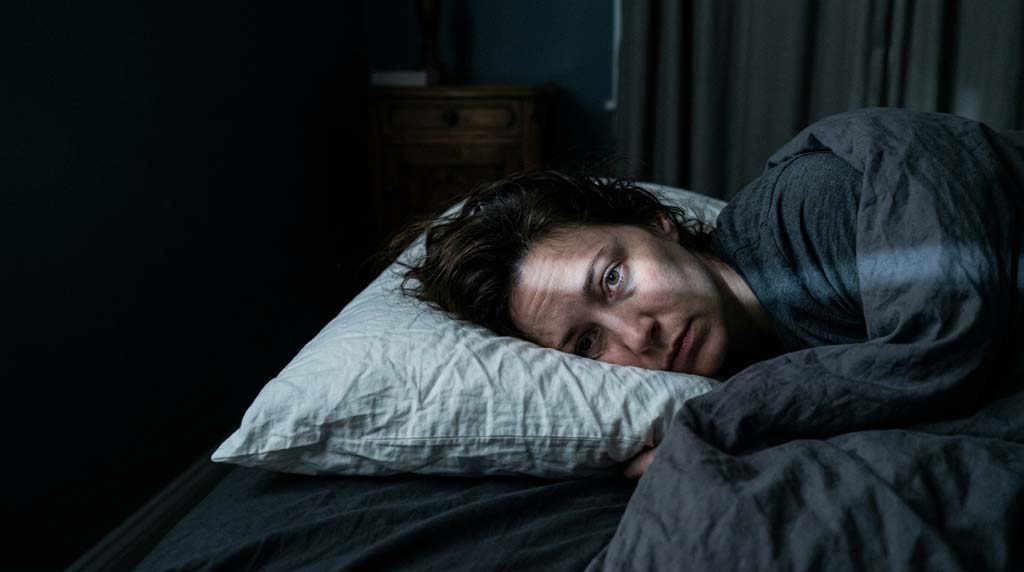
Impaired sleep affects 14% to 40% of the general population, including people who lie down tired but can’t sleep. Some feel exhausted all day, then stay wide awake once the lights go out. Others drift off, then wake repeatedly and struggle to settle again.
Sleep problems can take the form of difficulty falling asleep or sleep broken into fragments through the night. Both prevent the restorative sleep cycles the body needs. Their causes can differ, both between the two patterns and between people.
Losing just 1.3 to 1.5 hours of sleep for one night cuts daytime alertness by up to 32%. Yet feeling drained during the day does not guarantee sleep at night.
Insomnia, the most common sleep disorder, typically relates to psychological stress, poor sleep environments, irregular schedules or excessive stimulation. A run of bad nights, however, is not the same as a disorder. When someone is tired but can’t sleep, several systems may simply be out of step. Light, noise, temperature, physical activity and even hunger all feed into the brain processes that govern sleep and alertness.
You can adjust each of those to some degree, though no single change guarantees sleep tonight. Persistent problems may also require more than self-help.
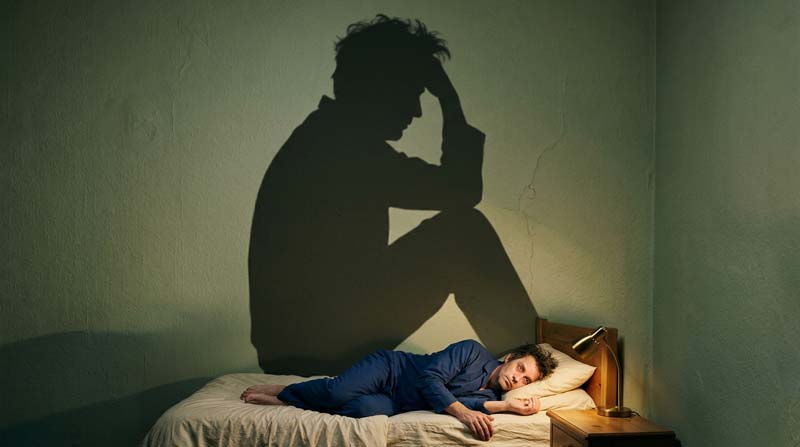
What Happens When You’re Tired but Can’t Sleep
Two interacting processes regulate sleep: sleep pressure and circadian timing, the body’s internal clock running on a roughly 24-hour cycle. Sleep pressure builds the longer someone stays awake, as a chemical called adenosine accumulates in the brain. Only sleep effectively clears it.
The body clock shifts when sleep pressure tips into sleep. It can also actively promote wakefulness against that pressure. The two also interact, so the clock’s influence on alertness grows when sleep pressure is high.
After a night without sleep, performance is at its worst from early to late morning. By the afternoon, it partly recovers, even though the sleep deprivation continues. Alertness can rise again while the sleep debt remains unpaid. For someone tired but can’t sleep, this offers one physiological explanation. Feeling drained does not switch off the processes that keep the brain alert.
A sleep-wake switch sits in the hypothalamus, a brain region close to the body’s master clock. It uses a chemical messenger called orexin to drive wakefulness, and at night orexin release stops so sleep can begin.
Body temperature follows the clock too. Self-chosen bedtimes typically coincide with the fastest fall in core body temperature. So a person who is tired but can’t sleep may be trying to sleep before the body clock allows it. Our article on how brain sleep stages control physical wellbeing covers these systems in full.
Why Your Mind Feels Busy at Bedtime
In insomnia, brain systems for arousal, emotion and thinking fail to quieten normally as wakefulness gives way to sleep. Researchers describe this as hyperarousal, a state of heightened mental and physical activation. It helps explain how someone can be tired but still has a mind that will not switch off.
Arousal and exhaustion can exist side by side. Anxiety disorders, for instance, are often associated with fatigue and low energy. A constant state of hyperarousal can itself lead to physical exhaustion. Feeling wide awake at midnight does not mean the body needs less sleep.
A busy mind at bedtime cannot, on its own, reveal an anxiety disorder or a hormone problem. For people who are tired but can’t sleep, stress is one contributor among several.
Broken sleep and distress can also feed each other. Night-to-night variation in sleep length and fragmentation has been linked with psychological stress. That evidence is observational, so it cannot show which comes first. Experimental work adds a clearer direction. The amygdala is a brain region central to emotional reactions. In one study, five nights of four-hour sleep increased its response to fearful faces.
Wider research describes a two-way relationship, with poor sleep worsening mental health and mental health conditions worsening sleep.
How Your Day Can Keep You Awake
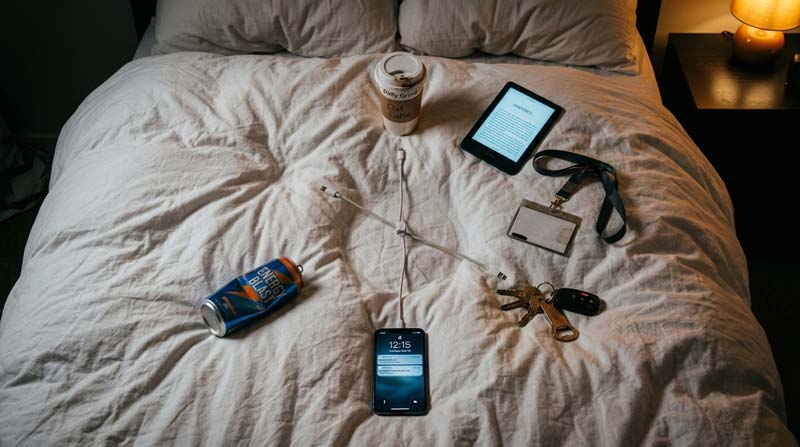
Light is the strongest external cue that sets the body clock. Morning light moves the clock earlier, while evening light pushes it later. Artificial light after dusk also suppresses melatonin, the hormone that signals night, and activates wake-promoting orexin neurons. Compared with a printed book, reading a light-emitting e-reader before bed delayed the body clock and increased next-morning sleepiness.
Late light also delays the clock’s end-of-day wake signal, keeping people awake into the night. An early start then removes the chance to recover sleep in the morning, squeezing sleep from both ends. That is one way someone ends up tired but can’t sleep at night, then sleepy again before work.
Irregular sleep patterns can disrupt normal sleep structure and reduce sleep efficiency. Shifting sleep between work days and days off, a gap researchers call social jetlag, is one form of that irregularity.
Caffeine raises alertness by blocking adenosine, yet only sleep clears it, so sleep pressure keeps building underneath. Caffeine can then disturb the next night’s sleep, creating a cycle of poor sleep and reliance on caffeine. For someone tired but can’t sleep, it may contribute, though it’s not the cause for everyone.
In a randomised trial, researchers advised against 400 mg of caffeine within 12 hours of bedtime. That interval applies to one dose in one trial, so it is no universal rule for every drink. Caffeine’s half-life (the time taken to clear half of it) is typically three to six hours.
It varies substantially between people, largely because of genetics. Participants in the trial also struggled to perceive their own caffeine-related sleep disruption. Our guide to caffeine fundamentals covers dosing and side effects.
Traffic noise is associated with delayed sleep onset and fragmented sleep, and may contribute to early waking. Noise, light and an uncomfortable room disturb sleep from outside, while a busy mind disturbs it from within.
What Helps When You’re Tired but Can’t Sleep
Keeping consistent sleep and wake times, even at weekends, is perhaps the single most effective way to improve sleep quality. Regularity has wider effects too, set out in our article on regular sleep timing and heart disease risk. It also anchors a short set of principles drawn from cognitive behavioural therapy for insomnia (CBT-I):
- Get up at the same time each day, including days off.
- Go to bed only when sleepy.
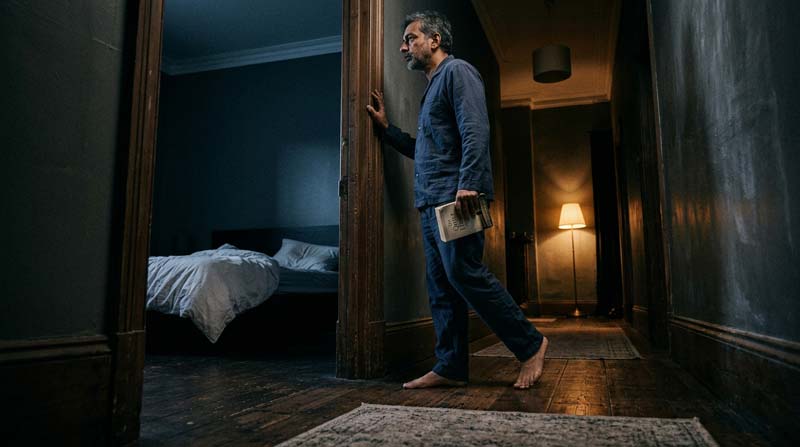
- Avoid lying awake in bed for long stretches, and get up if sleep will not come.
- Limit daytime napping.
- Keep clocks out of sight, since clock-watching feeds the anxiety that disrupts sleep.
- Build a relaxing pre-sleep routine, such as slow, deep breathing, to signal that sleep is near.
Breath-focused practices such as Samatha meditation offer one structured way to wind down. For someone tired but can’t sleep, these steps aim to cut the time spent struggling awake in bed.
Earlier daytime light exposure is associated with better sleep quality and fewer nighttime awakenings. Longer spells of bright daytime light have also been linked with better sleep quality.
Inside the bedroom, appropriate levels of light, noise and temperature support sleep, as does a comfortable sleeping surface. Even so, for someone who is tired but can’t sleep, no single temperature or routine resolves every difficulty.
Pooled studies of middle-aged and older adults with sleep problems found regular activity moderately improved sleep quality. Timing is where advice divides. Late-evening exercise can delay sleep onset by raising core body temperature, the reverse of the fall that precedes sleep.
Newer recommendations, however, set no time-of-day limit for healthy adults, as long as exercise doesn’t replace time needed for sleep. Intensity likely plays a part, since slow breathing or gentle yoga asks far less than a sprint session.
Our article on exercise after a bad night’s sleep covers how to adjust a session when sleep falls short. These habits support sleep without replacing treatment for a persistent sleep disorder.
When Sleep Problems Need More Support
Insomnia affects nearly a third of adults, with about 10% experiencing severe symptoms that carry daytime consequences. In 40% of severe cases, the condition persisted for more than five years. An occasional run of nights where you are tired but can’t sleep differs from a problem lasting months.
Clinical definitions of insomnia involve dissatisfaction with sleep on at least three nights a week for over three months. They also require significant daytime impairment, with no other medical condition causing the disruption. Some persistent patterns reflect other conditions, such as delayed sleep phase disorder, which need their own evaluation.
Guidelines from the American College of Physicians recommend CBT-I as the primary treatment for chronic insomnia in adults. It is a structured psychological treatment targeting the thoughts and habits that sustain insomnia.
European guidance describes components including sleep hygiene, relaxation training, stimulus control, sleep restriction therapy and cognitive therapy. Stimulus control rebuilds the link between bed and sleep, while cognitive therapy addresses unhelpful thoughts about sleep. CBT-I can be delivered one-to-one, in groups or digitally. Studies show it improves sleep efficiency and total sleep time, and reduces time to fall asleep and insomnia severity.
Sleep hygiene is one of those five components, so on its own it covers only part of the treatment. Sleep restriction therapy is likewise a structured clinical technique delivered within that programme, distinct from simply sleeping less.
Fewer than 15% of people with chronic sleep problems seek treatment or consult a healthcare provider. Persistent insomnia involves biological systems of arousal and timing, so needing help says nothing about willpower. If you stay tired but can’t sleep despite steady habits, a GP (general practitioner) can assess what’s behind it.
Sources
- Belenky G, Wesensten NJ, Thorne DR, et al. Patterns of performance degradation and restoration during sleep restriction and subsequent recovery: a sleep dose-response study. J Sleep Res 2003;12:1-12.
- Bonnet M.H., Arand D.L.. We are chronically sleep deprived. Sleep. 1995;18:908–911.
- Borbely A.A., Daan S., Wirz-Justice A., Deboer T. The Two-Process Model of Sleep Regulation: A Reappraisal. J. Sleep Res. 2016;25:131-143.
- Chang A.M., Aeschbach D., Duffy J.F., Czeisler C.A.. Evening use of light-emitting eReaders negatively affects sleep, circadian timing, and next-morning alertness. Proc. Natl. Acad. Sci. USA. 2015;112:1232–1237.
- Daan S, Beersma DG, Borbély AA. Timing of human sleep: recovery process gated by circadian pacemaker. Am J Physiol. 1984;246:R161-83.
- Dijk DJ, Duffy JF, Czeisler CA. Circadian and sleep/wake dependent aspects of subjective alertness and cognitive performance. J Sleep Res. 1992;1:112-7.
- Figueiro, MG ∙ Steverson, B ∙ Heerwagen, J. The impact of daytime light exposures on sleep and mood in office workers. Sleep Health. 2017; 3:204-215
- Frei P., Mohler E., Roosli M. Effect of nocturnal road traffic noise exposure and annoyance on objective and subjective sleep quality. Int J Hyg Environ Health. 2014;217(2-3):188–195.
- Gabehart RJ, Van Dongen HPA. Circadian rhythms in sleepiness, alertness, and performance. In: Kryger MH, Roth T, Dement WC, editors. Principles and practice of sleep medicine. 6th ed. Philadelphia: Elsevier; 2016. pp. 388–95.
- Gao Y, Ge L, Liu M, Niu M, Chen Y, Sun Y, Chen J, Yao L, Wang Q, Li Z, Xu J, Li M, Hou L, Shi J, Yang K, Cai Y, Li L, Zhang J, Tian J. Comparative efficacy and acceptability of cognitive behavioral therapy delivery formats for insomnia in adults: A systematic review and network meta-analysis. Sleep Med Rev. 2022 Aug;64:101648.
- Gardiner CL, Weakley J, Burke LM, Fernandez F, Johnston RD, Leota J, Russell S, Munteanu G, Townshend A, Halson SL. Dose and timing effects of caffeine on subsequent sleep: a randomized clinical crossover trial. Sleep. 2025 Apr 11;48(4).
- Holley L. Obstructive Sleep Apnea, Insomnia, and Snoring: Evolutionary Adaptations to Increase Alertness During Sleep? J Clin Sleep Med. 2019 Mar 15;15(3):523.
- Hossain JL & Shapiro CM (2002) The prevalence, cost implications, and management of sleep disorders: an overview. Sleep Breath 6, 85–102.
- Krauchi K. The thermophysiological cascasde leading to sleep initiation in relation to the phase of entrainment. Sleep Med Rev 2007;11:439-51.
- Mezick E. J., Matthews K. A., Hall M., Kamarck T. W., Buysse D. J., Owens J. F., et al. (2009). Intra-individual variability in sleep duration and fragmentation: associations with stress. Psychoneuroendocrinology 34 1346–1354.
- Morin CM, Jarrin DC, Ivers H, Mérette C, LeBlanc M, Savard J. Incidence, Persistence, and Remission Rates of Insomnia Over 5 Years. JAMA Netw Open. 2020 Nov 02;3(11):e2018782.
- Motomura Y., Kitamura S., Oba K., Terasawa Y., Enomoto M., Katayose Y., Hida A., Moriguchi Y., Higuchi S., Mishima K.. Sleep debt elicits negative emotional reaction through diminished amygdala-anterior cingulate functional connectivity. PLoS ONE. 2013;8:e56578.
- National Sleep Foundation Web site [Internet]. 2013 Sleep in America poll: exercise and sleep. National Sleep Foundation; Arlington (VA); 2013 [cited 2015 August 18].
- Pigeon WR, Grandner MA. Creating an optimal sleep environment In: Kushida CA, editor. Encyclopedia of sleep. Oxford (United Kingdom): Elsevier; 2013. p. 72–6
- Qaseem A, Kansagara D, Forciea MA, Cooke M, Denberg TD; Clinical Guidelines Committee of the American College of Physicians. Management of chronic insomnia disorder in adults: a clinical practice guideline from the American College of Physicians. Ann Intern Med. 2016;165(2):125-133.
- Remes O, Brayne C, van der Linde R, Lafortune L. A systematic review of reviews on the prevalence of anxiety disorders in adult populations. Brain Behav. 2016;6(7):e00497.
- Riemann D, Baglioni C, Bassetti C, Bjorvatn B, Dolenc Groselj L, Ellis JG, et al. European guideline for the diagnosis and treatment of insomnia. J Sleep Res. 2017;26:675–700.
- Riemann D., Nissen C., Palagini L., Otte A., Perlis M.L., Spiegelhalder K. The neurobiology, investigation, and treatment of chronic insomnia. Lancet Neurol. 2015;14:547–558.
- Yang PY, Ho KH, Chen HC, Chien MY. Exercise training improves sleep quality in middle-aged and older adults with sleep problems: a systematic review. J Physiother. 2012;58(3):157–163.