


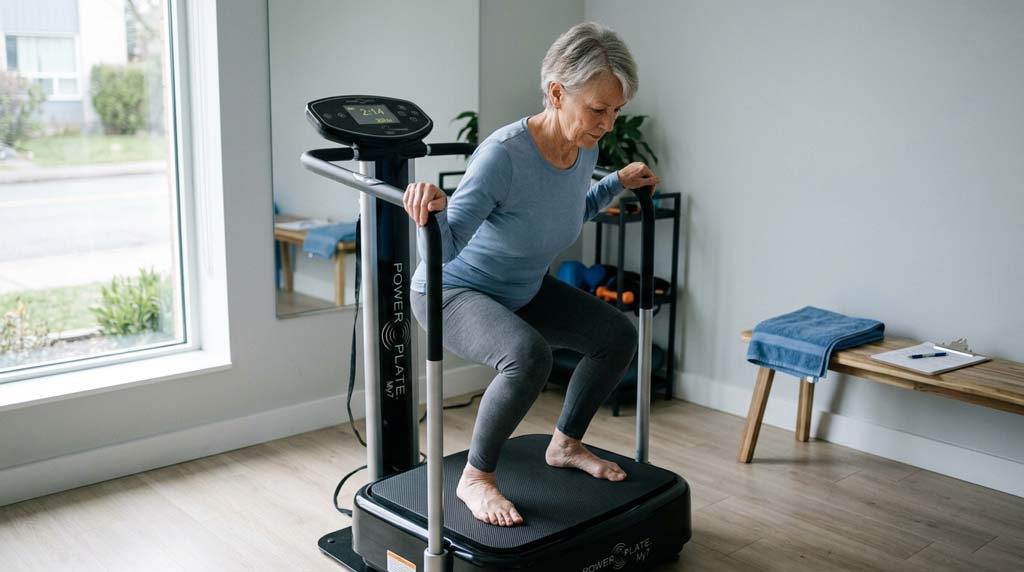
A vibration plate workout asks almost nothing of you. You stand still, and the machine does the work. A session can last as little as five minutes. Few fitness tools promise so much for so little effort.
That modest act now carries a heavy load of promises. The same platform is sold as a strength builder, a bone treatment and a weight-loss aid. It is marketed for circulation, for recovery, even for lymphatic drainage. Those are not one claim. They are several, and the evidence behind each is uneven.
The device did not start as a gadget. Whole-body vibration (mechanical loading delivered through a vibrating platform) began as a clinical and scientific tool. It fought muscle and bone loss in astronauts, and helped patients who could barely move. Only later did it reach the high street.
What the plate does depends on how it is used. Many settings can be changed, and small changes decide whether anything happens at all. Who stands on it matters just as much. A frail pensioner and a trained athlete are not the same case.
The way people use it varies too. Some simply stand and let it shake them, a form of passive exercise. Others hold a squat, or add movement and weights. Each version delivers a different stimulus.
So the honest questions are specific. Does standing on a plate give a real training stimulus, or only a pleasant buzz? Which benefits need active effort, and which come from passive shaking? And how should anyone read trial results when machines and people differ so widely? Sorting the genuine vibration plate benefits from the marketing is the aim here. A vibration plate workout rewards clear thinking more than blind faith.
What Happens During a Vibration Plate Workout?
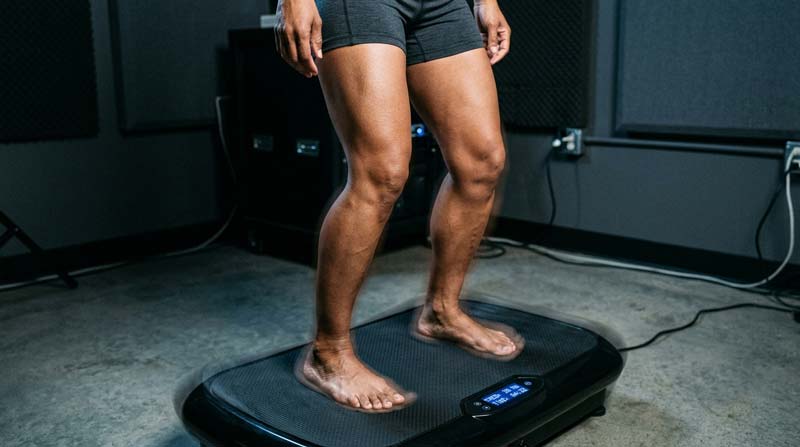
Step onto the platform, and your muscles start working before you decide to move. The shaking triggers a reflex, not a conscious effort. Tiny sensors in the muscle, called spindles, feel the rapid stretch and fire back a contraction. This is the tonic vibration reflex, the classic explanation for the effect.
The truth is more tangled than that. The classic reflex was described using vibration at 100 to 150 hertz, applied straight to a muscle. A plate runs below fifty hertz, and it shakes opposing muscles at the same time. For that reason, some researchers doubt the classic reflex even applies here.
Whole-body vibration may trigger a reflex of its own. It differs from the classic one in its timing and in how it recruits muscle fibres. Its response also arrives more slowly. So the plate is not simply a hands-off version of a laboratory reflex.
One careful experiment narrowed the argument. Low-frequency vibration through the sole of the foot did produce the classic reflex. It built force slowly in the calf, much like direct tendon vibration. Opposing muscles still fired together, which softens the reflex rather than cancelling it.
What is not in doubt is the sheer volume of work. Depending on the setting, the plate can drive over a thousand muscle contractions a minute. No act of will could match that rate. This is why the platform is often called passive exercise, since reflex does most of the labour.
That hidden workload stacks up fast. A single nine-minute session can deliver around ten thousand muscle stimuli. That is comparable to roughly three hours of walking. So standing on a plate is not nothing, and a vibration plate workout does place real demand on the muscles.
Yet passive standing is the weakest version of it. Hold a squat on the platform, and thigh-muscle activity climbs about fifty-seven per cent versus a squat off it. Adding load or movement recruits far more muscle than standing alone. Active effort, not the machine, does the heavy lifting.
There is a further layer beneath the nervous system. In muscle cells, low-amplitude vibration switched off two drivers of muscle wasting. It raised protein building and slowed protein breakdown. That points to a genuine tissue effect, not just a reflex trick.
Blood flow rises too, climbing as frequency and amplitude increase. Even so, the response stays blunted compared with actually exercising those muscles. The plate mimics effort; it does not fully replace it.
One limit deserves emphasis before any of this is oversold. Almost everything above describes an immediate response, seen during or soon after a session. Whether these reflexes build lasting strength is a separate question. That link still awaits long-term proof. A single vibration plate workout repeats the acute effect, yet durability is not guaranteed.
Why the Way You Use the Plate Matters
Turn the dial from 15 to 30 hertz, and you do not double the load. You roughly quadruple it. Acceleration climbs with the square of the frequency, so force rises far faster than speed. A two-millimetre movement gives about 1.8g at 15 hertz, but nearly 7.2g at 30.
This is why one machine behaves like many. The label on the box tells you very little. A vibration plate workout at a low setting and the same session at a high setting are different exercises.
Several controls decide how much of the shaking actually reaches your muscles and bones.
- Frequency: For building strength, around 40 hertz proved best in older adults with muscle loss. Anything below 20 hertz appears too gentle to help.
- Amplitude: Bigger movements hit harder. Trials using 8 to 10 millimetres produced greater strength gains than those using 2 to 6.
- Platform Type: Side-alternating plates rock around a central pivot; synchronous plates push straight up and down. The rocking motion resembles walking, and suits bone better.
- Posture: Locked, straight knees send vibration up into the skeleton, while bent knees absorb it into the leg muscles. A slight bend raises muscle activation.
- Footwear and Time: Shoes soak up vibration before it arrives, so some trials used thin socks. Around ten minutes of exposure suits muscle function, and longer sessions invite fatigue that erodes the benefit.
Here is the part most articles miss. Whether these settings matter depends on what you want from them. For leg strength in older adults, gains held up regardless of posture, platform, dose or magnitude. For bone, that indifference disappears, and plate type and knee angle do change the result.
Time matters in a second sense. Programmes of about ten weeks often showed limited change, while twelve weeks improved a wider range of measures. For beginners, that is worth knowing before judging a machine after a fortnight.
None of this transfers neatly to a machine bought online. Bone studies alone have used frequencies from about 12 to 40 hertz. Accelerations ran from 0.3 to 18g, and total doses from under an hour to many hours. Two devices with the same label may deliver quite different doses. So a home vibration plate workout is a reasonable stimulus, rarely the exact one a trial reports.
Can a Vibration Plate Workout Make You Fitter?
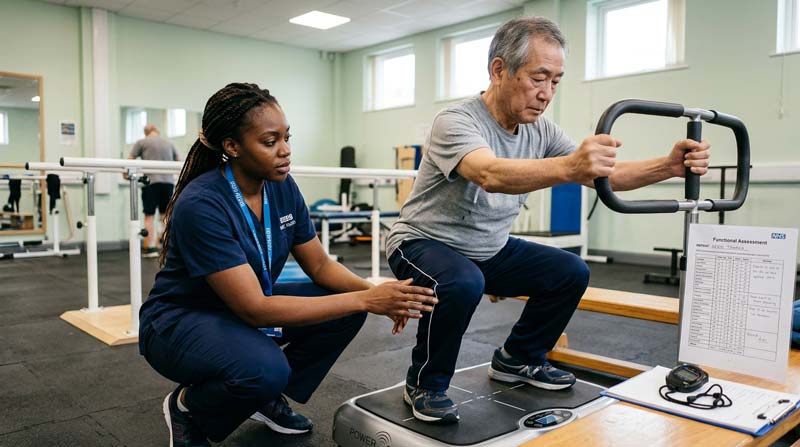
Strength is where the evidence is strongest, and also where it is most easily oversold. Pooled results from thirty-four trials in older adults show a real, moderate gain in lower-limb strength. The knee muscles and ankle plantar flexors respond most.
The gains stop there, though. The same analysis found no improvement in grip strength, muscle power or endurance. The reason is simple geometry. You stand on the plate, so little vibration reaches the arms. Place the hands directly on the platform and upper-body power can rise, at least briefly.
Power is the awkward outcome. Single sessions lift it briefly, yet those gains rarely survive a full programme. One trial did find faster contraction speed, which may matter more than it first appears.
Then comes the question that decides everything. How does it compare with ordinary exercise? Against doing nothing, vibration clearly wins on leg strength. Against conventional strength training, it draws level rather than pulling ahead. In direct comparison, its gains have also run smaller than resistance training.
Balance and falls are where the plate earns its keep; between a fifth and a third of people over sixty-five fall each year. Regular use has cut that risk by roughly a third.
One trial in severe lung disease shows the pattern clearly. Vibration balance training beat a conventional balance board on steadiness and jump power. Walking speed improved only in the vibration group. Thigh strength rose equally in both, since the plate imposes no heavy load.
A pattern runs through all of it. The benefit is largest where the starting point is lowest. Vibration helps those with poor balance or limited capacity, and does little for trained athletes. So a vibration plate workout is no shortcut for the already fit.
The same logic reaches much younger patients. In children with cerebral palsy, vibration improved walking speed, gross motor function and thigh-bone density.
Two cautions keep this honest. Reviews disagree about age-related muscle loss. One found gains only in mobility, not strength. Another found genuine strength gains, and put the difference down to the settings used. In one year-long trial, knee strength also improved in the non-exercising group, which hints at practice rather than training. A vibration plate workout can make you fitter, yet the size of that gain depends on who trains, and how.
How a Vibration Plate May Support Your Health
Bone, fat and blood vessels get bundled into a single sales pitch. The research treats them as three separate cases, with three different verdicts. What a vibration plate workout offers one of them, it does not offer the others.
Bone
Bone is the most studied claim, and the most conditional. In nine controlled trials of 527 postmenopausal women, vibration raised hip and spine density by two to five per cent. The lumbar spine responds most reliably. Below sixty-five, the femoral neck improves as well.
The weaker the bone, the better it answers. Sensitivity runs inversely to starting density, so thin bone gains most. Slimmer women under sixty-five showed the clearest effect.
Dose decides much of the rest. Totals above a thousand minutes track with success, and weekly frequency counts more than sheer programme length. Passing roughly a hundred sessions produced greater gains at the spine.
Two findings complicate the picture. Vibration alone improved bone, yet exercising on the plate produced almost nothing, as though movement disturbs the signal. The stimulus also stays local, doing little for the upper skeleton. Trials still disagree, and a year may be too short to judge, with two years suggested.
How it works is contested. One view holds that tiny impacts stress bone slightly, prompting repair that leaves it denser. Another argues the loads are far too small for that. In that reading, the benefit flows from muscle pumping blood and fluid through the bone itself.
Body Weight and Fat
This is where the adverts stretch furthest. Used alone across twenty-four weeks, vibration added a little lean tissue and removed no fat. On its own, a vibration plate workout for weight loss does very little.
Add a reduced-calorie diet, though, and the picture flips. Over a year, vibration plus diet beat both diet alone and aerobic exercise plus diet. That group lost around ten kilograms, against roughly four and six point six. It was also the only group to shed a tenth of body weight and hold it.
Deep abdominal fat responded best of all. Visceral fat fell by about forty-eight square centimetres, and only this group kept that loss at twelve months. Waist measurements followed. Aerobic work still won on cholesterol, triglycerides and fitness, so pairing both with a diet looks strongest.
The energy cost is genuine, if modest. Sessions raise oxygen uptake and measurable energy turnover, which reflects real muscle activation rather than a meter quirk.
Blood Pressure and Circulation
Blood vessels show the cleanest response of the three. A single session softens artery stiffness and lifts small-vessel blood flow, behaving like a mild dose of exercise. Across twelve weeks in postmenopausal women with raised pressure, systolic pressure fell about twelve points and diastolic about six. Leg artery stiffness dropped by roughly eight per cent.
The detail matters more than the headline. The aorta itself did not change, so the gain sat in the trained legs. It also occurred without any weight loss, which makes the two effects independent. The size of that drop matched what diet or blood-pressure medication can achieve. Leg-focused training appears to help arteries, whereas upper-body resistance work can stiffen them.
Can a Vibration Plate Help You Recover?
Soreness runs to a timetable. It surfaces eight to twenty hours after hard exercise, then peaks between one and two days. Repeated eccentric work, where muscles lengthen under load, disturbs the fibres and sets off inflammation.
Against that, vibration has a decent record. Meta-analyses judge it effective for preventing and treating soreness. Raised blood flow through the muscle is one likely route. Another sits in pain signalling, since vibration stimulates sensory nerves that dampen pain messages.
The clearest result came from elite hockey players. After damaging exercise, a session cut both pain and thigh tightness compared with stretching alone. Every player returned to normal training within a fortnight.
Step outside elite sport, and the record frays. Several trials in recreational participants found no pain relief at all. Training status alters the response, so seasoned athletes and beginners are not comparable. More importantly, easing soreness is not repairing muscle. One session lowered a marker of muscle damage and reduced soreness, yet strength recovery did not improve.
One study cuts the other way. Vibration matched to the muscle’s own resonance restored strength within a week, while untreated arms stayed weaker. Muscle stiffness also settled faster. So a vibration plate workout may aid recovery, though the conditions that make it work are far from settled.
The trials carry an obvious weakness. Vibration can be felt, so nobody can be blinded, and expectation may colour the pain scores. Pain and stiffness describe how a muscle feels, not the damage inside it.
That brings us to the boldest claim of all. Searches for a vibration plate workout for lymphatic drainage are common, and a real finding sits underneath. Lymph has no pump of its own, so it depends on tissue movement, and immobile limbs barely drain. Plantar vibration did raise fluid, lymph and venous drainage in the legs of perimenopausal women.
The leap from there to detox is where it breaks. That result came from a specific group using a specific device, not from healthy users chasing a cleanse. Warmth or tingling proves circulation, nothing more. No solid human evidence supports broad drainage or detoxification claims.
How to Fit a Vibration Plate Workout Into Your Routine
Placed properly, the plate is a supporting act. It works best added to training rather than swapped in for it. Research programmes ran from two to thirty minutes a session, most often three times a week. A ten-minute vibration plate workout sits comfortably inside that range.
Most trials had people perform lower-limb exercises on the platform, though static postures were common too. That choice shapes the result more than the machine does.
For anyone starting out, a conservative build works best.
- Start short and low. A few minutes at a modest setting is enough to learn how your body answers.
- Hold steady positions before you move. A supported stance or squat is safer than stepping about while the platform shakes.
- Add movement, then load. Simple exercises come first, and a vibration plate workout with weights only once the position feels secure.
- Judge progress by function. Track balance, walking and leg strength, not the vibration level or how much you sweat.
Tolerance is generally good. Across older-adult trials, adherence sat near ninety per cent, and about half reported no adverse events. A minority did note problems, including joint pain, swelling and dizziness. It has even proved safe in critically ill hospital patients.
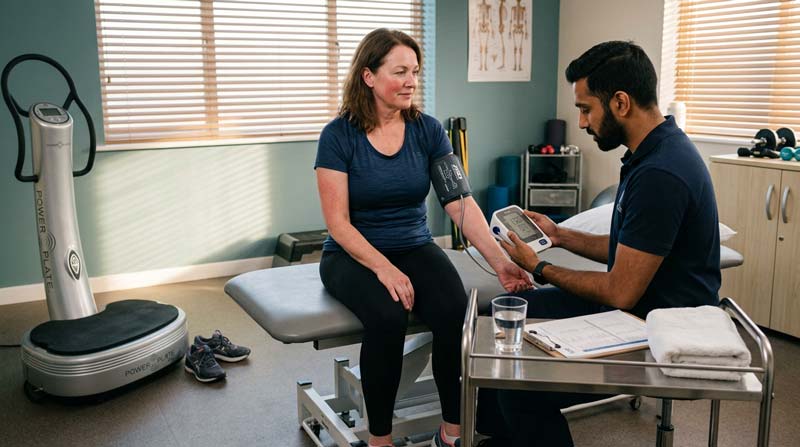
Some people should ask before starting. Trials routinely excluded pacemakers, recent clots, fresh fractures and joint replacements. Others excluded epilepsy, acute disc problems and severe heart valve disease. Those lists are screening criteria, not proven hazards. Anyone with a medical condition is better asking a doctor first.
One practical detail is often missed. Vibration used before exercise has performed as well as, or better than, vibration afterwards. And because a recovery session adds no time beyond stretching, it slots into an existing routine easily.
Step back from the detail, and a shape appears. The plate is not one treatment but a range of stimuli. Frequency, posture, dose and the body itself all set that stimulus. It gives most to those with least: the older, the unsteady, the recovering.
It amplifies effort rather than replacing it, whether that effort is a diet or a training week. Where the evidence is strong, it is also specific, tied to a population and a protocol. Where the claims are loudest, from detox to effortless fat loss, the research is thinnest. That gap between promise and proof is where the honest answer sits.
Sources
- Akehurst H, Grice JE, Angioi M, Morrissey D, Migliorini F, Maffulli N. Whole-body vibration decreases delayed onset muscle soreness following eccentric exercise in elite hockey players: a randomised controlled trial. J Orthop Surg Res. 2021;16(1):589.
- Aukland K and Reed RK. Interstitial-lymphatic mechanisms in the control of extracellular fluid volume. Physiol Rev 73: 1-78, 1993.
- Beck BR, Norling TL. The effect of 8 mos of twice-weekly low- or higher intensity whole body vibration on risk factors for postmenopausal hip fracture. Am J Phys Med Rehabil. 2010;89:997-1009.
- Betik AC, Parker L, Kaur G, Wadley GD, Keske MA. Whole-Body Vibration Stimulates Microvascular Blood Flow in Skeletal Muscle. Med Sci Sports Exerc. 2021;53:375-383.
- Byrnes WC, Clarkson PM. Delayed onset muscle soreness and training. Clin Sports Med. 1986;5:605-614.
- Cardinale M, Wakeling J. Whole body vibration exercise: are vibrations good for you? Br J Sports Med. 2005;39:585-589.
- Ceccarelli G, Benedetti L, Galli D, Prè D, Silvani G, Crosetto N, et al. Low-amplitude high frequency vibration down-regulates myostatin and atrogin-1 expression, two components of the atrophy pathway in muscle cells. J Tissue Eng Regen Med. 2014;8:396-406.
- Eklund G, Hagbarth KE: Vibratory induced motor effects in normal man and in patients with spastic paralysis. Electroencephalogr Clin Neurophysiol, 1967, 23: 393.
- Figueroa A, Kalfon R, Madzima TA, Wong A. Whole-body vibration exercise training reduces arterial stiffness in postmenopausal women with prehypertension and hypertension. Menopause. 2014;21(2):131-136.
- Fratini A, Bonci T, Bull AM. Whole Body Vibration Treatments in Postmenopausal Women Can Improve Bone Mineral Density: Results of a Stimulus Focussed Meta-Analysis. PLoS One. 2016;11(12):e0166774.
- Gloeckl R, Schneeberger T, Leitl D, Reinold T, Nell C, Jarosch I, Kenn K, Koczulla AR. Whole-body vibration training versus conventional balance training in patients with severe COPD-a randomized, controlled trial. Respir Res. 2021;22(1):138.
- Gonçalves de Oliveira R, Coutinho HMEL, Martins MNM, Bernardo-Filho M, de Sá-Caputo DDC, Campos de Oliveira L, Taiar R. Impacts of Whole-Body Vibration on Muscle Strength, Power, and Endurance in Older Adults: A Systematic Review and Meta-Analysis. J Clin Med. 2023;12(13):4467.
- Jones GC, Blotter JD, Smallwood CD, Eggett DL, Cochrane DJ, Feland JB. Effect of Resonant Frequency Vibration on Delayed Onset Muscle Soreness and Resulting Stiffness as Measured by Shear-Wave Elastography. Int J Environ Res Public Health. 2021;18(15):7853.
- Jones MT, Martin JR, Jagim AR, Oliver JM. Effect of Direct Whole-Body Vibration on Upper-Body Muscular Power in Recreational, Resistance-Trained Men. J Strength Cond Res. 2017;31:1371-1377.
- Karacan I, Cidem M, Cidem M, et al.: Whole-body vibration induces distinct reflex patterns in human soleus muscle. J Electromyogr Kinesiol, 2017, 34: 93-101.
- Kerschan-Schindl K, Grampp S, Henk C, Resch H, Preisinger E, Fialka-Moser V, et al. Whole-body vibration exercise leads to alterations in muscle blood volume. Clin Physiol Oxf Engl. 2001;21:377-382.
- Kienberger Y, Sassmann R, Rieder F, Johansson T, Kässmann H, Pirich C, Wicker A, Niebauer J. Effects of whole body vibration in postmenopausal osteopenic women on bone mineral density, muscle strength, postural control and quality of life: the T-bone randomized trial. Eur J Appl Physiol. 2022;122(11):2331-2342.
- Kim J-Y, Kang D-H, Lee J-H, Se M, Jeon J-K. The effects of pre-exercise vibration stimulation on the exercise-induced muscle damage. J Phys Ther Sci. 2017;29:119-122.
- Lai CL, Tseng SY, Chen CN, et al. Effect of 6 months of whole body vibration on lumbar spine bone density in postmenopausal women: a randomized controlled trial. Clin Interv Aging 2013;8:1603-9.
- Lewis PB, Ruby D, Bush-Joseph CA: Muscle soreness and delayed-onset muscle soreness. Clin Sports Med, 2012, 31: 255-262.
- Liao L-R, Ng GYF, Jones AYM, Chung RCK, Pang MYC. Effects of vibration intensity, exercise, and motor impairment on leg muscle activity induced by whole-body vibration in people with stroke. Phys Ther. 2015;95(12):1617-1627.
- Liu PY, Brummel-Smith K, Ilich JZ. Aerobic exercise and whole-body vibration in offsetting bone loss in older adults. J Aging Res 2011;2011:379674.
- Lu L, Mao L, Feng Y, Ainsworth BE, Liu Y, Chen N. Effects of different exercise training modes on muscle strength and physical performance in older people with sarcopenia: a systematic review and meta-analysis. BMC Geriatr. 2021;21(1):708.
- Lu X, Wang Y, Lu J, You Y, Zhang L, Zhu D, et al. Does vibration benefit delayed-onset muscle soreness? A meta-analysis and systematic review. J Int Med Res. 2019;47:3-18.
- Marín-Cascales E, Alcaraz PE, Ramos-Campo DJ, Martinez-Rodriguez A, Chung LH, Rubio-Arias JÁ. Whole-body vibration training and bone health in postmenopausal women: a systematic review and meta-analysis. Medicine (Baltimore). 2018;97(34):e11918.
- Marin PJ, Bunker D, Rhea MR, Ayllon FN. Neuromuscular activity during whole-body vibration of different amplitudes and footwear conditions: implications for prescription of vibratory stimulation. J Strength Cond Res. 2009;23:2311-2316.
- Marín PJ, Rhea MR. Effects of vibration training on muscle strength: a meta-analysis. J Strength Cond Res. 2010;24(2):548-556.
- Mikhael M, Orr R, Amsen F, Greene D, Singh MA. Effect of standing posture during whole body vibration training on muscle morphology and function in older adults: a randomised controlled trial. BMC Geriatr. 2010;10:74.
- Okamoto T, Masuhara M, Ikuta K. Upper but not lower limb resistance training increases arterial stiffness in humans. Eur J Appl Physiol. 2009;107:127-134.
- Ozcivici E, Luu YK, Adler B, Qin YX, Rubin J, Judex S, et al. Mechanical signals as anabolic agents in bone. Nature Reviews Rheumatology. 2010;6(1):50-9.
- Pollock RD, Woledge RC, Martin FC, et al.: Effects of whole body vibration on motor unit recruitment and threshold. J Appl Physiol, 2012, 112: 388-395.
- Proske U, Allen TJ: Damage to skeletal muscle from eccentric exercise. Exerc Sport Sci Rev, 2005, 33: 98-104.
- Qin YX, Rubin CT, and McLeod KJ. Nonlinear dependence of loading intensity and cycle number in the maintenance of bone mass and morphology. J Orthop Res 16: 482-489, 1998.
- Rauch F. Vibration therapy. Dev Med Child Neurol. 2009;51:166-168.
- Rauch F, Sievanen H, Boonen S, et al. Reporting whole-body vibration intervention studies: recommendations of the International Society of Musculoskeletal and Neuronal Interactions. J Musculoskelet Neuronal Interact 2010;10:193-8.
- Rittweger J. Vibration as an exercise modality: how it may work, and what its potential might be. Eur J Appl Physiol. 2010;108:877-904.
- Roelants M, Delecluse C, Goris M, Verschueren S. Effects of 24 weeks of whole body vibration training on body composition and muscle strength in untrained females. Int J Sports Med. 2004;25:1-5.
- Roelants M, Verschueren SMP, Delecluse C, Levin O, Stijnen V. Whole-body-vibration-induced increase in leg muscle activity during different squat exercises. J Strength Cond Res. 2006;20(1):124-9.
- Rønnestad BR, Holden G, Samnøy LE, Paulsen G. Acute effect of whole-body vibration on power, one-repetition maximum, and muscle activation in power lifters. J Strength Cond Res. 2012;26:531-539.
- Rubin C, Pope M, Fritton JC, Magnusson M, Hansson T, McLeod K. Transmissibility of 15-hertz to 35-hertz vibrations to the human hip and lumbar spine. Spine. 2003;28(23):2621-2627.
- Saquetto M, Carvalho V, Silva C, Conceicao C, Gomes-Neto M. The effects of whole body vibration on mobility and balance in children with cerebral palsy: a systematic review with meta-analysis. J Musculoskelet Neuronal Interact. 2015;15:137-144.
- Šarabon N, Kozinc Z, Löfler S, Hofer C. Resistance Exercise, Electrical Muscle Stimulation, and Whole-Body Vibration in Older Adults: Systematic Review and Meta-Analysis of Randomized Controlled Trials. J Clin Med. 2020;9:2902.
- Silva-Grigoletto MED, Hoyo MD, Sanudo B, Carrasco L, Garcia-Manso JM. Determining the optimal whole-body vibration dose-response relationship for muscle performance. J Strength Cond Res. 2011;25(12):3326-3333.
- Slatkovska L, Alibhai SMH, Beyene J, Cheung AM. Effect of whole-body vibration on BMD: a systematic review and meta-analysis. Osteoporosis Int. 2010;21(12):1969-80.
- Stewart JM, Karman C, Montgomery LD, McLeod KJ. Plantar vibration improves leg fluid flow in perimenopausal women. Am J Physiol Regul Integr Comp Physiol. 2005;288(3):R623-R629.
- Taylor-Piliae RE, Peterson R, Mohler MJ. Clinical and community strategies to prevent falls and fall-related injuries among community-dwelling older adults. Nurs Clin North Am. 2017;52(3):489-97.
- Timon R, Tejero J, Brazo-Sayavera J, Crespo C, Olcina G: Effects of whole-body vibration after eccentric exercise on muscle soreness and muscle strength recovery. J Phys Ther Sci, 2016, 28: 1781-1785.
- Vissers D, Verrijken A, Mertens I, Van Gils C, Van de Sompel A, Truijen S, Van Gaal L. Effect of long-term whole body vibration training on visceral adipose tissue: a preliminary report. Obes Facts. 2010;3(2):93-100
- Wei N, Pang MY, Ng SS, Ng GY. Optimal frequency/time combination of whole-body vibration training for improving muscle size and strength of people with age-related muscle loss (sarcopenia): a randomized controlled trial. Geriatr Gerontol Int. 2016;17(10):1412-1420.
- Wei N, Pang MY, Ng SS, Ng GY. Optimal frequency/time combination of whole body vibration training for developing physical performance of people with sarcopenia: a randomized controlled trial. Clin Rehabil. 2017;31(10):1313-1321.
- Wheeler AA, Jacobson BH. Effect of whole-body vibration on delayed onset muscular soreness, flexibility, and power. J Strength Cond Res. 2013;27:2527-2532.
- Wollersheim T, Haas K, Wolf S, Mai K, Spies C, Steinhagen-Thiessen E, Wernecke KD, Spranger J, Weber-Carstens S. Whole-body vibration to prevent intensive care unit-acquired weakness: safety, feasibility, and metabolic response. Crit Care. 2017;21(1):9.
- Wu S, Ning HT, Xiao SM, Hu MY, Wu XY, Deng HW, et al. Effects of vibration therapy on muscle mass, muscle strength and physical function in older adults with sarcopenia: a systematic review and meta-analysis. Eur Rev Aging Phys Act. 2020;17:14.
- Zaidell LN, Mileva KN, Sumners DP, Bowtell JL. Experimental evidence of the tonic vibration reflex during whole-body vibration of the loaded and unloaded leg. PLoS One. 2013;8(12):e85247.
- Zoppi M, Voegelin MR, Signorini M, et al.: Pain threshold changes by skin vibratory stimulation in healthy subjects. Acta Physiol Scand, 1991, 143: 439-443.