



Weight loss resistance is crucial in understanding why maintaining a reduced body weight proves challenging for many individuals worldwide. Scientific evidence reveals that our bodies possess sophisticated biological mechanisms that actively defend against weight loss, operating through complex metabolic and hormonal adaptations.
These adaptations trigger significant changes in energy expenditure, with research showing decreases often exceeding what would be expected based on changes in body composition alone. Studies indicate that even minimal weight loss of 2-3% activates these protective responses, demonstrating how quickly our bodies react to perceived threats to survival.
The mathematics of these biological responses proves fascinating. Research shows that calorie expenditure decreases by approximately 25 kilocalories per day for each kilogram of lost weight, while appetite increases by about 95 kilocalories above baseline levels. This creates a substantial gap between energy needs and hunger signals, making sustained weight loss resistance particularly challenging.
This article examines our body’s ancient survival mechanisms, investigating how evolution shaped our metabolic responses and why these adaptations pose unique challenges in our current environment.
We’ll uncover the scientific evidence behind metabolic adaptation, investigate biological responses to calorie restriction, and explore evidence-based strategies for working with rather than against these innate survival systems.
The Evolutionary Basis of Metabolic Adaptation
The concept of thrifty genes – genetic adaptations that evolved during periods of food scarcity to help humans survive famines by storing fat more efficiently – helps explain the foundations of weight loss resistance in our bodies.
This evolutionary adaptation developed through countless generations of humans facing uncertain food supplies, creating strong biological drives to maintain energy stores and weight loss resistance mechanisms.
Scientific evidence suggests these survival adaptations occurred during prolonged periods of seasonal starvation in our history. Studies examining obesity and diabetes-associated genetic variants have found specific adaptations, including the miR-128-1 gene variant, influencing feeding efficiency and fat storage capabilities.
During periods of food shortage, individuals with enhanced fat storage capabilities demonstrated higher survival rates, passing these genetic traits to future generations. Research indicates these adaptations affected fertility rates and survival, particularly during scarcity.
Research examining metabolic genes like PPARA (peroxisome proliferator-activated receptor alpha, a protein that helps regulate fat metabolism) demonstrates how populations developed different metabolic efficiencies based on their ancestral environments.

Weight Loss Resistance in Action
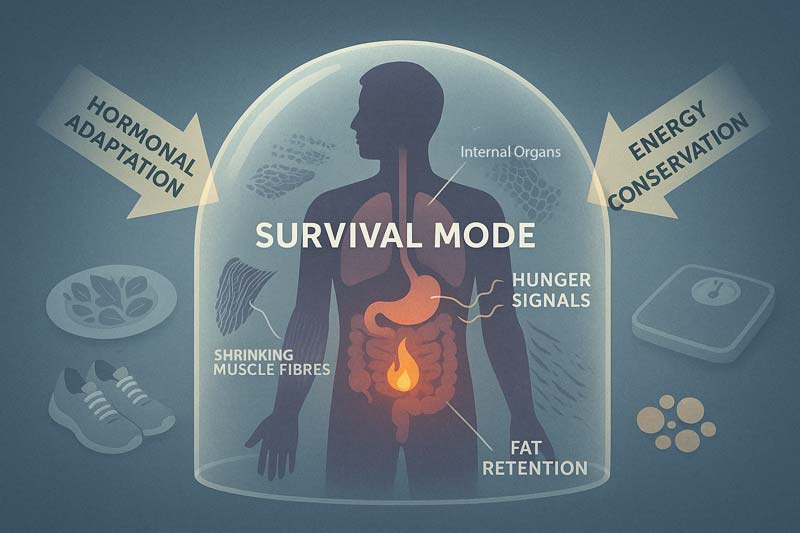
When faced with reduced calorie intake, the body exhibits profound biological responses, activating multiple protective systems beyond simple hunger signals. When calories decrease, the body demonstrates remarkable metabolic efficiency mechanisms, reducing energy expenditure by approximately 25 kilocalories for every kilogram of weight lost.
Scientific evidence shows these adaptations affect resting metabolism and fat oxidation (the breakdown of fat for energy). The body increases its metabolic efficiency, leading to decreased energy expenditure beyond what changes in body composition alone would predict. Studies indicate that these adaptations can persist for years even after energy balance stabilises at a lower weight.
The hormonal environment undergoes significant changes during calorie restriction. Research identifies substantial alterations in key hormones like leptin (appetite regulation hormone) and peptide YY (digestive hormone), alongside increases in ghrelin (hunger hormone) levels. These shifts persist long-term, creating biological signals that promote weight regain.
How Calorie Restriction Triggers Survival Mode
Knowledge of the body’s protective mechanisms enables the development of targeted strategies to work with these biological responses rather than against them. Research shows that physical activity is one of the strongest tools for managing weight loss resistance, particularly its effects on metabolic adaptation.
Scientific evidence highlights that exercise helps prevent the loss of lean tissue (muscle mass) that typically occurs with calorie restriction. This preservation proves crucial, as lean tissue drives our metabolic rate (the speed at which we burn calories). Studies demonstrate that exercise significantly reduces visceral adipose tissue (fat stored around organs) compared to overall body weight reduction.
The data reveals specific exercise thresholds for optimal results. Evidence indicates that 200-300 minutes of weekly physical activity during weight maintenance significantly reduces post-loss weight regain. Successful weight loss maintainers from large-scale studies typically engage in moderate-intensity exercise for 60-90 minutes daily, highlighting the importance of consistent activity patterns.
Managing Weight Loss Resistance Through Science
Studies examining hormonal changes identify specific biological patterns affecting weight loss resistance through various pathways. Research shows these adaptations involve caloric equations and bodily systems working in concert to preserve energy stores during periods of reduced intake.
The timing and composition of meals significantly influence these protective responses. Scientific evidence reveals that protein intake plays a particularly crucial role, with higher protein consumption helping preserve lean tissue mass during caloric restriction. This preservation proves vital, as lean tissue directly affects metabolic rate (the speed at which calories are burned) and weight loss resistance patterns.
Physical activity demonstrates unique benefits beyond caloric expenditure alone. Research indicates exercise helps prevent the loss of lean tissue that typically occurs with moderate caloric restriction, potentially reducing diet-induced decreases in resting metabolic rate (how many calories are burned at rest). Additionally, studies show exercise exhibits particular effectiveness in reducing visceral adipose tissue (fat stored around organs) compared to overall body weight reduction.

Evidence-Based Solutions for Long-Term Success
Data from large-scale studies identify distinct patterns among individuals who achieve lasting success with weight loss resistance. These maintainers typically consume carefully planned diets while limiting exposure to high-calorie foods. Their habits include eating smaller meals 4-5 times daily, maintaining consistent food intake patterns, and implementing early corrective actions when needed.
Scientific evidence highlights specific exercise thresholds for optimal results. Studies demonstrate a clear dose-response relationship, with 150 minutes of weekly physical activity resulting in modest 2-3 kg reductions, while 225-420 minutes weekly leads to 5-7.5 kg decreases.
For sustainable maintenance, research indicates 250-300 minutes of moderate-to-vigorous exercise weekly proves most effective in managing weight loss resistance.
Research reveals successful maintainers share common characteristics beyond diet and exercise. They typically watch television less than 10 hours weekly, regularly monitor their weight, and maintain consistent daily routines. Studies show these behavioural patterns help create an environment conducive to long-term success.
The relationship between ancient survival mechanisms and contemporary weight management continues to evolve. Each breakthrough provides new aspects of human metabolism’s remarkable complexity while revealing promising pathways for enhancing metabolic health.
Sources
- Camps SG, Verhoef SP, Westerterp KR. Weight loss, weight maintenance, and adaptive thermogenesis. Am J Clin Nutr. 2013;97:990–994.
- Donnelly JE, Blair SN, Jakicic JM, et al. American College of Sports Medicine position stand. Appropriate physical activity intervention strategies for weight loss and prevention of weight regain for adults. Med Sci Sports Exerc. 2009;41(2):459–71
- Doucet E, St-Pierre S, Alméras N, Després JP, Bouchard C, Tremblay A. Evidence for the existence of adaptive thermogenesis during weight loss. Br J Nutr 2001;85:715–723
- Fothergill E, Guo J, Howard L, et al. Persistent metabolic adaptation 6 years after “The Biggest Loser” competition. Obesity (Silver Spring) 2016;24:1612–1619
- Frey-Hewitt B, Vranizan KM, Dreon DM, Wood PD. The effect of weight loss by dieting or exercise on resting metabolic rate in overweight women. Int J Obes. 1990; 14: 57-73
- Frey-Hewitt B, Vranizan KM, Dreon DM, Wood PD. The effect of weight loss by dieting or exercise on resting metabolic rate in overweight women. Int J Obes. 1990; 14: 57-73
- Jensen MD, Ryan DH, Apovian CM, Ard JD, Comuzzie AG, Donato KA, Hu FB, Hubbard VS, Jakicic JM, Kushner RF, Loria CM, Millen BE, Nonas CA, Pi-Sunyer FX, Stevens J, Stevens VJ, Wadden TA, Wolfe BM, Yanovski SZ, Jordan HS, Kendall KA, Lux LJ, Mentor-Marcel R, Morgan LC, Trisolini MG, Wnek J, Anderson JL, Halperin JL, Albert NM, Bozkurt B, Brindis RG, Curtis LH, DeMets D, Hochman JS, Kovacs RJ, Ohman EM, Pressler SJ, Sellke FW, Shen WK, Smith SC Jr, Tomaselli GF; American College of Cardiology/American Heart Association Task Force on Practice Guidelines; Obesity Society. 2013 AHA/ACC/TOS guideline for the management of overweight and obesity in adults: a report of the American College of Cardiology/American Heart Association Task Force on Practice Guidelines and The Obesity Society. Circulation. 2014 Jun 24;129(25 Suppl 2):S102-38.
- Kersten S, Seydoux J, Peters JM, Gonzalez FJ, Desvergne B, Wahli W. Peroxisome proliferator-activated receptor alpha mediates the adaptive response to fasting. J Clin Invest. 1999;103(11):1489–1498.
- Klem ML, Wing RR, Lang W, McGuire MT, Hill JO. Does weight loss maintenance become easier over time? Obes Res. 2000;8(6):438–444
- Paixão C, Dias CM, Jorge R, Carraça EV, Yannakoulia M, de Zwaan M, Soini S, Hill JO, Teixeira PJ, Santos I. Successful weight loss maintenance: A systematic review of weight control registries. Obes Rev. 2020 May;21(5):e13003.
- Polidori D, Sanghvi A, Seeley R, Hall K. How strongly does appetite counter weight loss? Quantification of the feedback control of human energy intake. Obesity (Silver Spring) 2016;24:2289–2295.
- Prentice AM. Early influences on human energy regulation: thrifty genotypes and thrifty phenotypes. Physiol Behav. 2005;86(5):640–645.
- Ravussin E., Smith S.R., Ferrante A.W., Jr. Physiology of energy expenditure in the weight-reduced state. Obesity (Silver Spring) 2021;29(Suppl 1):S31–S38
- Rosenbaum M, Leibel RL. Adaptive thermogenesis in humans. Int J Obes (Lond) 2010;34(Suppl 1):S47–S55.
- Rosenbaum M, Leibel R. Metabolic Responses to Weight Perturbation. In: Christen, Y., Clément, K., Spiegelman, B. (eds) Novel Insights into Adipose Cell Functions. Research and Perspectives in Endocrine Interactions. Springer, Berlin, Heidelberg. 2010:121–133Sardeli AV, Komatsu TR, Mori MA, Gáspari AF, Chacon‐Mikahil MPT. Resistance training prevents muscle loss induced by caloric restriction in obese elderly individuals: a systematic review and meta‐ Nutrients. 2018;10(4):423‐432
- Southam L, Soranzo N, Montgomery SB, Frayling TM, McCarthy MI, Barroso I. et al. Is the thrifty genotype hypothesis supported by evidence based on confirmed type 2 diabetes- and obesity-susceptibility variants? 2009;52(9):1846–1851.
- Sumithran P, Proietto J. The defence of body weight: a physiological basis for weight regain after weight loss. Clinical Science. 2013;124(4):231–241.
- Sumithran P, Prendergas LA, Delbridge E, et al. Long-term persistence of hormonal adaptations to weight loss. The New England Journal of Medicine. 2011;365(17):1597–1604
- Swift DL, Johannsen NM, Lavie CJ, Earnest CP, Church TS. The role of exercise and physical activity in weight loss and maintenance. Prog Cardiovasc Dis. 2014;56:441–447
- Thompson, JL, Manore, MM, Vaughan, LA. The Science of Nutrition. 4th ed. Upper Saddle River, NJ: Pearson; 2017. 773 p.
- Verheggen R., Maessen M., Green D.J., Hermus A., Hopman M., Thijssen D. A systematic review and meta-analysis on the effects of exercise training versus hypocaloric diet: Distinct effects on body weight and visceral adipose tissue. Obes. Rev. 2016;17:664–690
- Wang L, Sinnott-Armstrong N, Wagschal A, Wark AR, Camporez JP, Perry RJ, et al. A MicroRNA linking human positive selection and metabolic disorders. Cell. 2020;183(3):684–701.e14.