


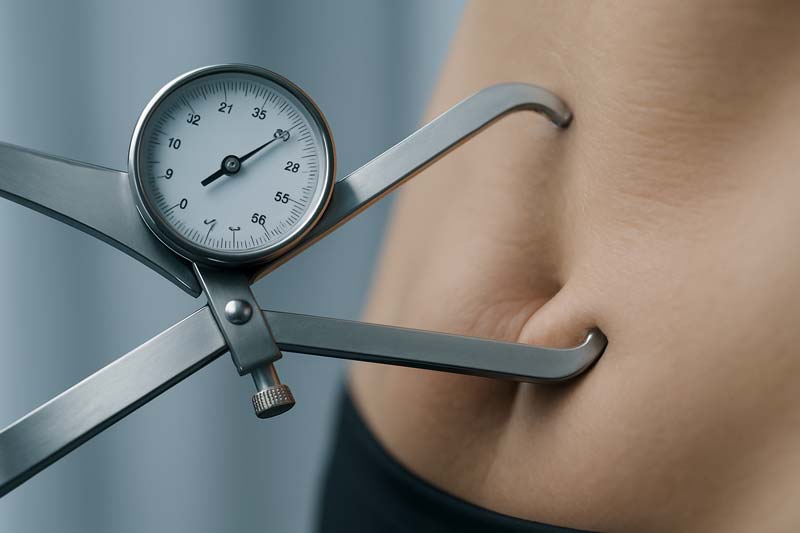
Skinfold measurement body fat testing involves using callipers (specialised pinching tools) to measure the thickness of skin and fat at specific body locations. This technique estimates overall body fat percentage by calculating how much fat sits just beneath your skin across multiple measurement sites.
The testing sounds precise, but the reality is messier than most people realise. That 18% reading could actually mean anywhere from 14.5% to 21.5% when you factor in the ±3.5% standard error of estimate. This isn’t measurement failure; it’s the honest truth about a technique that millions use to track their health.
The method estimates body composition by measuring subcutaneous fat (fat just beneath the skin) thickness at specific anatomical sites. Research shows approximately one-third of total body fat sits just beneath your skin, making these measurements valuable indicators of overall fat distribution. However, the remaining two-thirds exist as visceral fat (fat surrounding organs) and intramuscular fat (fat between muscle fibres), areas that skinfolds cannot assess.
Skinfold measurement body fat correlates well with gold-standard methods like hydrostatic weighing (underwater weighing), showing correlations between 0.70-0.93 in controlled laboratory conditions. These numbers look impressive on paper, but real-world application tells a different story.
Why The Numbers Dance Around
Professional-grade callipers maintain a constant pressure of 10 grams per square millimetre. Budget alternatives apply inconsistent pressure, leading to measurement errors exceeding 8%. The difference between a £20 calliper and a £200 established professional model isn’t just price; it’s data reliability.
Skinfold measurement body fat accuracy depends heavily on the technician’s skill, which creates the biggest variable. Experienced operators achieve measurement errors around ±3.5%, whilst inexperienced technicians may exceed ±8% error rates. Proper anatomical landmark identification requires extensive training. The chest measurement alone differs significantly between men and women: men measure halfway between the anterior axillary line (front of armpit) and nipple, while women measure one-third of this distance.
Environmental factors matter more than most realise:
- Room temperature affects skin thickness
- Recent exercise increases blood flow to the skin surfaces
- Hydration status changes subcutaneous tissue composition
- Time of day influences readings by several percentage points
Skinfold measurement and body fat testing become particularly challenging when these environmental factors align unfavourably.
The comparison chart below illustrates how different body composition methods perform across key practical factors:
SKINFOLD MEASUREMENT BODY FAT ACCURACY VS ALTERNATIVE METHODS
When Standard Equations Fall Apart
Population-specific limitations significantly affect the skinfold measurement body fat accuracy. The Jackson-Pollock equations, considered the gold standard, were developed primarily on Caucasian adults aged 18-61 years. Accuracy decreases substantially for:
- Very lean individuals (below 8% men, 15% women)
- People with obesity exceeding calliper capacity
- Children and adolescents due to growth patterns
- Elderly populations with altered skin properties
- Certain ethnic groups with different fat distribution patterns
African Americans typically show higher lean tissue density (>1.10 g·cm⁻³) compared to the assumed 1.100 g·cm⁻³ in standard equations. Children and older adults often show lower lean tissue density (<1.10 g·cm⁻³), creating systematic errors if population-specific equations aren’t used.
Age-related skin changes complicate measurements in older adults. Decreased skin elasticity makes consistent fold grasping difficult. Additionally, subcutaneous fat distribution shifts with age, potentially reducing the accuracy of equations developed on younger populations.
Professional skinfold measurement body fat assessment requires recognition of these population-specific limitations to provide meaningful results.
The Real-World Reality Check
Single measurements provide limited value due to inherent variability. The most appropriate application involves tracking changes over time using identical conditions, technicians, and equipment. Skinfold measurement body fat monitoring requires monthly assessments to identify meaningful trends whilst avoiding over-interpretation of normal variation.
Quality control measures include:
- Taking 2-3 measurements at each site
- Ensuring readings within 2mm agreement
- Rotating through sites rather than sequential sampling
- Averaging measurements for final calculations
Measurement error considerations become crucial for interpretation. A person with a 25% skinfold measurement body fat could actually possess between 21.5% and 28.5% when considering the 95% confidence interval (±2 standard errors). This range spans multiple health categories.
The body fat classification chart below shows how these measurement ranges translate into health and fitness categories:
SKINFOLD MEASUREMENT BODY FAT CLASSIFICATION BY AGE AND GENDER
MEN – Body Fat Percentage Ranges (%)
WOMEN – Body Fat Percentage Ranges (%)
Beyond The Standard Seven Sites
Most skinfold measurement body fat protocols use either three-site or seven-site measurements. The seven-site approach (chest, midaxillary, triceps, subscapular, abdomen, suprailiac, thigh) provides the most comprehensive assessment of subcutaneous fat distribution across the body.
This method accounts for individual variations in fat storage patterns and typically yields more accurate results than shorter protocols. The seven-site protocol follows Jackson and Pollock’s original research methodology, measuring:
- Chest and midaxillary sites for upper body assessment
- Triceps and subscapular for the arm and back regions
- Abdomen and suprailiac for midsection evaluation
- Thigh measurement for lower body representation
Three-site protocols offer practical alternatives:
- Men: chest, abdomen, thigh
- Women: triceps, suprailiac, thigh
Site-specific considerations matter enormously. The abdominal measurement alone can vary between vertical and horizontal fold orientations depending on the original equation development. Mismatching fold orientation with equation requirements creates systematic error.
Alternative Methods and Skinfold Measurement Body Fat: The Trade-Offs
Bioelectrical Impedance Analysis (BIA), found in many home bathroom scales and handheld devices, offers convenience but variable skinfold measurement body fat accuracy. Single-frequency devices (50 kHz) estimate total body water and calculate body fat using assumptions about hydration levels. Accuracy varies considerably, with errors potentially reaching 8% under certain conditions.
Factors affecting BIA reliability include:
- Hydration status changes
- Recent food intake
- Exercise within 12 hours
- Skin temperature variations
- Electrode placement consistency
Multi-frequency BIA analysers (5-1000 kHz) allow partitioning of intracellular (inside cells) and extracellular (outside cells) fluid compartments, potentially improving accuracy. However, these devices remain expensive and primarily available in research settings.
Dual-Energy X-ray Absorptiometry (DEXA) represents the current gold standard for body composition analysis. DEXA provides detailed regional breakdowns of fat, lean tissue, and bone mass. However, cost, radiation exposure (minimal), and accessibility limit practical application for regular monitoring.

Making Sense of Your Results
Skinfold measurement body fat interpretation requires considering measurement limitations alongside health implications. Rather than obsessing over precise percentages, focus on trends and ranges.
Research-based health categories provide practical guidance:
Men:
- Essential fat: 3-5%
- Athletic: 8-22%
- Recommended (under 35 years): 8-25%
- Recommended (over 55 years): 10-25%
- Obesity threshold: 25%+
Women:
- Essential fat: 8-12%
- Athletic: 12-22%
- Recommended (under 35 years): 20-35%
- Recommended (over 55 years): 25-38%
- Obesity threshold: 35%+
These ranges account for age-related changes in optimal body fat for health maintenance.
Skinfold Measurement Body Fat Applications That Work
Consistency trumps absolute accuracy for most applications. Standardising measurement conditions eliminates variables that affect readings:
- Test at the same time of day
- Maintain consistent room temperature
- Avoid eating 4-6 hours before measurement
- Use identical calliper placement techniques
- Employ the same technician when possible
Serial skinfold measurement body fat measurements over 4-8 week periods reveal genuine body composition changes whilst minimising measurement variability effects. Rapid changes often indicate water loss or measurement error rather than actual fat reduction.
The technique works best for programme evaluation rather than precise body fat determination. Consistent procedures allow assessment of dietary and exercise intervention effectiveness over time.
When To Choose Different Methods
Skinfold measurement body fat assessment isn’t suitable for everyone. Individuals with significant obesity may require alternative methods when tissue thickness exceeds calliper capacity. Very lean individuals may lack sufficient subcutaneous fat for reliable measurements.
DEXA scanning provides superior regional analysis and accounts for bone density variations. This becomes important for athletes with high bone mass or elderly individuals with osteoporosis. However, cost and accessibility limit DEXA to clinical and research applications.
Hydrostatic weighing offers excellent accuracy but requires specialised facilities and complete water submersion. Air displacement plethysmography (BOD POD) provides similar accuracy without water immersion but remains expensive and primarily available at universities.
Skinfold Measurement Body Fat: The Bottom Line On Accuracy
Skinfold measurement body fat provides reasonable estimates when performed correctly with quality equipment. The ±3.5% error margin means treating results as ranges rather than precise values. Single measurements offer limited insight; tracking trends over months provides meaningful information about body composition changes.
The method’s strength lies in accessibility and cost-effectiveness for regular monitoring. Professional guidance ensures proper technique development for consistent long-term tracking. Recognising limitations prevents over-interpretation whilst maximising the technique’s practical value for health assessment.
Sources
- American College of Sports Medicine. ACSM’s Guidelines for Exercise Testing and Prescription. 11th ed. Philadelphia: Wolters Kluwer; 2021.
- American College of Sports Medicine. ACSM’s Guidelines for Exercise Testing and Prescription. 10th ed. Philadelphia (PA): Wolters Kluwer; 2018. 480 p.
- Clarys JP, Scafoglieri A, Provyn S, Sesboüé B, Van Roy P. Hazards of hydrodensitometry. Journal of Sports Medicine and Physical Fitness. 2011;51:95–102.
- Fosbøl MØ, Zerahn B. Contemporary methods of body composition measurement. Clinical Physiology and Functional Imaging. 2015;35(2):81–97.
- Graves JE, Kanaley JA, Garzarella L, Pollock ML. Anthropometry and body composition measurement. In: Maud PJ, Foster C, editors. Physiological Assessment of Human Fitness. 2nd ed. Champaign (IL): Human Kinetics; 2006. p. 185–225.
- Heyward VH. Practical body composition assessment for children, adults, and older adults. International Journal of Sport Nutrition. 1998;8(3):285–307.
- Hillier S, Beck L, Petropoulou A, Clegg M. A comparison of body composition measurement techniques. Journal of Human Nutrition and Diet. 2014;27(6):626–31.
- Imboden MT, Welch WA, Swartz AM, et al. Reference standards for body fat measures using GE dual energy x-ray absorptiometry in Caucasian adults. PLoS One. 2017;12(4):e0175110.
- Jackson AS, Ellis KJ, McFarlin BK, Sailors MH, Bray MS. Cross-validation of generalised body composition equations with diverse young men and women: the Training Intervention and Genetics of Exercise Response (TIGER) Study. British Journal of Nutrition. 2009;101(6):871–8.
- Jackson AS, Pollock ML. Practical assessment of body composition. Physician and Sportsmedicine. 1985;13(5):76–90.
- Jackson AS, Pollock ML. Generalised equations for predicting body density of men. British Journal of Nutrition. 1978;40:497-504.
- Lohman TG. Skinfolds and body density and their relation to body fatness: a review. Human Biology. 1981;53(2):181–225.
- Moon JR. Body composition in athletes and sports nutrition: an examination of bioimpedance analysis technique. European Journal of Clinical Nutrition. 2013;67(suppl 1):S54–9.
- Moon JR, Tobkin SE, Roberts MD, et al. Total body water estimations in healthy men and women using bioimpedance spectroscopy: a deuterium oxide comparison. Nutrition & Metabolism (London). 2008;5:7.
- Thibault R, Genton L, Pichard C. Body composition: why, when and for who? Clinical Nutrition. 2012;31:435–47.