


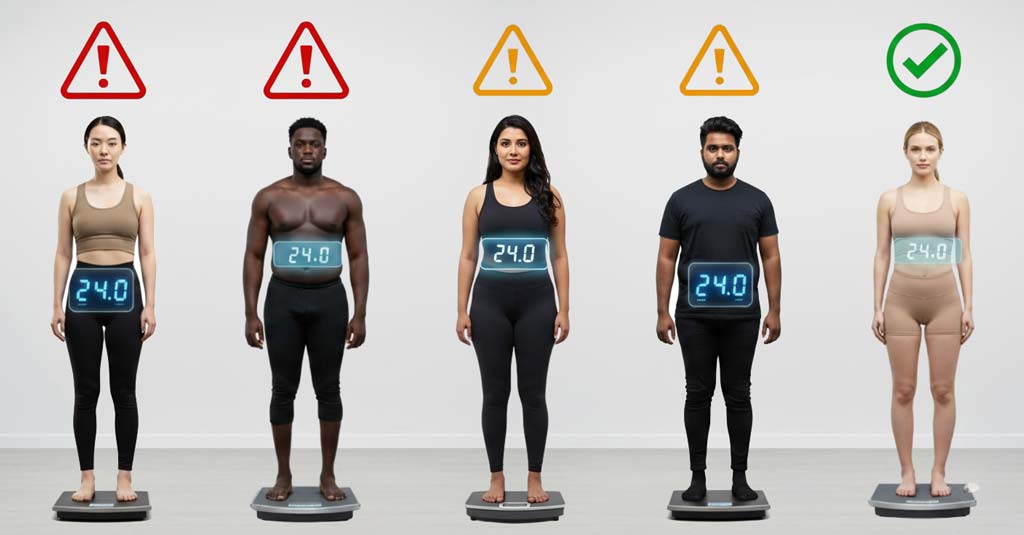
BMI and ethnicity together determine whether you’re classified as healthy or at risk. A person from Singapore sits at BMI 24 and is told they’re overweight. Their White colleague at BMI 26 receives a “normal weight” classification. Same workplace, similar lifestyles, different medical advice. This isn’t a measurement error. It reflects decades of research showing that health risks emerge at various body weights across populations.
The global standard for BMI and ethnicity classifications changed in 2004 when the World Health Organization acknowledged what epidemiologists (scientists who study disease patterns in populations) had been observing for years. Asian populations were developing type 2 diabetes and cardiovascular disease at body mass index (BMI) values considered healthy for European populations. The evidence proved too consistent to ignore.
Standard BMI thresholds place overweight at 25 kg/m² and obesity at 30 kg/m². These numbers work reasonably well for White populations. They fail catastrophically for Asian, Black African, African-Caribbean, and Middle Eastern populations. A Malaysian man at BMI 24 faces a diabetes risk equivalent to a European at BMI 28. The maths stays the same. The health implications shift dramatically.
This matters beyond academic classification systems. Insurance assessments, surgical eligibility, and preventative care recommendations all flow from BMI categories. Getting the thresholds wrong means missing disease risk in millions of people or wrongly labelling healthy individuals as at-risk. The 2004 WHO Expert Consultation established adjusted cut-points that fundamentally changed how healthcare systems assess weight-related health risks globally.
The threshold adjustments weren’t arbitrary. Research revealed profound differences in how populations store fat and respond metabolically (relating to the body’s chemical processes) to weight gain. Visceral fat (fat surrounding internal organs) accumulates differently across ethnic groups.
This fat type drives disease more powerfully than subcutaneous fat (fat beneath skin). Asian individuals typically carry more visceral fat at any given BMI compared to White individuals. Black populations show elevated metabolic risk despite similar overall fat percentages.
Knowing which thresholds apply to you changes everything. It determines when your doctor recommends intervention. It affects your actual disease risk versus your perceived risk. Most importantly, it ensures you receive appropriate health guidance based on how your body responds explicitly to weight gain.
What BMI and Ethnicity Research Revealed
Epidemiologists started noticing a pattern in the 1990s that didn’t fit existing models. Hospital records from Singapore, Hong Kong, and Mumbai showed type 2 diabetes diagnoses in patients with BMI values of 23-24 kg/m². By European standards, these individuals weren’t even overweight.
Yet they presented with the full metabolic syndrome (a cluster of conditions including high blood pressure, elevated blood sugar, and abnormal cholesterol). Something fundamental about the relationship between BMI and ethnicity wasn’t captured in standard classifications.
The observations extended beyond diabetes. Cardiovascular disease rates in Asian populations peaked at lower BMI ranges than in European populations. Stroke risk increased at BMI 23 rather than 25.
Hypertension (high blood pressure) developed more frequently in individuals classified as normal weight by existing standards. The epidemiological data proved consistent across multiple Asian countries despite different dietary patterns and physical activity levels.
Research teams began investigating body composition differences that might explain these patterns. Dual-energy X-ray absorptiometry scans revealed that Asian individuals carried higher body fat percentages at equivalent BMI values compared to White individuals.
More critically, the fat is distributed differently. Visceral adiposity (fat accumulation around internal organs) appeared disproportionately high in Asian populations even at lower total body weights.
The pathway shown above traces how scattered clinical observations became global policy. Initial epidemiological findings from Southeast Asian hospitals prompted larger population studies. These studies consistently demonstrated metabolic dysfunction (impaired chemical processes that regulate energy and metabolism) appearing at a BMI of 23-24 in Asian populations. The evidence became impossible to dismiss as regional variation or measurement error.
The World Health Organization convened an Expert Consultation in 2004 to address mounting evidence that standard BMI categories failed for significant portions of the global population.
This consultation reviewed data from multiple large-scale studies tracking health outcomes across ethnic groups. The findings proved definitive enough to establish new action points for Asian populations: overweight at a BMI of 23 kg/m² and obesity at 27.5 kg/m².
Subsequent research extended these findings beyond Asian populations. Studies examining Black African and African-Caribbean populations revealed elevated diabetes and hypertension risk at BMI levels previously considered healthy.
Middle Eastern populations showed similar patterns of metabolic dysfunction emerging at lower BMI values than White populations. The relationship between BMI and ethnicity proved more complex than initially suspected.
The research fundamentally challenged assumptions about universal BMI thresholds. Body composition varies systematically across populations due to genetic factors affecting fat distribution, lean tissue density, and metabolic responses to weight gain. These aren’t minor variations requiring footnotes. They represent substantial differences affecting millions of people’s health assessments.
Which Populations Need Different BMI Thresholds
The adjusted BMI thresholds apply to specific populations where research has demonstrated health risks emerge at lower body weights. Knowing which category you fall into determines the appropriate standards for your health assessment.
Asian Populations
This encompasses individuals from Bangladeshi, Chinese, Indian, Japanese, Korean, Thai, Vietnamese, and other Asian backgrounds. Research across these diverse populations consistently shows metabolic disease developing at BMI 23 kg/m² rather than 25 kg/m².
The pattern holds regardless of whether individuals live in Asia or have emigrated to Western countries. Asian populations typically develop 30-40% more visceral fat at any given BMI compared to White populations.
Type 2 diabetes risk in Asian individuals at BMI 23 equals the risk White individuals face at BMI 28. This five-point difference represents years of potential preventative intervention lost if standard thresholds are applied. Cardiovascular disease follows similar patterns, with elevated risk appearing earlier on the BMI scale.
Black African and African-Caribbean Populations
Individuals from African, African American, Afro-Caribbean, or other Black backgrounds face elevated metabolic risk at BMI values considered healthy by standard classifications.
Research tracking mortality and disease incidence in Black populations demonstrates significantly increased diabetes and hypertension risk at BMI 23-24 kg/m². However, the relationship between BMI and ethnicity in Black populations shows some complexity.
Black individuals often have higher lean tissue density and greater muscle mass at equivalent BMI values. This means BMI potentially overestimates body fat in some Black individuals whilst simultaneously failing to capture metabolic risk in others.
Waist circumference measurements provide additional important information for this population beyond BMI alone.
Middle Eastern and North African Populations
Individuals from Arab, Iranian, Turkish, Egyptian, or other Middle Eastern and North African backgrounds require adjusted thresholds. Studies examining populations across this region demonstrate that metabolic syndrome develops at a BMI of 23-24 kg/m². Fat distribution patterns in Middle Eastern populations show elevated visceral adiposity similar to those in Asian populations.
The research on BMI and ethnicity in Middle Eastern populations remains less extensive than that in Asian populations. However, available evidence consistently supports using lower cut-points to identify health risk. Clinical practice in countries across this region has adopted adjusted thresholds based on observed disease patterns.
Mixed Heritage Populations
Individuals with mixed ethnic backgrounds that include Asian, Black, Middle Eastern, or African-Caribbean ancestry require adjusted thresholds. The genetic factors affecting body composition and metabolic responses don’t disappear with mixed heritage. Research suggests that even partial ancestry from higher-risk populations warrants using adjusted BMI categories.
Determining which thresholds to apply with mixed heritage requires considering all ancestral backgrounds. If any component includes populations requiring adjusted thresholds, the lower cut-points provide a more appropriate health risk assessment.
Who Uses Standard Thresholds
Standard BMI categories (overweight ≥25, obesity ≥30) remain appropriate for White European, North American, Australian, and similar populations. These represent the populations where BMI thresholds were validated initially against health outcomes. The standard categories also apply to individuals who prefer not to specify their ethnic background or to those in “other ethnic group” categories, where there is insufficient research to support adjusted thresholds.
The division into two main threshold sets rather than population-specific cut-points for each ethnicity reflects current evidence limitations. Research has established clear health risk patterns for the populations listed above. More granular distinctions require additional large-scale epidemiological studies tracking health outcomes.

Why BMI and Ethnicity Affect Health Risks Differently
The relationship between BMI and ethnicity reflects fundamental differences in how populations store fat and respond metabolically to weight gain. These aren’t superficial variations. They represent distinct physiological patterns affecting disease development.
Visceral adiposity drives the differential risk. This fat accumulates around internal organs rather than beneath the skin. It releases inflammatory molecules (chemical messengers that trigger inflammation) and metabolic products directly into the portal circulation, supplying the liver. This creates insulin resistance, disrupts glucose metabolism, and elevates cardiovascular risk factors more powerfully than subcutaneous fat.
Asian populations develop substantially more visceral fat at any given BMI. Studies using computed tomography (CT scanning that creates detailed cross-sectional images of the body) show that Asian individuals with a BMI of 23 kg/m² often carry visceral fat volumes equivalent to those of White individuals with a BMI of 28 kg/m².
This explains why metabolic disease emerges at lower body weights. The problematic fat type accumulates earlier despite similar total body mass.
Body composition proportions differ systematically across populations. Lean tissue density varies between ethnic groups. White populations typically show lean tissue density of 1.100 g/cm³. Asian populations often demonstrate higher density approaching 1.113 g/cm³.
Black populations frequently exceed 1.113 g/cm³. These density differences mean BMI calculations, which assume uniform tissue composition, systematically misclassify individuals from populations with higher lean tissue density.
The skeletal muscle mass relative to total body weight shows ethnic variation. Black individuals typically carry greater muscle mass at equivalent BMI values. This means BMI potentially overestimates body fat percentage in Black populations. However, this muscle mass advantage doesn’t prevent elevated metabolic risk. Black individuals still face increased diabetes and hypertension rates at lower BMI values than White populations.
Metabolic responses to weight gain vary across ethnic groups. Research examining insulin sensitivity demonstrates that Asian populations become insulin resistant at lower degrees of obesity than White populations.
The pancreatic beta cells (cells producing insulin) respond differently to the metabolic stress (strain placed on the body’s chemical processes by excess weight). These cells may exhaust earlier in Asian populations, leading to diabetes at lower BMI values.
Fat cell function differs between populations. Adipocytes (fat storage cells) from Asian individuals show altered gene expression patterns compared to those of White individuals. These cells release different profiles of adipokines (hormones produced by fat tissue). The inflammatory adipokines that promote insulin resistance appear elevated in Asian populations even at modest degrees of overweight.
Genetic factors influencing the relationship between BMI and ethnicity are being identified through genome-wide association studies. Variants affecting fat distribution have been discovered, differing in frequency across populations.
The thrifty gene hypothesis (the theory that some populations evolved to store energy more efficiently during food scarcity) suggests that some populations became more efficient at storing energy as fat during such periods.
This evolutionary advantage becomes disadvantageous in modern environments with consistent food availability. Populations with stronger genetic predisposition to efficient energy storage may develop metabolic disease at lower body weights when exposed to Western dietary patterns.
Developmental factors contribute to ethnic differences in metabolic risk. Nutritional conditions during foetal development and early childhood affect later metabolic responses.
Populations experiencing recent nutrition transitions from traditional to Western diets may show heightened metabolic vulnerability. The body’s metabolic programming developed for one nutritional environment now operates in a completely different context.
The Threshold Numbers That Change Your Risk
The difference between standard and adjusted BMI classifications creates a substantial shift in how health risk is assessed. A five-point BMI difference separates the two systems. This gap represents the distinction between receiving preventative care recommendations and being told your weight poses no concern.
The comparison shown above illustrates how dramatically classifications shift between standard and adjusted thresholds. An individual with a BMI of 24 kg/m² receives opposite messages depending on which system applies.
Under standard WHO classifications for White populations, this falls comfortably within normal weight. Under adjusted classifications for Asian, Black, Middle Eastern, and mixed heritage populations, this crosses into overweight territory requiring intervention.
Standard classifications establish overweight at 25.0 kg/m² and obesity at 30.0 kg/m². These thresholds emerged from epidemiological studies tracking disease incidence in predominantly White European and North American populations. The numbers represent points where health risks demonstrably increase across large population groups.
Adjusted classifications lower both cut-points substantially. Overweight begins at 23.0 kg/m² rather than 25.0 kg/m². Obesity threshold drops to 27.5 kg/m² from 30.0 kg/m². These represent the BMI values where metabolic disease risk increases equivalently in Asian, Black African, African-Caribbean, and Middle Eastern populations.
The underweight and normal weight categories remain consistent across both classification systems. Underweight is defined as staying below 18.5 kg/m² in the BMI scale universally. Normal weight spans 18.5-24.9 kg/m² under standard classifications but only reaches 18.5-22.9 kg/m² under adjusted thresholds. This narrower normal weight range reflects where health outcomes prove optimal in populations requiring adjusted cut-points.
Consider practical implications. A 170-cm-tall individual weighs 70 kg. This produces BMI 24.2 kg/m². Under standard thresholds, this person sits near the top of normal weight with no health concerns indicated.
Under adjusted thresholds, this same individual crosses into overweight, potentially triggering diabetes screening recommendations and lifestyle intervention discussions.
The threshold difference affects millions globally. Approximately 60% of the world’s population comes from ethnic backgrounds requiring adjusted BMI categories. Using standard thresholds for these populations systematically underestimates health risk. Disease develops whilst individuals believe their weight poses no concern.
Healthcare systems vary in the adoption of adjusted thresholds. Our online BMI calculator requests ethnic background information to apply appropriate thresholds. Other healthcare systems continue using universal cut-points, missing early disease risk in substantial portions of their patient populations.
The relationship between BMI and ethnicity shows more complexity than two simple threshold sets can fully capture. Research continues to identify additional populations that may require adjusted categories. However, current evidence strongly supports the two-tier system as substantially better than universal thresholds for all populations.
Individual variation within ethnic groups remains substantial. Not every Asian individual with a BMI of 24 faces an elevated health risk. Not every White individual at BMI 26 avoids metabolic complications. BMI provides population-level screening, not individual diagnosis. Body composition, fat distribution, and metabolic health markers provide additional essential information beyond BMI alone.
The adjusted thresholds enable earlier intervention when it matters most. Metabolic disease proves far more responsive to lifestyle modification in early stages. Catching risk at a BMI of 23 rather than waiting until a BMI of 30 provides years of potential prevention. This timing difference fundamentally changes health trajectories.

Understanding Your Personal BMI Classification
Determining which BMI thresholds apply requires an honest assessment of ethnic background. Mixed heritage, including any Asian, Black African, African-Caribbean, or Middle Eastern ancestry, warrants the use of adjusted categories. The genetic factors affecting body composition don’t disappear with partial ancestry from these populations.
Online BMI calculators vary in sophistication. Basic versions apply universal thresholds regardless of ethnicity. Better calculators request ethnic background information and adjust classifications accordingly. Our comprehensive BMI assessment tool provides ethnicity-adjusted results with detailed health risk interpretation.
BMI represents screening, not diagnosis. The calculation cannot distinguish muscle from fat. Athletes and individuals with substantial muscle mass may receive elevated BMI classifications despite low body fat percentages. This limitation affects all populations but proves particularly relevant for individuals engaging in resistance training or manual labour.
Body fat percentage provides complementary information that BMI alone cannot offer. Both BMI and body fat percentage together give a more complete insight into health status. Visceral fat accumulation matters more than total body fat for disease risk. Waist circumference measurements help assess abdominal fat distribution.
Results falling into the overweight or obese categories don’t guarantee disease. They indicate an increased statistical risk that requires additional assessment. Blood pressure, blood glucose, and lipid profiles provide metabolic health information beyond body weight. Some individuals maintain healthy metabolic function despite elevated BMI. Others develop metabolic dysfunction at normal BMI values.
The relationship between BMI and ethnicity means health conversations must account for family background. Individuals from populations requiring adjusted thresholds need earlier screening and intervention discussions. Waiting until BMI reaches standard obesity thresholds means missing years of potential prevention.
Losing 5-10% of body weight significantly improves metabolic health markers even when BMI remains elevated. This modest reduction often normalises blood pressure and glucose regulation.
The improvements occur long before reaching ideal weight ranges. Starting intervention earlier, based on appropriate ethnic-specific thresholds, maximises these benefits.
Regular monitoring proves more valuable than single measurements. BMI fluctuates with hydration, recent meals, and time of day. Tracking over 4-8 week periods reveals genuine trends whilst minimising measurement noise. Consistent protocols for timing and clothing enhance reliability when comparing measurements across time.
Healthcare providers increasingly recognise that universal BMI thresholds fail substantial portions of their patient populations. Advocating for ethnic-specific assessment ensures you receive appropriate health guidance.
If your provider uses only standard thresholds, requesting an adjusted category assessment based on your ethnic background proves entirely reasonable.
The science behind adjusted BMI categories continues evolving. Additional populations may require specific thresholds as research accumulates. Current evidence strongly supports the two-tier system as substantially better than universal cut-points for all populations.
Acting on appropriate thresholds now provides preventative health benefits regardless of future refinements to classification systems.
Sources
- Camastra S, Vitali A, Anselmino M, Gastaldelli A, Bellini R, Berta R, Severi I, Baldi S, Astiarraga B, Barbatelli G, Cinti S, Ferrannini E. Muscle and adipose tissue morphology, insulin sensitivity and beta-cell function in diabetic and nondiabetic obese patients: effects of bariatric surgery. Sci Rep. 2018 May 22;8(1):8177.
- Duren DL, Sherwood RJ, Czerwinski SA, et al. Body composition methods: comparisons and interpretation. J Diabetes Sci Technol. 2008;2(6):1139–46.
- Heymsfield SB, Peterson CM, Thomas DM, Heo M, Schuna JM Jr. Why are there race/ethnic differences in adult body mass index-adiposity relationships? A quantitative critical review. Obes Rev. 2016;17(3):262–75.
- Hsu WC, Araneta MR, Kanaya AM, Chiang JL, Fujimoto W. BMI cut points to identify at-risk Asian Americans for type 2 diabetes screening. Diabetes Care. 2015;38(1):150–8.
- Jensen MD, Ryan DH, Apovian CM, et al. 2013 AHA/ACC/TOS guideline for the management of overweight and obesity in adults: a report of the American College of Cardiology/American Heart Association Task Force on Practice Guidelines and The Obesity Society. J Am Coll Cardiol. 2014;63(25 pt B):2985–3023.
- Katzmarzyk PT, Mire E, Bray GA, Greenway FL, Heymsfield SB, Bouchard C. Anthropometric markers of obesity and mortality in White and African American adults: the Pennington Longitudinal Study. Obesity (Silver Spring). 2013;21(5):1070–5.
- Marfell-Jones M, Nevill AM, Steward AD. Anthropometric surrogates for fatness and health. In: Stewart AD, Sutton L, editors. Body Composition in Sport, Exercise and Health. London (United Kingdom): Routledge; 2012. p. 126–46.
- Misra A. Ethnic-Specific Criteria for Classification of Body Mass Index: A Perspective for Asian Indians and American Diabetes Association Position Statement. Diabetes Technol Ther. 2015 Sep;17(9):667-71.
- Shuster A, Patlas M, Pinthus JH, Mourtzakis M. The clinical importance of visceral adiposity: a critical review of methods for visceral adipose tissue analysis. Br J Radiol. 2012 Jan;85(1009):1-10.
- WHO Expert Consultation. Appropriate body-mass index for Asian populations and its implications for policy and intervention strategies. Lancet. 2004 Jan 10;363(9403):157-63.