


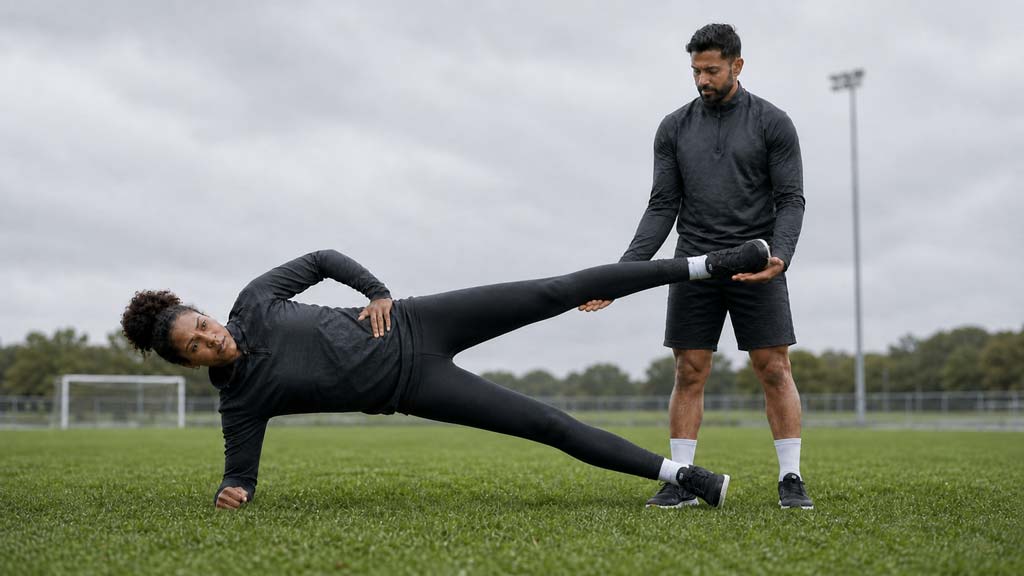
The Copenhagen plank arrived with a promise attached, and that promise has run ahead of the evidence. Meanwhile, fitness pages present it as an inner thigh builder, a core test and protection against groin injury. Yet those three claims sit on very different amounts of research.
Groin pain is common in sports that demand cutting, twisting and sudden changes of direction. It also has a habit of returning, which makes it frustrating rather than simply painful. In one study of professional footballers, adductor-related pain accounted for 61% of all groin pain. Specifically, the muscles involved run along the inner thigh and pull the leg inwards. Worse still, a previous groin injury raises risk as long as twenty months later.
What most coverage leaves out is how few options exist. A recent review of exercises for preventing groin pain called the Copenhagen adduction exercise the only widely adopted one. That is a statement about scarcity rather than quality. By comparison, hamstring prevention has a whole family of tested movements, because those muscles cross two joints. By contrast, the groin has one movement carrying most of the weight.
There is a second confusion, and it matters more than the first. The exercise is one thing. The programme built around it is another. Research on groin prevention tested a progressive plan, delivered across weeks, with volume rising in stages. So adding a hard side plank to a Tuesday workout is not the same intervention.
Most of what is known comes from football, and mostly from men. That is less a flaw in the research than a limit on it. Muscle injury prevention was studied there because that is where injuries were being counted. A smaller body of work has since tested the movement in ordinary recreational exercisers. Those results are among the most useful for anyone training outside a squad.
So the Copenhagen plank is a genuinely demanding movement with a real and measurable effect. It is also surrounded by claims ranging from well supported to never tested. Separating those two things changes how the exercise is used and how it is loaded. It also changes how much anyone should reasonably expect from it.
What is the Copenhagen plank
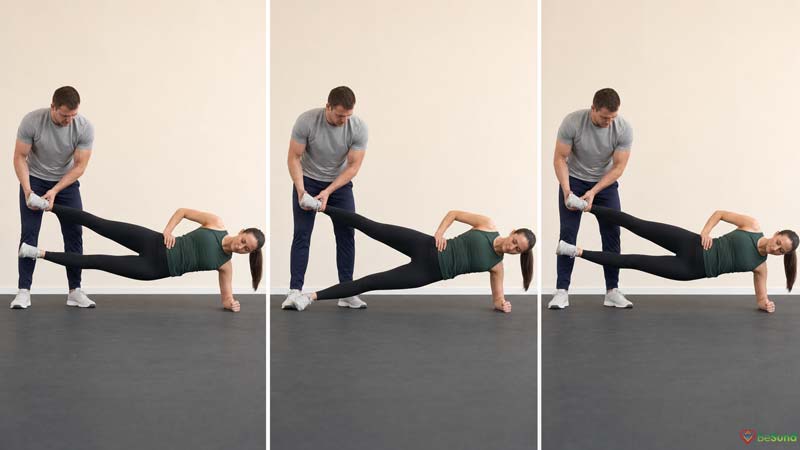
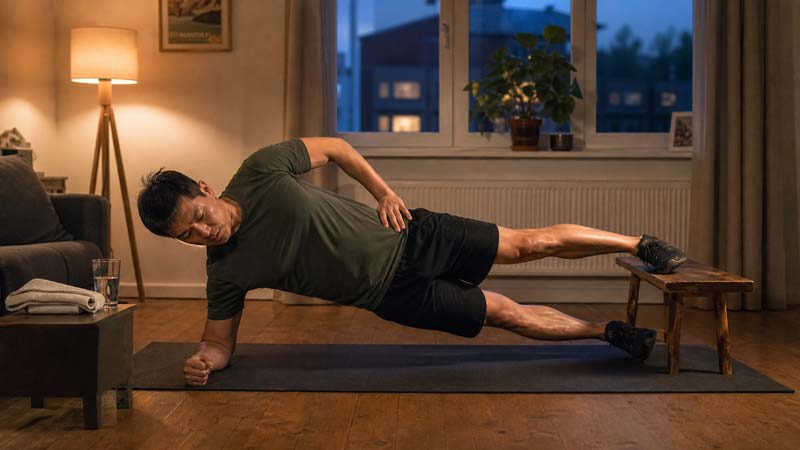
Strip the movement back, and it is a side plank with one important difference. The upper leg does not rest on the floor or hang free. Instead, a partner or a bench holds it, and the body hangs from the inner thigh of that supported leg.
Search engines know the movement as the Copenhagen plank. Research papers call it the Copenhagen adduction exercise, and knowing both names is useful. The second one opens the actual evidence for anyone who wants to check it.
The mechanics are simple enough to picture. The supporting elbow acts as a fulcrum, and the supported leg acts as the lever. Where that leg is held decides how long the lever becomes. Support near the knee gives a short lever, while support at the ankle gives a long one. Moving the hold further down the leg therefore increases the turning force at the hip.
No weights are involved, no machine and no gym membership. That has made it attractive to teams, since it can be run in pairs almost anywhere. Two people work through it together, one holding while the other lifts. The same feature makes it awkward for anyone training alone.
Loading style matters as much as position. Lowering the body under control is where the inner thigh does its hardest work. That pattern is called eccentric work, meaning the muscle produces force while it lengthens. It mirrors what the Nordic hamstring exercise asks of the hamstrings, although that movement has been studied far more.
One further development is worth knowing. The same movement has recently been repurposed as a test rather than a training tool. Researchers now use it to measure eccentric adductor capacity, so it both builds strength and gauges it.
The Copenhagen plank is not one fixed thing. It exists in several forms, differing in how the leg is held and how effort is applied. Those differences change the demand enough to be worth treating separately.
Static Holds: the body is lifted and then simply held in place. The longest lever sits in that raised position, with the supported leg roughly parallel to the ground. Teams often use an isometric version as a lighter entry point, since holding still is easier to control than lowering. A weighted isometric variation has also been built, so force output can be compared across different adductor exercises.
Dynamic Repetitions: This is the original form and the one most studies used. The body rises until it forms a straight line, and the lower leg comes up to meet it. Then everything lowers again under control. Repeating that cycle exposes the muscle to the lengthening phase again and again. That repeated exposure is where the training effect is thought to come from.
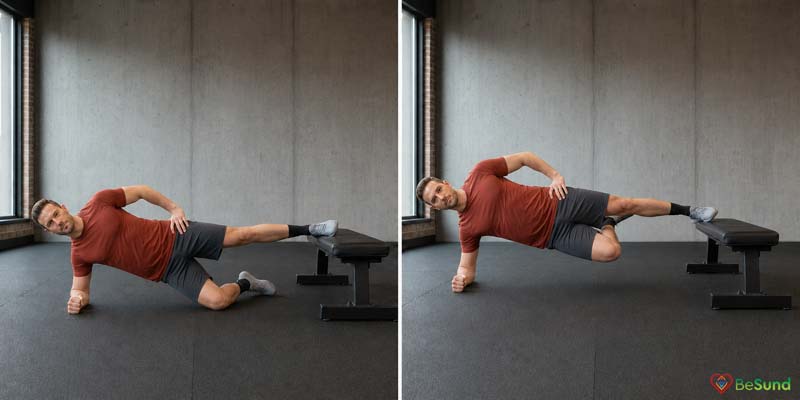
Partner or Bench Versions: who or what holds the leg decides who can do the movement at all. The original needs a training partner supporting both the ankle and the knee. A bench version instead places the working leg on a bench around forty-five centimetres high. That single substitution turns a team exercise into something a person can do alone at home.
How to do the Copenhagen plank
Good technique here is less about effort and more about geometry. The body has to form one line, and that line has to hold while the hip works. Almost everything that goes wrong is a version of that line breaking.
Start with the supporting arm, because it decides everything above it. The elbow sits directly beneath the shoulder, neither drifting forward nor trailing behind. From there, the instruction is a single straight line through shoulder, hip, knee and ankle. That line has to hold when viewed from the front and from the side.
The order of the lift matters too, because the movement starts at the hip. It is not heaved upwards from the shoulder. Taken step by step, the sequence runs like this.
- Lie on your side with the forearm on the floor and the elbow underneath the shoulder.
- Have the upper leg supported at hip height, held at the knee, mid shin, or ankle.
- Lift the body by driving the supported hip down and inwards, until the line is straight.
- Bring the lower leg up until the ankles touch, which completes the repetition.
- Lower under control until the lower foot brushes the floor without taking any weight.
- Repeat on the other side, because both hips need the work.
Support position is the load dial, and it is the single most useful thing to understand about the Copenhagen plank. Because the elbow acts as a fulcrum, moving the held leg further out lengthens the lever. The change is substantial. Holding at the ankle asks roughly two-thirds more of the inner thigh than holding at the knee. Progress is not linear though, since a longer lever also means less force passing through the leg.
the two
Speed is the next control. A single repetition takes around three seconds from the floor to the finish. Protocols commonly use three seconds down and three seconds up. Some set that tempo with a metronome rather than leaving it to feel. Either way, the aim is a deliberate lowering rather than a dropped and swung leg.
Most faults in the Copenhagen plank are attempts to make the movement easier without admitting it. Hips sag lower with each repetition as fatigue arrives, quietly shortening the range.
One practical fix uses an elastic band set at hip height as a target to touch. Every repetition then finishes in the same place. Swinging the lower leg is the other common cheat, because momentum does work the muscle should be doing. Returning fully to the start position each time removes both problems.
Volume is where confidence should drop. Tempo and repetition length are described consistently across studies. How many sets and how often vary considerably from one protocol to the next. One rule does travel well, however. Players are instructed to stop if pain during the movement passes three out of ten.
Which muscles does it train
Ask which muscles this movement trains and the honest answer arrives in layers. Some of those layers have been measured. Others are inferred. One is simply assumed. Treating them as equal is how the claims around the Copenhagen plank became inflated.
There is a further trap worth naming first. Muscle activity is usually recorded by surface electromyography, meaning electrodes on the skin that pick up electrical signals. A high signal shows a muscle working hard. However, it does not show that performance improved or that an injury was avoided.
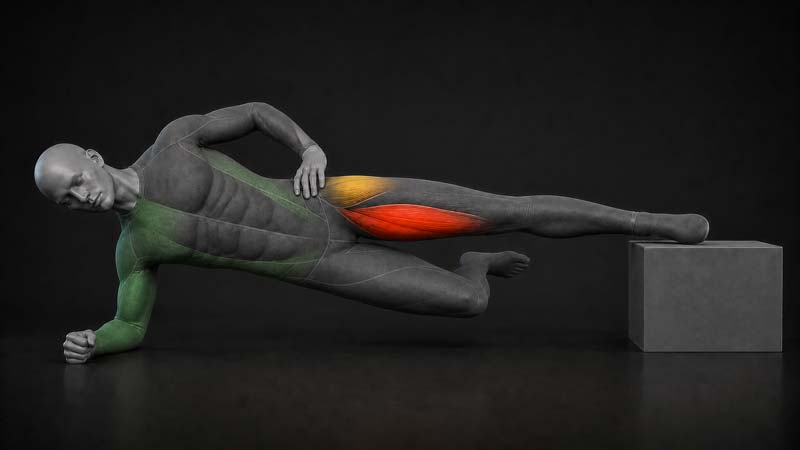
The Hip Adductors
These are the inner thigh muscles, and they are the target. During the movement, the adductor longus produces a signal of around 108% of its reference value. A figure above 100% is possible because the reference is a still, held contraction rather than a moving one. Anything above 40% is treated as enough to build strength, so this clears the bar comfortably.
In fact, five separate muscles are classified as hip adductors. Electrodes reach only part of one of them, so the picture is narrower than it appears. That matters more than it sounds. The largest of the five, the adductor magnus, has recently been argued to act mainly as a hip extensor.
The Hip Abductors
These sit on the outside of the hip and are trained as a documented side effect. They work at around 48% of maximum while the position is being held. Since that figure sits above the strengthening threshold, the Copenhagen plank also builds the opposing muscles. Trials measuring both have found the balance between the two groups improving, not just one side of it.
The Trunk and Pelvis
From here, the evidence changes character. The trunk clearly has to resist rotation and sag, since nothing else is holding the body up. Stabilising demands are thought to rise during eccentric loading through a full range of movement.
One proposal is that the adductors and the abdominal obliques learn to work together more effectively. Its authors describe that idea as speculative and awaiting further investigation. The trunk muscle recordings often quoted in this context come from the Nordic hamstring exercise instead.
The Shoulder
The shoulder holds the body clear of the floor for every second of every repetition. It appears in the research only as a set-up instruction, telling people where to place the elbow. Yet nobody has measured it as an outcome of doing the exercise. That is worth stating plainly rather than dressing the position up as shoulder training.
What does the research show
The research base is considerably smaller than the exercise’s popularity suggests. To begin with, a systematic search across nine databases returned 8,880 titles. Of those, fifty-three went to full review. In the end, five met the criteria. Notably, all five studied male footballers.
Within that narrow band, however, the strength finding is remarkably consistent. Every study that measured eccentric adductor strength found it had increased. Those measuring the abductors, and the balance between the two muscle groups, found the same. However, the size of the gain is where results scatter.
Reported increases run from single figures to almost half again, and that spread is not noise. Different protocols produced different results, which is a useful warning against treating any one number as the answer.
| Reported Gain in Eccentric Adductor Strength | How the Exercise Was Delivered | Who Was Trained |
|---|---|---|
| 8.9% | Substituted into an existing warm-up, three times a week | Male footballers, over eight weeks |
| 24% and 25% | Progressive six-level programme, run before training, twice a week | Senior professional squad, over eight weeks |
| 35.7% | Added on top of usual training, twice a week | Under-19 footballers, over eight weeks |
| 45.8% | Field-based resistance protocol, twice a week | Young elite players, over eight weeks |
A 15% change is generally treated as the smallest gain worth calling clinically meaningful. Even so, three of those four results clear it without difficulty.
More relevant for most readers is what happens outside sport entirely. Forty-five recreational exercisers, none with previous eccentric training experience, followed an eight-week programme. Adductor thickness rose by around 18%, and hip range of movement by around 7%. Then came the part usually left out. Four weeks without the exercise returned both measures to where they had started.
A separate trial looked at something other than strength. Two hundred male athletes from a range of sports were split into four groups. Dynamic balance improved most in those doing both this movement and the Nordic hamstring exercise.
The control group improved as well, which the authors attributed partly to a learning effect on re-test. Laboratory balance testing also keeps the athlete stationary and on both feet, which is not how sport works.
Rehabilitation is a separate question from prevention, and the evidence there is older and firmer. Active physical training was shown to treat long-standing adductor-related groin pain in a randomised trial. So that supports strengthening for people already in recovery, under guidance. It does not make the Copenhagen plank a self-treatment for anyone with a sore groin. Meanwhile, no studies could be found on treating acute adductor injuries at all.
One more piece of the record needs stating openly. A 2025 systematic review with meta-analysis of this exercise has been retracted. Therefore, its pooled conclusions cannot be used as evidence in either direction. That includes its finding that the exercise strengthens the adductors without preventing injuries. Removing it leaves no gap, because the primary studies it drew on are still standing.
Among the reviews still standing, one mapped every randomised trial of groin pain prevention since 1983. Nineteen trials qualified from 502 records, with methodological quality rated moderate. The Copenhagen plank appeared in thirteen of them. Of those, eight measured muscle strength. Yet only one reported a reduction in the number of injuries.
Can the Copenhagen plank prevent groin injuries
Weak adductors predict groin trouble, and that much is settled. Previous injury and reduced hip adductor strength are the two risk factors that survive review. Strength also tracks risk on a sliding scale rather than as a simple threshold.
One prospective study put the increase in risk at around fourfold for players with weaker adduction. Across a full season, each additional unit of squeeze strength was linked to 35% lower groin injury risk.
From there, the reasoning looks obvious. Strengthen the weak thing and the injuries should fall. Association is not causation though, and the Copenhagen plank is exactly where that distinction starts to bite.
The strongest positive result came from a cluster-randomised trial across thirty-five semi-professional football teams. One group ran a progressive adductor strengthening programme through pre-season. The other trained as normal. Average weekly prevalence of groin problems fell from 21.3% to 13.5%, giving a 41% lower risk.
That figure deserves reading carefully. It was collected using a questionnaire built to capture all problems, not only injuries causing absence. So it includes everything from muscle soreness upwards. In the same trial, substantial groin problems fell by 18%, and that difference was not statistically significant.
A second trial, in male high school players, found larger effects. Relative risk of groin pain was 0.42 for the exercise performed alone. Pairing it with the Nordic hamstring exercise brought that figure down to 0.19. In absolute terms, four players developed groin pain in the combined group against eighteen in the control teams. Days lost also differed, averaging 5.5 in one intervention group against 14.4 in control teams.
Pooled analyses tell a flatter story about the Copenhagen plank. Specific adductor strength training produced a risk ratio of 0.80 across 1,067 players. The confidence interval crossed one, so the result was not significant, and the evidence was graded low quality. Mixed groin prevention programmes performed no better.
Underneath all of this sits a problem of definition. Three different things are being counted, and they are not interchangeable. A risk factor is a measurement taken before anything has happened. A self-reported groin problem is whatever a player ticks on a questionnaire that week.
A diagnosed time-loss injury is a clinical finding that stops someone playing. No randomised trial of groin prevention has reported specifically on acute adductor strain injuries. Every prevention finding therefore sits one step away from the injury these exercises were designed to stop.
Transfer beyond the tested population is the final problem, and it is a genuine one. Efficacy has been demonstrated in male players. A recent randomised trial including female players found no effect from the intervention. Runners, general gym users and athletes in most other sports have not been tested at all. The dose needed to reduce injury also remains unknown, which makes any confident prescription premature.
How to progress it safely
Progression here is earned rather than scheduled. A six-level version was designed for professional footballers with one aim: building strength without generating soreness. Level one is an assisted isometric hold, meaning a still position held against resistance. Level six is the full movement. Players moved up only once a supervising clinician was satisfied with the level below.
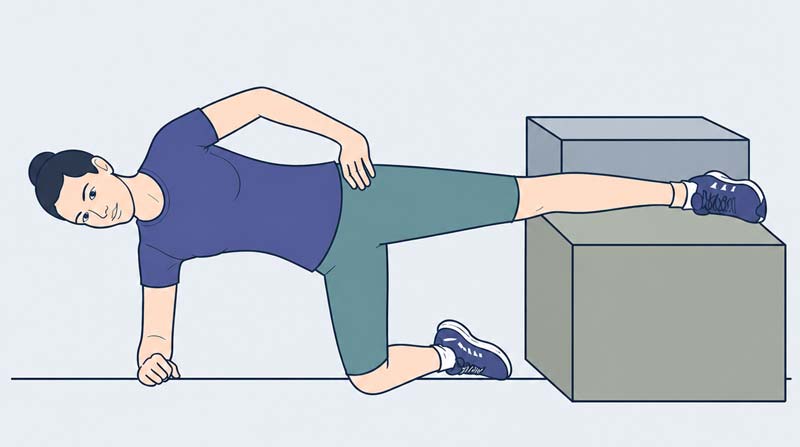
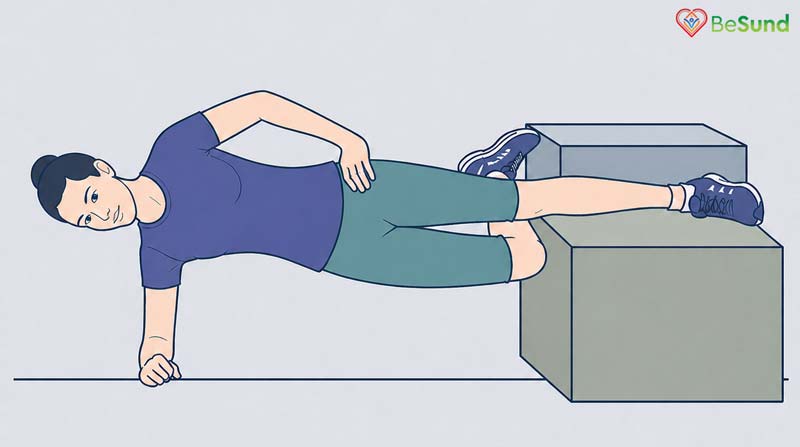
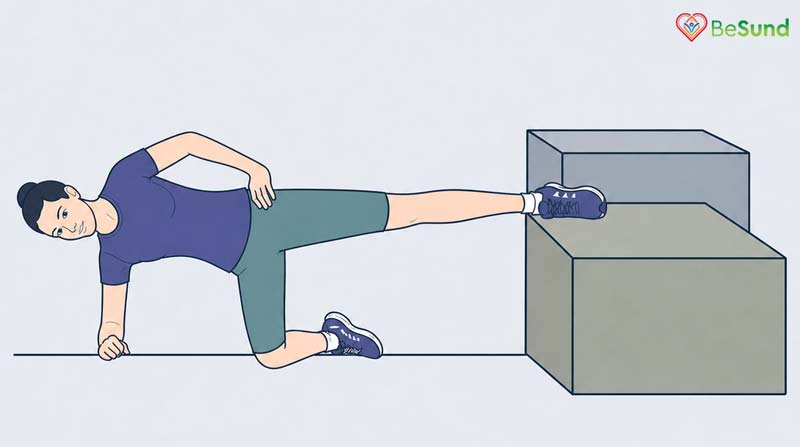
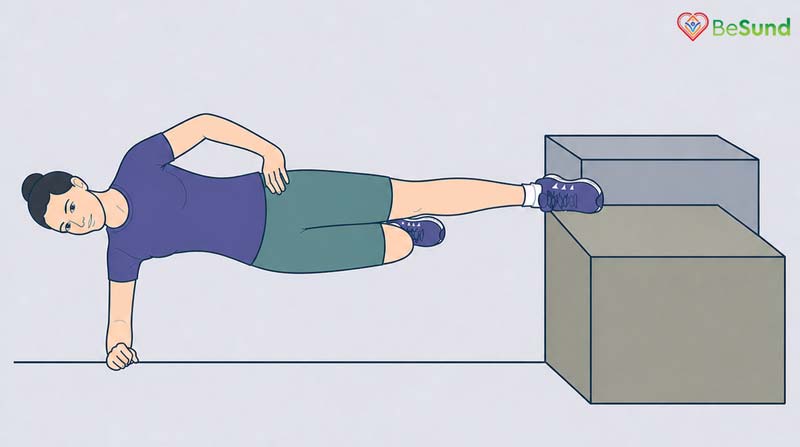
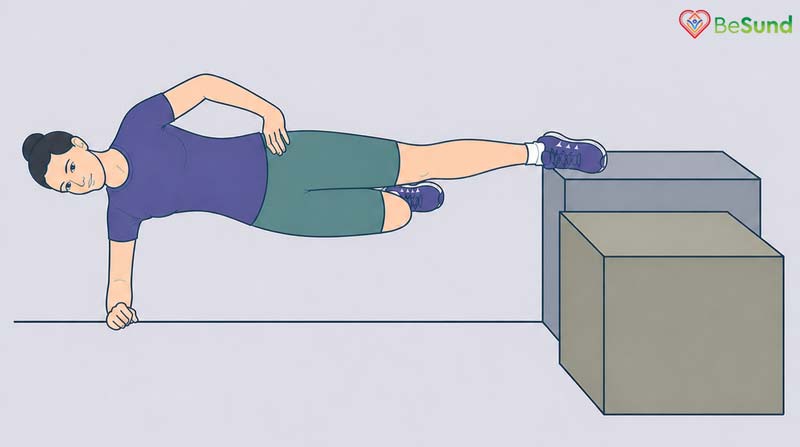
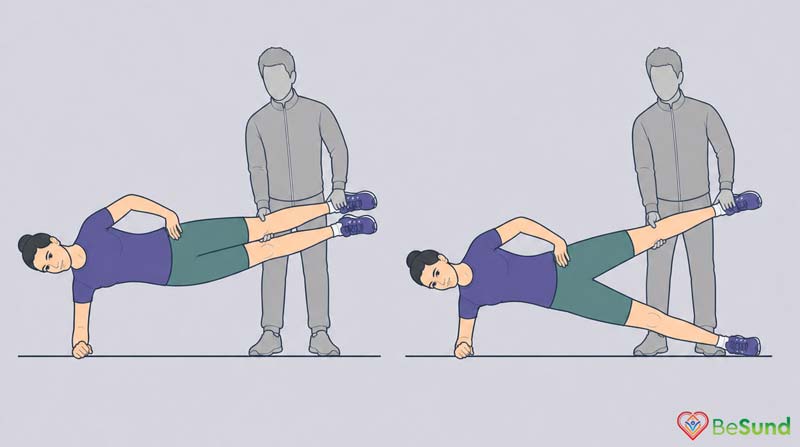
Three dials control the difficulty of the Copenhagen plank, and they should not all be turned at once. Support position is the first, moving from knee towards ankle as capacity grows.
Effort type is the second, shifting from held positions to controlled repetitions. Volume is the third, and it builds gradually rather than jumping. One programme rose from two sets of six repetitions to two sets of twelve across eight weeks.
Knowing when not to progress matters more than knowing when to. The published programmes share a set of stopping rules, and each has a reason sitting behind it. They are worth following even on days when the session feels manageable.
- Next-Day Soreness above Five out of Ten: repeat the level rather than advancing. Loading a sore muscle increases the soreness further and eats into the training days that follow.
- A Dropped Lowering: the descent is the point of the exercise. If it becomes a fall rather than a controlled lower, the level is currently too hard.
- A Broken Hold: needing a rest partway through means the position has beaten you. Two professional footballers repeated the fifth of six levels for this reason, then cleared it the following week.
- Pain above Three out of Ten during the Movement: stop the set.
- Any Knee Pain or Discomfort: end the session. Support below the knee reverses the direction of loading at that joint. It is the one place the position asks something unusual of the body.
- Groin Pain on a Squeeze Test: anything above four out of ten means the programme waits until that settles.
Placement in the week matters as much as the programme itself. Adductor strength can be reduced for up to 72 hours after a hard match. Stacking demanding adductor work onto an already fatigued muscle is how progress stalls. Where overall training load is already high, a rest period can be more useful than another block.
Repetition alone eventually stops working, which surprises people. A second identical training block, run after a four-week break, produced no further strength gain. Adding a new stimulus is the suggested route out of that plateau. In practice that means more volume, external load, or a slower lowering phase against a quicker lift.
Detraining behaves oddly here, and in a way that is quietly encouraging. Adductor strength held across four weeks with no programme and no sport at all. Hamstring strength, measured over the same four weeks, fell back to where it started. Muscle thickness and flexibility do fade though, so structural gains need an ongoing dose.
Almost nobody runs these Copenhagen plank programmes exactly as written. Around two thirds of football teams use a modified version, most often to manage overall player load. Standing hip adduction with a cable or band is the most common substitution. Whether those modifications preserve the benefit is simply unknown. No single exercise was ever an injury prevention programme on its own. Instead, it sits inside wider work on load management and general strength.
Two situations sit outside anything this evidence can guide. The trials excluded people with a previous groin strain, so anyone currently carrying symptoms falls outside the tested population. For them, assessment of isometric and eccentric strength, and of side-to-side symmetry, is what specialists actually use.
Expert panels rank the athlete’s own feedback above every other criterion for returning to sport. The second situation involves the shoulder. If it gives out before the inner thigh does, the research has nothing to say about that. The position was never studied from the shoulder’s point of view.
The Copenhagen plank is a strong exercise carrying an uneven reputation. What it does to the inner thigh is well documented, and unusually large for a movement needing no equipment. What it does to injury risk, however, is a smaller and messier claim. It rests on one population, one style of programme, and an outcome that was never measured directly.
Those two things travel together in almost all coverage, although separating them costs nothing. So the exercise still earns its place for anyone wanting stronger adductors and willing to progress slowly. It simply carries less certainty than its popularity suggests. The gap between what it builds and what it prevents is the honest part of the picture.
Sources
- Alonso-Fernández D., Fernández-Rodríguez R., Taboada-Iglesias Y., Gutiérrez-Sánchez Á. Effects of Copenhagen adduction exercise on muscle architecture and adductor flexibility. International Journal of Environmental Research and Public Health. 2022 May 27;19(11):6563.
- Bourne MN, Williams MD, Opar DA, Al Najjar A, Kerr GK, Shield AJ. Impact of exercise selection on hamstring muscle activation. British Journal of Sports Medicine. 2017;51:1021–1028.
- Clarsen B, Myklebust G, Bahr R. Development and validation of a new method for the registration of overuse injuries in sports injury epidemiology: the Oslo Sports Trauma Research Centre (OSTRC) overuse injury questionnaire. British Journal of Sports Medicine. 2013;47:495–502.
- Dæhlin TE, Dmytriieva D, Rutherford E, Chiu LZF. Three-dimensional hip and knee loading during the Copenhagen adductor exercise. Journal of Biomechanics. 2026 Jan;195:113116.
- Dæhlin TE, Dmytriieva D, Rutherford E, Chiu LZF. Three-dimensional hip and knee loading during the Copenhagen adductor exercise. Journal of Biomechanics. 2026 Jan;195:113116.
- DeLang M.D., Ishøi L., Hole M.N., Wilson P., Segbefia M., Thorborg K. Implementing the Copenhagen adductor exercise and Nordic hamstring exercise in West African academy soccer players: an intervention study. International Journal of Sports Physical Therapy. 2024 Oct 2;19(10):1188–1196.
- Dalen-Lorentsen T, O’Brien J, Harøy J. Real-world implementation of the Copenhagen Adduction Exercise: what do football teams modify and why? BMJ Open Sport & Exercise Medicine. 2024 Aug 22;10(3):e001982.
- Engebretsen AH, Myklebust G, Holme I, et al. Intrinsic risk factors for groin injuries among male soccer players: a prospective cohort study. American Journal of Sports Medicine. 2010;38:2051–2057.
- Esteve E., Casals M., Saez M., et al. Past-season, pre-season and in-season risk assessment of groin problems in male football players: a prospective full-season study. British Journal of Sports Medicine. 2022;56(9):484–489.
- Esteve E, Rathleff MS, Bagur-Calafat C, et al. Prevention of groin injuries in sports: a systematic review with meta-analysis of randomised controlled trials. British Journal of Sports Medicine. 2015;49:785–791.
- Estévez Rodríguez J.L., Rivilla García J., Jiménez-Sáiz S.L., Jiménez-Rubio S. Consensus of return-to-play criteria after adductor longus injury in professional soccer. Sports (Basel). 2025 Apr 27;13(5):134.
- Freckleton G., Pizzari T. Risk factors for hamstring muscle strain injury in sport: a systematic review and meta-analysis. British Journal of Sports Medicine. 2013;47:351–358.
- Fujisaki K, Akasaka K, Otsudo T, Hattori H, Hasebe Y, Hall T. Effects of a groin pain prevention program in male high school soccer players: a cluster-randomized controlled trial. International Journal of Sports Physical Therapy. 2022 Aug 1;17(5):841–850.
- Harøy Joar, Clarsen Benjamin, Wiger Espen Guldahl, Øyen Mari Glomnes, Serner Andreas, Thorborg Kristian, Hölmich Per, Andersen Thor Einar, Bahr Roald. The Adductor Strengthening Programme prevents groin problems among male football players: a cluster-randomised controlled trial. British Journal of Sports Medicine. 2018 Jun 10;53(3):150–157.
- Harøy J, Thorborg K, Serner A, et al. Including the Copenhagen adduction exercise in the FIFA 11+ provides missing eccentric hip adduction strength effect in male soccer players: a randomized controlled trial. American Journal of Sports Medicine. 2017;45:3052–3059.
- Hickey J.T., Lennon C., Gillick M., Sweeney L. Measuring eccentric hip adductor strength during the Copenhagen adduction exercise: a proof-of-concept and test re-test reliability study. Physical Therapy in Sport. 2025;73:34–38.
- Hölmich Per, Thorborg Kristian, Dehlendorff Christian, Krogsgaard Kim, Gluud Christian. Incidence and clinical presentation of groin injuries in sub-elite male soccer. British Journal of Sports Medicine. 2013 Aug 16;48(16):1245–1250.
- Hölmich Per, Uhrskou Pernille, Ulnits Lisbeth, Kanstrup Inge-Lis, Nielsen Michael Bachmann, Bjerg Anders Munch, Krogsgaard Kim. Effectiveness of active physical training as treatment for long-standing adductor-related groin pain in athletes: randomised trial. The Lancet. 1999 Feb;353(9151):439–443.
- Ishøi L, Krommes K, Husted RS, Juhl CB, Thorborg K. Diagnosis, prevention and treatment of common lower extremity muscle injuries in sport – grading the evidence: a statement paper commissioned by the Danish Society of Sports Physical Therapy (DSSF). British Journal of Sports Medicine. 2020 Jan 14;54(9):528–537.
- Ishøi L., Sørensen C.N., Kaae N.M., Jørgensen L.B., Hölmich P., Serner A. Large eccentric strength increase using the Copenhagen adduction exercise in football: a randomized controlled trial. Scandinavian Journal of Medicine & Science in Sports. 2015;26:1334–1342.
- Ishøi Lasse, Thorborg Kristian. Copenhagen adduction exercise can increase eccentric strength and mitigate the risk of groin problems: but how much is enough! British Journal of Sports Medicine. 2021.
- Khaitin V., Bezuglov E., Lazarev A., et al. Markers of muscle damage and strength performance in professional football (soccer) players during the competitive period. Annals of Translational Medicine. 2021;9(2):113.
- Kohavi B, Beato M, Laver L, et al. Effectiveness of field-based resistance training protocols on hip muscle strength among young elite football players. Clinical Journal of Sport Medicine. 2018.
- Marušič J, Cvjetičanin O, Šarabon N. Joint torque and electromyographic activity during eccentric exercise for hip adductors at different hip flexion angles. PLoS One. 2025 Nov 12;20(11):e0336699.
- Miralles-Iborra A., Urban T., De Los Ríos-Calonge J., Elvira J.L.L., Del Coso J., Tomás-Rodríguez M.I., Juan-Recio C., Moreno-Pérez V. Dynamic field assessment of hip adductor function using a smartphone-based Copenhagen test: reliability and concurrent associations with isometric strength in amateur football players. Sports (Basel). 2026 Mar 24;14(4):125.
- Mosler Andrea B, Weir Adam, Eirale Cristiano, Farooq Abdulaziz, Thorborg Kristian, Whiteley Rod J, Hölmich Per, Crossley Kay M. Epidemiology of time loss groin injuries in a men’s professional football league: a 2-year prospective study of 17 clubs and 606 players. British Journal of Sports Medicine. 2018;52(5):292–297.
- Narouei S, Imai A, Akuzawa H, Hasebe K, Kaneoka K. Hip and trunk muscles activity during Nordic hamstring exercise. Journal of Exercise Rehabilitation. 2018;14:231–238.
- O’Connor C, Coyle E, Mc Intyre M, Delahunt E, Thorborg K. A comparison of force generation in isometric hip adductor strength exercises: introducing the weighted isometric Copenhagen Adduction exercise. Physical Therapy in Sport. 2025;72:46–52.
- Polglass G, Burrows A, Willett M. Impact of a modified progressive Copenhagen adduction exercise programme on hip adduction strength and postexercise muscle soreness in professional footballers. BMJ Open Sport & Exercise Medicine. 2019 Oct 15;5(1):e000570.
- Quintana-Cepedal M, de la Calle O, Diez-Solorzano P, Sanchez-Martinez B, Crespo I, Olmedillas H. The Copenhagen Adduction Exercise effect on sport performance and injury prevention: a systematic review with meta-analysis. Scandinavian Journal of Medicine & Science in Sports. 2025;35:0. [Retracted]
- Reiman Michael P., Bolgla Lori A., Loudon Janice K. A literature review of studies evaluating gluteus maximus and gluteus medius activation during rehabilitation exercises. Physiotherapy Theory and Practice. 2011;28(4):257–268.
- Saito H, Hakariya N, Ebato T, Hirose N. A scoping review of exercises for preventing athletic groin pain. Cureus. 2025 Dec 22;17(12):e99883.
- Saleh A Al Attar W, Faude O, Husain MA, Soomro N, Sanders RH. Combining the Copenhagen adduction exercise and Nordic hamstring exercise improves dynamic balance among male athletes: a randomized controlled trial. Sports Health. 2021 Nov-Dec;13(6):580–587.
- Schaber M., Guiser Z., Brauer L., Jackson R., Banyasz J., Miletti R., Hassen-Miller A. The neuromuscular effects of the Copenhagen adductor exercise: a systematic review. International Journal of Sports Physical Therapy. 2021 Oct 1;16(5):1210–1221.
- Serner A, Jakobsen MD, Andersen LL, Hölmich P, Sundstrup E, Thorborg K. EMG evaluation of hip adduction exercises for soccer players: implications for exercise selection in prevention and treatment of groin injuries. British Journal of Sports Medicine. 2014;48:1108–1114.
- Serner A, Mosler AB, Tol JL, Bahr R, Weir A. Mechanisms of acute adductor longus injuries in male football players: a systematic visual video analysis. British Journal of Sports Medicine. 2019;53:158–164.
- Takahashi K, Tozawa H, Kawama R, Wakahara T. Redefining muscular action: human “adductor” magnus is designed to act primarily for hip “extension” rather than adduction in living young individuals. Journal of Applied Physiology. 2025;138:1088–1099.
- Thorborg K, Branci S, Nielsen M P, Langelund M T, Hölmich P. Copenhagen five-second squeeze: a valid indicator of sports-related hip and groin function. British Journal of Sports Medicine. 2017;51(7):594–599.
- Whittaker JL, Small C, Maffey L, Emery CA. Risk factors for groin injury in sport: an updated systematic review. British Journal of Sports Medicine. 2015;49(12):803–809.