



What meditation does to your brain might be the most misunderstood topic in well-being. Millions of people sit down each day, close their eyes, and assume they are calming their minds. The feeling afterwards often confirms this. A sense of stillness.
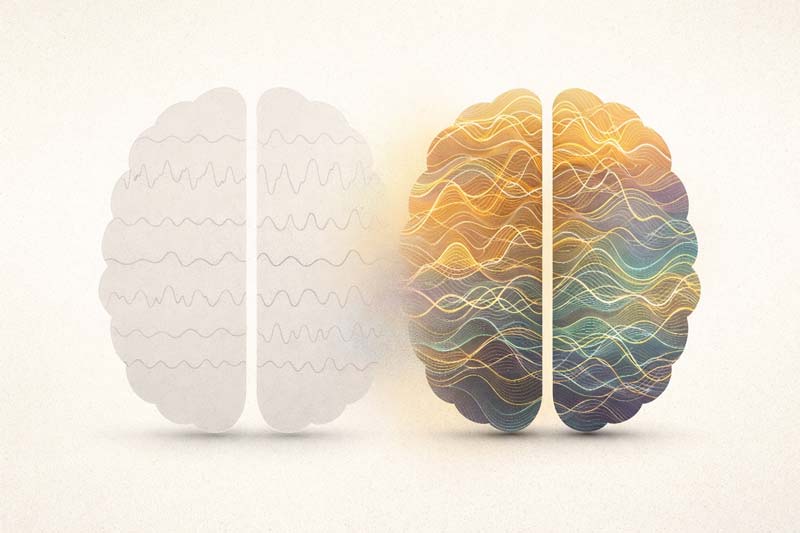
A quieter inner voice. Less mental clutter. Yet a new study published in Neuroscience of Consciousness found something that contradicts this assumption entirely. The brain during meditation is not calm. It is more active, more complex, and more dynamically alive than when you sit doing nothing.
This matters for anyone who has ever wondered whether meditation is worth their time. If you have tried it and thought nothing was happening, the science suggests otherwise. If you have never tried it because it seemed passive, the data says the opposite. And if you practise regularly and feel genuinely different afterwards, this study offers a biological explanation for why.
Researchers recruited 12 monks from the Theravada Buddhist tradition at the Santacittarama monastery in Italy. These were not people who meditated casually for ten minutes before work. The monks had accumulated a mean of 15,343 hours of practice. The least experienced had completed 2,375 hours. The most dedicated had reached 26,600 hours. Their daily routine included at least two hours of communal sitting, individual sessions on top of that, and an intensive three-month winter retreat each year.
The research team recorded the monks’ brain activity using magnetoencephalography (MEG). This brain-scanning technology detects the tiny magnetic fields generated by electrical activity in the brain. MEG captures brain signals with millisecond precision, far faster than the fMRI scans used in most previous meditation research. This speed matters because the brain changes that meditation produces occur rapidly, and slower technologies simply miss them.
The monks performed two types of meditation during scanning. First, Samatha, which involves anchoring attention on a single point, typically the breath, to build concentration and mental stability. Second, Vipassana, which takes the opposite approach. This involves sitting with open awareness, letting thoughts, feelings, and sensations arise and pass without clinging to any of them. Both were practised with eyes closed, without any chanting, breathing techniques, or visualisation.
What the researchers found challenges a decade of assumptions. Both types of meditation made the brain’s electrical signals richer and more varied, not quieter. A widely reported claim that meditation increases gamma brainwaves (the fastest type of brain wave, with five primary types ranging from slow delta waves during deep sleep to fast gamma waves during focused attention) turned out to be misleading once the data were properly analysed.
And the two meditation styles, despite both being called meditation, produced measurably different effects on how the brain organises itself. Perhaps most relevant for anyone considering a regular practice, the most experienced monks showed something striking.
Their brains at rest had already begun to resemble those during meditation. The longer someone had practised, the more their everyday brain function shifted toward the meditative state. This suggests that meditation does not just change how you feel in the moment. Over time, it may change how your brain operates at baseline.
What meditation does to your brain touches stress, focus, emotional regulation, and mental flexibility. In this post, we will walk through what increased brain complexity actually means for your mental sharpness and well-being. We will look at why the two main meditation styles produce different brain states and what that means for choosing a practice.
A long-standing finding about gamma brainwaves turns out to have been wrong, and the correction matters. And the data on how meditation experience accumulates in the brain over the years offers a compelling case for consistency over intensity.
What Meditation Does to Your Brain When Complexity Increases
Most people think of a busy brain as a stressed brain. Thoughts racing. Mind scattered. Too much is happening at once. So when researchers say that meditation increases brain complexity, it sounds like bad news. It sounds like the opposite of what meditation should do.
But brain complexity in this context means something entirely different from mental chaos. It refers to how rich, varied, and non-repetitive the brain’s electrical patterns are. A brain stuck in the same loops, recycling the same anxious thought or replaying the same worry, actually has low complexity. It is predictable. A brain that generates a wide range of diverse signals, adapting fluidly from moment to moment, is highly complex. It is flexible. And flexibility is what allows you to respond to life rather than react to it.
The researchers measured this flexibility using three tools, each capturing a different aspect of how the brain’s signals behaved during meditation compared to rest.
- Lempel-Ziv complexity measures the number of unique patterns in a brain signal. Imagine trying to compress a text file. A document that repeats “hello” a thousand times compresses to almost nothing. A document filled with varied, non-repeating sentences barely compresses at all. The brain’s signals during meditation resembled those in the second document. During Samatha, this uniqueness increased significantly in brain regions handling sensory integration and spatial awareness. During Vipassana, it rose in regions linked to self-awareness and internal reflection. The brain was not noisier. It was producing more original content, if you like.
- Higuchi fractal dimension captures how intricate the brain’s electrical patterns look across different time scales. A value of 1 represents a flat, simple line. A value approaching 2 represents a signal so complex it fills an entire plane. During Samatha meditation, this measure increased significantly in regions responsible for movement planning, touch processing, and higher-order thinking. The brain’s moment-to-moment electrical output became geometrically richer, generating more elaborate patterns than it did at rest.
- Spectral entropy measures how evenly the brain spreads its energy across different frequency bands. Think of an orchestra. If only the violins play, the sound is narrow and predictable. If every section plays, the sound is full and rich. Both Samatha and Vipassana shifted the brain toward that full orchestra state, mainly in the cingulate (an area central to attention and emotion regulation), central, and frontal regions.
What does all this mean for someone who meditates at home for twenty minutes before work? It means that the stillness you feel is not the brain shutting down. It is the brain opening up. The repetitive mental loops that characterise stress and rumination give way to a broader, more varied pattern of neural activity. This is the biological signature of mental flexibility, the capacity to shift attention, process new information, and respond creatively rather than falling back on autopilot.
Research into psychedelic substances has found a strikingly similar increase in brain complexity. Substances like psilocybin produce richer neural signals alongside reports of expanded awareness and altered perception. The monks achieved a comparable shift through practice alone. No substances. No external intervention. Just sustained, disciplined attention.
What meditation does to your brain in terms of complexity carries practical weight. A more flexible brain handles stress better because it does not get trapped in repetitive patterns. It adapts to new situations faster. It maintains focus without rigidity. A recent review of complexity across multiple meditation studies confirmed this consistent finding.
Regardless of the tradition or technique, expert meditators show richer brain signals during practice than during rest. Meditation appears to follow a reliable pattern: less repetition, more variety, and a neural environment better equipped for the demands of daily life.
Why Focused Attention and Open Awareness Produce Different Brain States
People often talk about meditation as though it were a single thing. You meditate, or you don’t. But that is like saying you exercise without distinguishing between sprinting and yoga. The monks in this study practised two fundamentally different techniques, and their brains responded in fundamentally different ways.
The first, Samatha, works like a spotlight. You choose one object of attention, usually the breath, and hold your focus there. When the mind drifts, you bring it back. Again and again. The practice builds concentration, and over time, the ability to sustain attention for longer periods without distraction.
The second, Vipassana, works like a floodlight. There is no chosen object. You sit with open awareness and observe whatever arises, thoughts, sounds, bodily sensations, emotions, without grasping at any of them or pushing them away. Samatha trains depth. Vipassana trains breadth.
The What meditation does to your brain data revealed that this experiential difference has a measurable biological basis.
Samatha: The Brain Locks In
During Samatha, the brain’s overall position relative to its optimal operating state (measured by the deviation from criticality coefficient, or DCC, which indicates how far the brain is from the boundary between rigid order and flexible chaos) did not change significantly from rest. The brain was not moving toward greater flexibility. It was holding steady, concentrating its resources.
Yet something unusual happened. When the brain moved further from this optimal boundary during Samatha, its complexity actually increased. This contradicts what happens in states like anaesthesia or severe neurological conditions, where drifting from the optimal boundary means reduced complexity and diminished awareness. Samatha appears to create a unique neural configuration. The brain sacrifices flexibility in exchange for deep, stable focus and, in the process, becomes more complex, not less.
The machine learning algorithm trained on brain data identified the frontal, anterior cingulate (involved in error detection and focus), lingual (visual processing), and insular (internal body awareness) regions as the most important for distinguishing Samatha from rest. These are regions associated with sustained attention and inward monitoring, exactly what the practice demands.
For someone practising Samatha at home, this translates directly. The intense focus you build during breath-centred meditation is not just a feeling. It corresponds to a measurable brain state in which neural resources concentrate rather than disperse, producing a kind of complexity born of depth rather than breadth.
Vipassana: The Brain Opens Up
Vipassana pushed the brain in a completely different direction. The DCC decreased, meaning the brain moved closer to its optimal operating boundary, that sweet spot between rigidity and chaos where information processing works best. This shift appeared in brain regions spanning the ventral attention network (which detects unexpected events), the dorsal attention network (which directs voluntary focus), and the default mode network (the brain’s resting state activity associated with mind wandering and self-referential thought).
The correlations that defined Samatha disappeared during Vipassana. The tight relationship between the brain’s distance from its optimal point and its complexity weakened substantially. Instead, complexity, the brain’s excitation balance, and its proximity to the optimal boundary all aligned more coherently. The brain was not fighting itself. Everything pointed in the same direction.
For a practitioner, this matches the lived experience precisely. Vipassana feels spacious. The mind is alert but not straining. Attention is broad. There is a quality of responsiveness where you notice things without effort. Brain data suggests that this feeling reflects a genuine shift toward a state in which the brain is maximally responsive and adaptable.
The effects of meditation on the brain depend entirely on what you ask of it. Samatha cultivates a concentrated, stable state of mind suited to tasks that require sustained focus. Vipassana builds an open, flexible brain state suited to awareness and adaptability.
What meditation does to your brain during one is neurologically distinct from what happens during the other, even though both increase complexity compared to simply sitting still. The distinction is not a matter of preference. It is written in the electrical patterns of neural activity itself.
The Gamma Power Myth That Misled Researchers for Years
If you have read anything about meditation and the brain over the past fifteen years, you will likely have encountered one particular claim. Meditation increases gamma brainwaves.
This finding appeared in study after study, starting with a landmark paper that reported that experienced meditators produced unusually high gamma activity. Gamma waves are the fastest of the brain’s four main wave types, oscillating above 30 Hz, and they are linked to focused attention, memory formation, and conscious awareness. The conclusion became part of the accepted story: meditation strengthens these fast brainwaves, and this explains its benefits.
The monks’ brains in this study said otherwise: gamma power decreased during both Samatha and Vipassana, not increased. The reduction was statistically significant (the observed effect is unlikely to be due to chance alone, given the statistical test and its assumptions). It appeared mainly in the frontal, parietal, and cingulate regions, areas central to attention, self-awareness, and cognitive control.
The explanation for why previous studies got a different answer is both technical and important. It changes how we interpret not just meditation research, but any study claiming to measure brainwave changes.
The brain’s electrical output has two layers:
- The first layer consists of actual rhythmic oscillations, the brainwaves themselves, pulsing at specific frequencies like alpha, beta, and gamma.
- The second layer is a background electrical signal unrelated to rhythmic oscillation. This background follows what physicists call a 1/f pattern (a mathematical relationship where electrical power decreases as frequency increases).
Every brain recording captures both layers mixed together.
Here is where the problem lies. Most previous meditation studies measured the total electrical power in the gamma frequency range without separating these two layers. They assumed that all the power in the gamma band represented gamma brainwaves. It did not. Changes in the background electrical layer can push power values up across all higher frequencies, making it appear that gamma oscillations have increased when they have not changed at all, or even decreased.
The researchers in this study separated the two layers using a method called specparam. Think of it like isolating a singer’s voice from the background noise in a recording. Once they removed the background electrical component, the actual oscillatory gamma power had fallen during meditation.
The apparent increase reported by previous studies was caused by a flattening of the background signal, which boosted power across higher frequencies and masked the actual brainwaves.
This matters beyond academic debate. If you have ever read that meditation boosts gamma brainwaves and thought this sounded like a good reason to practise, the benefit is still there; it is just not coming from where you thought it would. The real gamma story is a decrease. What meditation does to your brain is dial down fast oscillatory activity in regions associated with active cognitive processing and mind wandering. This is consistent with what meditators actually experience. Less mental chatter. Less reactive processing. A quieter foreground against a richer, more complex background.
The brain’s gamma activity during meditation was misread for years because the tools were not precise enough to separate signal from noise. The corrected picture is more interesting than the original claim. What meditation does to your brain is not a simple boost of one brainwave type. It is a subtle reorganisation in which the background electrical profile shifts, actual fast oscillations decrease, and the overall result is a brain less driven by reactive processing and more available for sustained awareness.
What Meditation Does to Your Brain After Thousands of Hours of Practice
The monks in this study ranged from 2,375 to 26,600 hours of practice. That gap is enormous. The least experienced monk had sat for the equivalent of meditating one hour daily for about six and a half years.
The most experienced had done the equivalent for over seventy years at that pace. This range allowed the researchers to ask a question directly relevant to anyone who meditates: Does the effect build over time, and if so, how?
The answer reshapes how we think about meditation as a long-term investment in brain health.
- The resting brain starts to resemble the meditating brain. During Samatha, the brain’s background electrical profile (the 1/f slope) flattened compared to rest. But in monks with more hours of practice, this flattening was smaller. Not because the effect weakened. Because their resting brain had already shifted toward the meditative pattern. The starting line had moved. The gap between rest and meditation shrank because rest itself had changed.
- The brain’s dependence on its own past decreases at baseline. Long-range temporal correlations (LRTC; a measure of how strongly the brain’s current activity is influenced by events moments before) decreased during meditation in the gamma frequency bands. Monks with more practice hours showed smaller decreases. Again, this was not a weakening of meditation’s effect. Their resting brains already showed the reduced temporal dependency that less experienced monks only achieved during active practice. In practical terms, this means a more experienced meditator’s everyday brain is already less locked into habitual patterns of thought.
- The two meditation styles converge with expertise. In less experienced monks, Samatha and Vipassana produced clearly different effects on the brain’s critical dynamics. In the most experienced, this difference shrank substantially. The DCC (deviation from criticality coefficient, measuring the brain’s distance from its optimal operating point) gap between the two practices was largest at lower experience levels and smallest at the highest. As expertise accumulates, the brain appears to find a common ground that transcends technique.
- Age did not drive these patterns. The researchers controlled for age and found that all associations between meditation hours and brain changes held. These were not effects of ageing. They tracked specifically with hours on the cushion.
What does this mean for someone who is not a monk? The data suggest that meditation works cumulatively. Each session does not just produce a temporary state that evaporates when you stand up. It nudges the brain’s baseline slightly. Over months and years, these nudges accumulate.
The resting brain of someone who has practised consistently for a decade operates differently from someone who started last month, not because of a single breakthrough session, but because of thousands of small, barely noticeable shifts.
Previous research aligns with this. A study of Vipassana practitioners at different experience levels found increased fractal dimension and entropy in both experienced teachers and relative novices compared to non-meditators. Another investigation revealed lasting changes in brain connectivity patterns that persisted well outside of meditation sessions, detectable even during ordinary tasks.
What meditation does to your brain over years of practice is not simply a repetition of the same fleeting state. The evidence points toward cumulative restructuring.
The resting brain gradually absorbs the qualities that meditation produces: greater complexity, reduced dependence on habitual patterns, and a shifted excitation balance. After 26,600 hours, it looks fundamentally different from what it does after 2,375, not because the practice itself changed, but because the brain underneath it did.

Why Your Brain Operates Best Between Order and Chaos
Imagine a motorway where every car drives at exactly the same speed in exactly the same lane. Perfectly ordered. Nothing goes wrong. But nothing adapts either. A car breaks down, and the entire system freezes because there is no room to manoeuvre.
Now imagine a motorway where every car drives at random speeds in random directions. Total chaos. Maximum flexibility, technically, but also maximum danger. No information travels reliably because nothing is predictable enough to coordinate with.
The brain lives between these two extremes every second of your life. Physicists call the boundary between them the critical point. At this boundary, a system holds enough structure to function reliably while retaining enough flexibility to adapt instantly to new demands. The critical brain hypothesis proposes that healthy brain function depends on operating near this exact boundary. Too much order can make the brain rigid, unable to shift between tasks or respond to the unexpected. Too much chaos and it loses the ability to maintain coherent thought.
The evidence from this study suggests that meditation actively steers the brain toward this boundary.
Several findings converge on this conclusion. First, the brain’s background electrical profile (the 1/f slope) flattened during both Samatha and Vipassana. Research suggests this flattening reflects a shift in the excitation-inhibition balance (the ratio between brain cells that activate neighbouring cells and brain cells that calm them down). A flatter slope means relatively more excitation. And increased excitation, within healthy limits, has been linked to the brain moving closer to its critical point.
Second, long-range temporal correlations (LRTC, the degree to which the brain’s current activity is shaped by its recent past) decreased across both meditation types, particularly in the gamma frequency bands and the broadband signal. When LRTC drops, the brain is less tethered to its own history. Each moment becomes less determined by the one before it. This loosening is precisely what criticality theory predicts should happen as a system approaches its optimal boundary.
The machine learning algorithm confirmed just how important this loosening was. When trained on all 2,844 features extracted from the monks’ brain recordings, it identified LRTC as the single most discriminating factor between meditation and rest. Not brainwave power. Not complexity. The degree to which the brain freed itself from its own recent past was the clearest marker that meditation was happening.
Third, Vipassana specifically reduced the DCC (deviation from criticality coefficient) in brain regions spanning attention, motor control, and default mode networks. The brain during open awareness meditation moved measurably closer to its critical point. It edged toward that precise boundary where the balance between stability and flexibility reaches its optimum.
What meditation does to your brain at this level has direct implications for everyday life. A brain closer to its critical point processes information more efficiently. It switches between tasks more fluidly. It responds to the unexpected without either freezing or overreacting. Researchers have described this state as one in which the brain maximises its capacity for learning, adaptation, and flexible responses.
A recent study on caffeine found strikingly similar shifts in brain dynamics. Caffeine increased complexity, flattened the aperiodic slope, and reduced LRTC. The researchers concluded that caffeine pushed the brain closer to its critical regime. That meditation produces the same directional changes, without any chemical substance, speaks to the potency of sustained attentional practice as a tool for optimising brain function.
What meditation does to your brain is not about emptying it. It is not about slowing it down. It is about tuning the brain toward the state where it operates at its most capable, the narrow boundary where structure meets flexibility. The monks sitting quietly in that Italian laboratory were not resting. Their brains were working at the edge of their capacity, balanced between order and chaos, precisely where the science suggests human neural function is at its finest.
Sources
- Marzetti L, di Lanzo C, Zappasodi F et al. Magnetoencephalographic alpha band connectivity reveals differential default mode network interactions during focused attention and open monitoring meditation. Frontiers in Human Neuroscience 2014;8:832.
- Arcara G, Pellegrino G, Pascarella A, Mantini D, Kobayashi E, Jerbi K. Meg. In: Valeriani M, de Tommaso M (eds.), Psychophysiology Methods New York, NY: Humana Press US; 2024, pp. 157–80.
- Lutz A, Slagter HA, Dunne JD, Davidson RJ. Attention regulation and monitoring in meditation. Trends in Cognitive Sciences 2008;12:163–9.
- Lutz A, Jha AP, Dunne JD et al. Investigating the phenomenological matrix of mindfulness-related practices from a neurocognitive perspective. American Psychologist 2015;70:632–58.
- Zhang Y, Hao J, Zhou C et al. Normalised Lempel-Ziv complexity and its application in bio-sequence analysis. Journal of Mathematical Chemistry 2009;46:1203–12.
- Pascarella A, Tholke P, Meunier D, O’Byrne J, Lajnef T, Raffone A, Guidotti R, Pizzella V, Marzetti L, Jerbi K. Meditation induces shifts in neural oscillations, brain complexity, and critical dynamics: novel insights from MEG. Neuroscience of Consciousness 2025;2025(1):niaf047.
- Higuchi T. Approach to an irregular time series on the basis of the fractal theory. Physica D 1988;31:277–83.
- Pardey J, Roberts S, Tarassenko L. A review of parametric modelling techniques for EEG analysis. Medical Engineering and Physics 1996;18:2–11.
- Carhart-Harris RL, Leech R, Hellyer PJ et al. The entropic brain: a theory of conscious states informed by neuroimaging research with psychedelic drugs. Frontiers in Human Neuroscience 2014;8:20.
- Timmermann C, Roseman L, Schartner M et al. Neural correlates of the DMT experience assessed with multivariate EEG. Scientific Reports 2019;9:16324.
- Atad DA, Mediano PAM, Rosas FE et al. Meditation and complexity: a review and synthesis of evidence. Neuroscience of Consciousness 2025;2025:niaf013.
- Walter N, Hinterberger T. Determining states of consciousness in the electroencephalogram based on spectral, complexity, and criticality features. Neuroscience of Consciousness 2022;2022:niac008.
- Maschke C, O’Byrne J, Colombo MA et al. Critical dynamics in spontaneous EEG predict anaesthetic-induced loss of consciousness and perturbational complexity. Communications Biology 2024;7:946.
- Yeo BTT et al. The organisation of the human cerebral cortex estimated by intrinsic functional connectivity. Journal of Neurophysiology 2011;106:1125–65.
- Lutz A, Greischar LL, Rawlings NB et al. Long-term meditators self-induce high-amplitude gamma synchrony during mental practice. Proceedings of the National Academy of Sciences 2004;101:16369–73. 17. Jensen O, Kaiser J, Lachaux J-P. Human gamma-frequency oscillations associated with attention and memory. Trends in Neurosciences 2007;30:317–24.
- Donoghue T, Haller M, Peterson EJ et al. Parameterising neural power spectra into periodic and aperiodic components. Nature Neuroscience 2020;23:1655–65.
- Donoghue T, Dominguez J, Voytek B. Electrophysiological frequency band ratio measures conflate periodic and aperiodic neural activity. eNeuro 2020;7.
- Garrison KA, Zeffiro TA, Scheinost D et al. Meditation leads to reduced default mode network activity beyond an active task. Cognitive, Affective, and Behavioral Neuroscience 2015;15:712–20.
- Gao R, Peterson EJ, Voytek B. Inferring synaptic excitation/inhibition balance from field potentials. Neuroimage 2017;158:70–8.
- Irrmischer M, Houtman SJ, Mansvelder HD et al. Controlling the temporal structure of brain oscillations by focused attention meditation. Human Brain Mapping 2018;39:1825–38.
- Kakumanu RJ, Nair AK, Venugopal R et al. Dissociating meditation proficiency and experience dependent EEG changes during traditional vipassana meditation practice. Biological Psychology 2018;135:65–75.
- Guidotti R, D’Andrea A, Basti A et al. Long-term and meditation-specific modulations of brain connectivity revealed through multivariate pattern analysis. Brain Topography 2023;36:409–18.
- O’Byrne J, Jerbi K. How critical is brain criticality? Trends in Neurosciences 2022;45:820–37.
- Hengen KB, Shew WL. Is criticality a unified setpoint of brain function? Neuron 2024;113:2582–98.
- Tholke P et al. Caffeine induces age-dependent increases in brain complexity and criticality during sleep. Communications Biology 2025;8:685.