


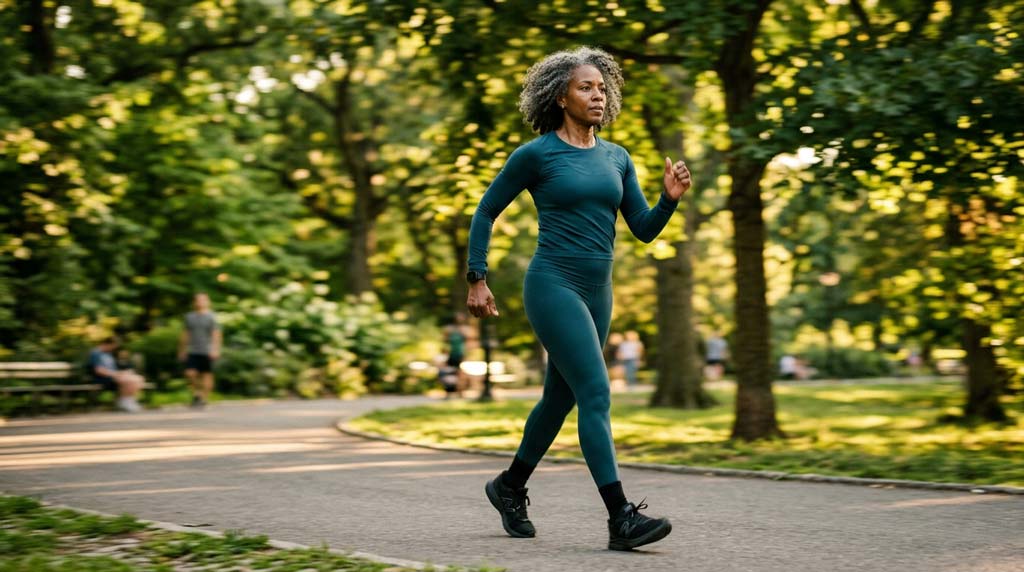
Does Japanese walking really work better than 10,000 steps a day? The question now fills search bars and social feeds. A three-minute pattern, repeated for half an hour, promises real fitness without a gym. Its appeal is obvious. There is no treadmill, no running, and no kit beyond comfortable shoes.
The name Japanese walking is new, but the method behind it is not. It began in Japan, where it is sometimes called Nihon Aruki. In the scientific literature it carries a plainer label: interval walking training (IWT). Hiroshi Nose and Shizue Masuki defined the approach in a 2007 study in Mayo Clinic Proceedings. They divided 246 middle-aged and older adults into three groups and followed them for five months.
Underneath the label sits a serious idea. Walking intensity, not just step volume, shapes the result. Physical fitness ranks among the strongest predictors of long-term health and mortality. Yet a gentle daily stroll may be too easy to lift it. That gap is why people now ask whether structured effort beats simply chasing a step target. The same tension runs through the question of how many steps a day actually protect your health.
IWT was built for everyday life, not the laboratory, and large groups have kept it up. This article looks at what interval walking training actually does for fitness, blood pressure and weight. It also marks where the popular claims outrun the evidence. The honest answer depends on three things. They are how hard the fast minutes are, how consistent the habit becomes, and which outcome you measure.
What Is Japanese Walking?
Strip away the branding and the method is simple to describe. You alternate three minutes of fast walking with three minutes of slow walking. Then you repeat that cycle for about thirty minutes.
The fast phase is meant to be hard, the slow phase a genuine recovery. In its defined form, fast means at least 70% of peak aerobic capacity (the most oxygen your body can use). Slow drops to 40% or below.
None of this is a separate branch of science. It is interval training applied to walking, nothing more exotic. Aerobic exercise means continuous, rhythmic movement of large muscles, such as walking or cycling. Interval walking simply takes that base and adds structured surges of effort. The label Japanese walking is new, yet the underlying principle is decades old.
The approach has a clear birthplace. Researchers at Shinshu University in Japan developed it in 1999. Since then, roughly 8,700 generally healthy people have joined the research. Early versions used a small device worn on the back. It beeped when it was time to change pace. That signal removed the guesswork from each switch.
Crucially, fast does not mean reckless. The pace should feel purposeful and challenging, not a sprint or a scramble. In the original trial, the hard phase sat above 70% but below 85% of peak capacity.
That ceiling matters because the interval design lets people put in real effort in short, manageable bursts. They push until fatigue, ease off, recover, then push again. Japanese walking works precisely because the hard part never lasts long.
Does Japanese Walking Improve Fitness And Blood Pressure?
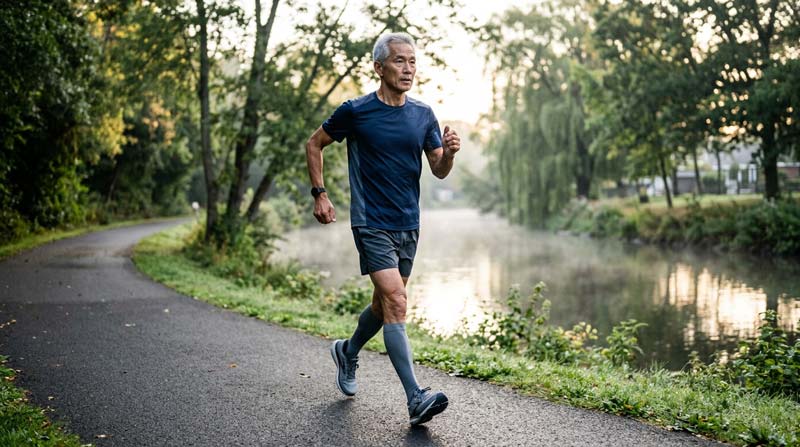
Here the evidence is at its strongest. In the founding trial, the interval group raised peak aerobic capacity by about 9% over five months. Their systolic blood pressure, the higher reading, fell by about 9 mmHg. Diastolic, the lower reading, dropped by 5 mmHg. The steady-paced walkers, by contrast, barely moved on either measure. Same activity, different intensity, very different result.
| Measure | Interval Walking (IWT) | Steady Walking | What It Means |
|---|---|---|---|
| Peak aerobic fitness | +9% | No real change | Fitness rose with intervals only |
| Knee-extension strength | +13% | No real change | Legs gained like light weights |
| Knee-flexion strength | +17% | No real change | Hamstrings strengthened too |
| Systolic blood pressure | -9 mmHg | -3 mmHg | Bigger drop from harder effort |
| Diastolic blood pressure | -5 mmHg | -2 mmHg | Same pattern, lower reading |
Why should the harder version do so much more? The principle is that short efforts above the anaerobic threshold drive adaptation. The anaerobic threshold is the point where effort outpaces the body’s steady oxygen supply.
Such hard work cannot last long, because lactic acid builds and forces a slowdown. So a slow phase is inserted to clear it, readying the body for the next surge. Interval training, therefore, delivers a stronger stimulus than walking at a steady pace.
This is the same logic behind better-known interval systems. Higher-intensity intervals increase VO2max (the maximum amount of oxygen the body can use) more than steady, moderate exercise. The same principle, pushed to its structured extreme, drives the HIIT 4×4 VO2 max protocol.
Interval walking training applies the gentler end of that spectrum. You do not need to run to gain from added intensity. This is where Japanese walking earns its reputation: real effort, reached on foot.
Balance matters here, though. The numbers are averages, and individuals respond differently to the same programme. Baseline health shapes the outcome; people in poorer metabolic condition often gain less at first.
Age, starting fitness and consistency all move the result. Japanese walking can improve fitness and lower blood pressure, but it is not a fixed dose with a guaranteed return. The honest claim is a strong, well-evidenced tendency, not a promise for every walker.
Steps, Intensity, And The 10,000-Step Comparison
This is the comparison driving the whole trend. Is a structured interval walk really better than 10,000 steps a day? The honest answer starts by separating two different things. Step count measures volume: how much you move. Intensity measures how hard you work while moving. They are not the same, and they do not deliver the same effects.
Here is the catch with a pure step target. Self-selected walking pace tends to be comfortable, and often too easy to lift fitness. Many walking programmes have produced small or no gains for exactly this reason. The hard, fast minutes do most of the work. Research on interval walking found that high-intensity walking time, not slow walking time, drives the gains. This is the real case for Japanese walking over a step target: it rewards effort, not just distance.
The original researchers made this point directly. Their earlier work tracked moderate walking at roughly 10,000 steps a day for 18 weeks. It did not raise thigh-muscle strength. Intensity-based training did. In their main trial, the interval group walked only 83% as long as the continuous group. Yet both burned similar amounts of energy because the faster intervals were so much harder. Intensity, in other words, can partly stand in for sheer volume.
None of this makes step counts useless. Steps remain a fine measure of everyday movement, and more of them link to lower mortality. The same myth gets unpicked in detail in 5,000 steps a day and the 10,000-step myth.
The point is that the two tools answer different questions. A daily step target builds the habit of moving more. Japanese walking adds the intensity that a step count alone often misses. Used together, they cover both volume and effort, rather than competing.
Can Japanese Walking Help With Weight Loss?
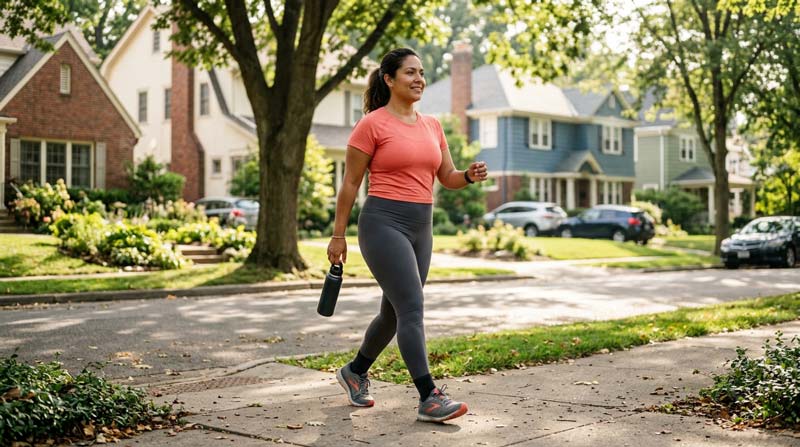
This is where the online claims run hottest. Videos promise that a short walking method melts belly fat. The evidence supports something more modest and more useful. Interval walking has been shown to lower body mass index and body fat percentage in middle-aged and older adults. So it can help. What it cannot do is strip fat from one chosen area on command.
Spot reduction, the idea of burning fat from one body part, is the core misunderstanding. When total energy burned and food intake are held steady, exercise intensity does not change where fat comes off. Body fat falls in response to an overall energy deficit, not a targeted move. Diet does much of that work. A walk cannot outrun a consistently poor diet, whatever the format.
Two further factors complicate the picture. First, the body compensates for exercise through a slower metabolism or a quietly larger appetite. That can blunt weight change despite real effort. Second, people vary. Higher activity lowers body fat percentage even when body mass index barely changes. So the scales can mislead. Judge progress by fitness, waist size and how clothes fit, not weight alone.
Set against that, the realistic verdict is encouraging without being inflated. Japanese walking can support fat loss by increasing energy expenditure and fitness.
For weight change, though, it works best as one part of a wider routine. It will not target the belly, and it will not outrun a poor diet. Treated as a fitness habit that also nudges body composition, Japanese walking delivers; sold as a fat-melting shortcut, it disappoints.
Who Should Be Careful Before Trying It?
Interval walking is gentle by the standards of high-intensity exercise, but it is not effortless. The fast phase genuinely raises heart rate and breathing. For most healthy adults, that is the point and poses no problem. A smaller group should take more care before pushing the pace. Caution here is about sensible screening, not fear.
Some conditions warrant a word with a doctor first. Sensible screening excludes vigorous exercise for people with heart, lung, kidney, or liver disease. Anyone with uncontrolled blood pressure, chest pain, dizziness or marked breathlessness should get checked before starting.
Certain diabetes medicines, such as insulin, can trigger low blood sugar during exercise, so doses may need to be adjusted. Existing joint problems, poor balance and very low fitness also call for a gentler entry.
The faster pace asks more of the joints. In trials, interval walkers reported knee and hip discomfort more often than steady walkers. Carrying extra weight adds to that load, because it alters stride and stresses the knees. Older adults face a further consideration. Reduced balance and muscle weakness raise the risk of falls, so steady ground and supportive footwear matter. Heat is worth respecting too, since older bodies cope less well with it.
None of this makes Japanese walking dangerous. The opposite is closer to the truth: started sensibly, it is well tolerated. Beginners do not need to fear intensity, provided they build up gradually. Starting at a light-to-moderate effort and progressing over two to three months is both safe and effective.
The interval format helps, because the hard spells are short and followed by recovery. Approached this way, Japanese walking suits a wide range of starting fitness, including people well past 40.

A Simple Way To Try The 3/3 Walking Method
Trying it requires almost nothing. Begin with five to ten minutes of easy walking to warm up. Then walk fast for three minutes, and slow for three minutes. Repeat that pair five or more times. Finish with a few easy minutes to cool down. That single session is the whole method.
How hard should fast feel? Hard enough that holding a conversation becomes difficult, but not a flat-out sprint. In research, it means operating above 70% of peak capacity, though most people will not measure that.
Perceived effort is a fair everyday guide. The slow phase should feel genuinely easy, letting you recover before the next push. Getting this contrast right matters more than any gadget.
A sensible weekly target gives the habit shape. Research suggests about 60 minutes of fast walking per week. That breaks down to five to ten sets of three-minute intervals, on four or more days. Usefully, the fitness gains largely plateau after about 50 minutes of fast walking per week. More is not required to benefit. This is a realistic dose, not an all-or-nothing crusade.
What carries Japanese walking long term is consistency, not perfection. Habits form when a clear cue triggers a rewarded action, again and again. So anchor the walk to an existing routine, such as after lunch or before dinner.
A timer or app that signals each switch removes friction and aids adherence. Enjoyment helps more than willpower, so choose a route you like. Done three or four times a week, Japanese walking becomes automatic, which is exactly where its benefits accrue.
Sources
- Ballor DL, McCarthy JP, Wilterdink EJ. Exercise intensity does not affect the composition of diet- and exercise-induced body mass loss. Am J Clin Nutr. 1990;51:142-146.
- Boule NG, Kenny GP, Haddad E, Wells GA, Sigal RJ. Meta-analysis of the effect of structured exercise training on cardiorespiratory fitness in type 2 diabetes mellitus. Diabetologia. 2003;46(8):1071-1081.
- Bradbury KE, Guo W, Cairns BJ, Armstrong MEG, Key TJ. Association between physical activity and body fat percentage, with adjustment for BMI: a large cross-sectional analysis of UK Biobank. BMJ Open. 2017;7(3):e011843.
- Colberg SR, Sigal RJ, Yardley JE, et al. Physical activity/exercise and diabetes: a position statement of the American Diabetes Association. Diabetes Care. 2016;39:2065-2079.
- Dela F, von Linstow ME, Mikines KJ, Galbo H. Physical training may enhance beta-cell function in type 2 diabetes. Am J Physiol Endocrinol Metab. 2004;287:E1024-E1031.
- Garber CE, Blissmer B, Deschenes MR, et al. American College of Sports Medicine position stand. Quantity and quality of exercise for developing and maintaining cardiorespiratory, musculoskeletal, and neuromotor fitness in apparently healthy adults: guidance for prescribing exercise. Med Sci Sports Exerc. 2011;43(7):1334-1359.
- Gardner B. A review and analysis of the use of ‘habit’ in understanding, predicting and influencing health-related behaviour. Health Psychol Rev. 2015;9:277-295.
- King NA, Caudwell P, Hopkins M, et al. Metabolic and behavioral compensatory responses to exercise interventions: barriers to weight loss. Obesity. 2007;15(6):1373-1383.
- Lin CC, Ou HY, Hsu HY, et al. Beyond sarcopenia: older adults with type II diabetes mellitus tend to experience an elevated risk of poor dynamic balance – a case-control study. BMC Geriatr. 2022;22:138.
- Masuki S, Morikawa M, Nose H. Internet of Things (IoT) system and field sensors for exercise intensity measurements. Compr Physiol. 2020;10(3):1207-1240.
- Masuki S, Morikawa M, Nose H. High-intensity walking time is a key determinant to increase physical fitness and improve health outcomes after interval walking training in middle-aged and older people. Mayo Clin Proc. 2019;94(12):2415-2426.
- Masuki S, Morikawa M, Nose H. Interval walking training can increase physical fitness in middle-aged and older people. Exerc Sport Sci Rev. 2017;45(3):154-162.
- Myers J, Prakash M, Froelicher V, Do D, Partington S, Atwood JE. Exercise capacity and mortality among men referred for exercise testing. N Engl J Med. 2002;346:793-801.
- Nemoto K, Gen-no H, Masuki S, Okazaki K, Nose H. Effects of high-intensity interval walking training on physical fitness and blood pressure in middle-aged and older people. Mayo Clin Proc. 2007;82(7):803-811.
- Pataky Z, Armand S, Muller-Pinget S, et al. Effects of obesity on functional capacity. Obesity (Silver Spring). 2014;22:56-62.
- Pedersen BK, Saltin B. Evidence for prescribing exercise as therapy in chronic disease. Scand J Med Sci Sports. 2006;16(Suppl 1):3-63.
- Riebe D, Franklin BA, Thompson PD, et al. Updating ACSM’s recommendations for exercise preparticipation health screening. Med Sci Sports Exerc. 2015;47(8):2473-2479.
- Tjonna AE, Lee SJ, Rognmo O, et al. Aerobic interval training versus continuous moderate exercise as a treatment for the metabolic syndrome: a pilot study. Circulation. 2008;118:346-354.
- Tudor-Locke C, Bell RC, Myers AM, et al. Controlled outcome evaluation of the First Step Program: a daily physical activity intervention for individuals with type II diabetes. Int J Obes Relat Metab Disord. 2004;28:113-119.
- Wisloff U, Ellingsen O, Kemi OJ. High-intensity interval training to maximise cardiac benefits of exercise training? Exerc Sport Sci Rev. 2009;37:139-146.