


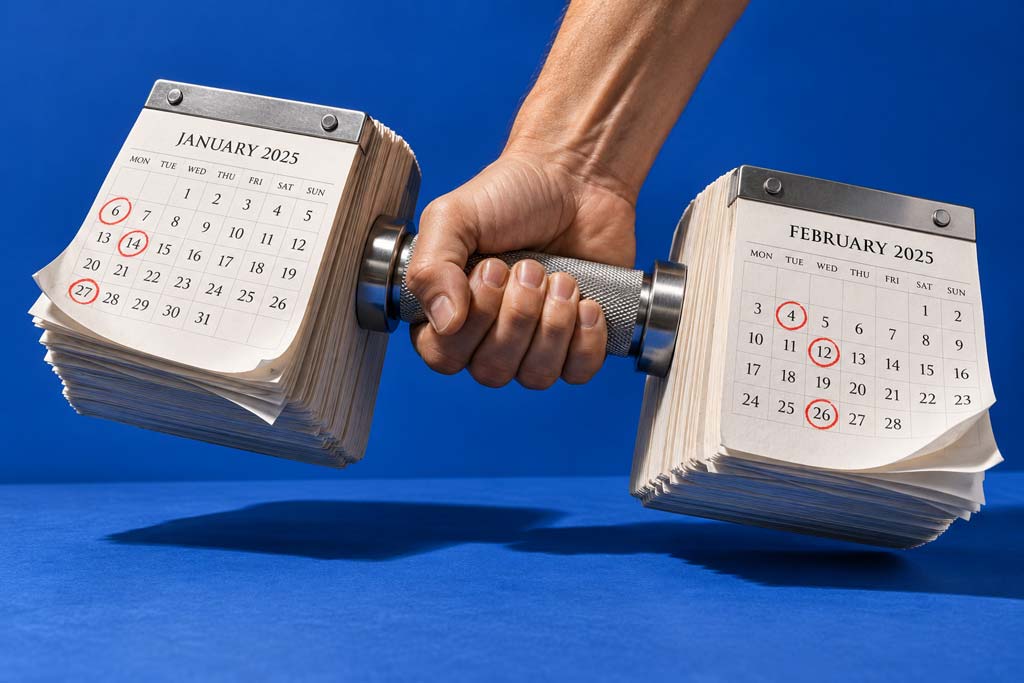
Advice on strength training varies from once a week to twice or three times a week, depending on the question. Some people fear that one or two sessions barely count. Others assume every extra day adds muscle. A third group worries that more sessions will leave too little time for rest.
People also face practical limits on how often they can train. Many adults work five days a week while caring for children or ageing parents. A regular exercise routine is often what suffers. Older adults face extra barriers: pain during exercise, fear of falling, and the time or transport a session demands. In the United States, only 28% of adults report the two weekly strength sessions that guidelines recommend.
The gap between guidance and daily life leaves room for confident advice. In research on diet tips shared online, social approval replaced evidence, with likes and comments making claims seem proven and pressuring others to follow.
Part of the confusion comes from treating three goals as one. Most research calls strength training resistance training (exercise in which muscles work against a weight or force). It builds strength through changes in the nervous system and the muscle itself, while size comes from muscle protein synthesis (the making of new muscle protein). Keeping strength and muscle already gained is a third goal. Each responds differently to how often, how hard and how much someone trains.
Skeletal muscle adapts to use and disuse at every age. Muscle mass also falls with age, by roughly 3% to 8% each decade after 30 and by 5% to 10% each decade after 50. Enough muscular fitness (a combination of strength, endurance and power) keeps everyday tasks manageable and supports independence in later life.
Improving it also benefits body composition, blood glucose and insulin sensitivity. In people with mild or moderate hypertension (high blood pressure), it also improves blood pressure. Resistance training is considered safe for healthy and frail older adults, and for people with several chronic diseases.
No single weekly number can suit everyone. The minimum dose that produces a benefit varies with fitness, age, health, genetics and habitual activity. Social and psychological factors also shift it. The evidence on strength training frequency describes a workable range instead. Where you fit depends on your goal, how much you train each week, how well you recover and how much time you have.
What Strength Training Frequency Really Means
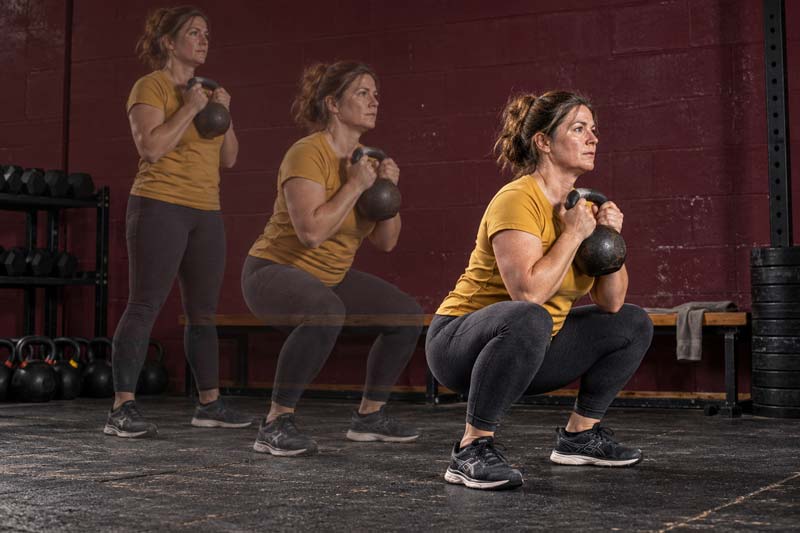
The World Health Organization advises adults to do muscle-strengthening activity at least twice a week. More detailed guidance counts frequency per muscle, with each major muscle group trained two to three days a week. Whole-body and split routines both qualify.
Gym visits and muscle sessions are therefore separate counts. Two whole-body sessions a week train every major muscle twice in two visits. An upper-body day and a lower-body day, each repeated twice, also train every muscle twice, across four visits. Both reach the same strength training frequency. Counted by visits alone, one looks twice as demanding as the other.
The rest of the vocabulary describes the work itself. A repetition is one complete lift, and a set is a run of repetitions performed back to back. Load is the weight, usually expressed as a percentage of a one-repetition maximum (the heaviest weight a person can lift once).
That system dates from the mid-1940s, when it was developed for physical medicine and rehabilitation. For improving strength, standard guidance is two to four sets of 8 to 12 repetitions per muscle group. Each set uses 60% to 80% of that maximum, with 2 to 3 minutes of rest between sets.
Multiply sets by sessions and the result is weekly volume (the total work a muscle does across a week). Sets and weekly frequency are its two main ingredients. Adding a training day can therefore mean two different things. It can spread the same weekly sets across more sessions, or it can add new sets on top. The first changes frequency alone, while the second changes both frequency and volume.
Research comparing frequencies suggests that total weekly volume may influence results more than the number of sessions. Yet 90.3% of surveyed gym-goers believed several sessions would beat one, even with identical total work.
Adding work is a different matter. Ten or more weekly sets per muscle produced about 3.2% more muscle growth than five to nine sets. When researchers removed one particularly influential study from the analysis, that difference fell to 1.4%.
Two to three days is the guidance for improving muscular fitness, and results still appear below it. Training each muscle once a week still builds muscle effectively, though twice a week may maximise growth. Minimal-dose strength training (programmes deliberately kept small) has been proposed to make starting easier. Strength and muscle gains have appeared below the commonly cited levels. That fits the principle that some activity beats none.
Very low frequencies come with a trade-off. One or two sessions a week still bring health and fitness benefits. General exercise guidance notes that they fall short of the optimum and may carry more injury risk than regular training. That still leaves the question of how much lifting each week is linked to a longer life, which BeSund has covered in its own post.
What Changes When You Train More Often
Across 178 randomised trials and 5,097 adults, every programme tested beat no exercise for strength. A parallel analysis of 119 trials and 3,364 adults found the same for muscle size. The study pooled these trials in a network meta-analysis (a method that compares many programmes at once). It also estimated how likely each programme was to rank highest.
There was a 95% probability that training with at least two sets or two sessions a week increases strength. The same probability applied to muscle growth from at least two sets and two sessions a week. Even at the most cautious end of the estimates, every programme produced at least a moderate strength gain. Each also produced at least a small rise in muscle mass.
The rankings did produce winners. Heavy loads, above 80% of a one-repetition maximum, did the most for strength. The top-ranked strength programme combined heavy loads and multiple sets, three times a week. For muscle size, the same heavy, multi-set approach ranked first at twice a week. Yet all the prescriptions built muscle to a broadly similar degree. Multiple sets, rather than heavy weights, were the feature most likely to lift a programme into the top three for growth. Separate analyses agree that load drives strength far more than muscle growth.
Across 111 head-to-head comparisons between programmes, 91% could not confidently separate the two. Nine of the ten clear differences involved a heavy, multi-set programme beating a lighter-load programme for strength. An unclear result is not proof that two programmes are equal, though. Many estimates were wide, and the evidence does not support the conclusion that all programmes perform the same.
A top-ranked programme is not automatically the best choice for everyone. Someone who dislikes heavy weights can still benefit from strength training. So can someone who can only manage one session a week.
The trials also limit who these findings describe. Participants were healthy adults aged 18 and over, and roughly 45% to 47% were women. The study excluded athletes and people with additional health conditions. Age, training experience, programme length and training to fatigue did not obviously change the results. Thin data in some comparisons reduced precision, though. Frequency was tested as one part of each combination, so its effect cannot be fully separated from load and sets.
Adding more work does not guarantee more progress either. In one hamstring programme comparing high and low volumes, strength stopped improving after the halfway point.
Strength and muscle also change on different timelines. Early in a programme, strength gains come largely from the nervous system and small changes in muscle architecture. They usually appear before any measurable growth. A rising number on the bar therefore doesn’t prove muscle is being built. Novices also tend to adapt faster than experienced lifters, so the same frequency can produce very different rates of change.
Individual responses vary widely, even within one programme. In one study, trained men and women followed the same heavy strength training programme and high-protein diet. Some gained up to 7 kg of fat-free mass (body weight minus fat) while losing 4 kg of fat. Others lost fat-free mass and gained fat, and around 70% improved their overall body composition. Responses to identical training in older women vary similarly. Researchers have yet to explain why.
How Much Rest Do Your Muscles Need
Hard exercise can leave a muscle temporarily weaker, with the dip lasting minutes, hours or several days. If the next hard session comes too soon, fatigue can reduce quality and may limit adaptation. Standard guidance leaves 48 hours between demanding strength training sessions for the same muscle group. That gap is a convention. A clock cannot confirm that a muscle has recovered.
Recovery time depends on how much damage a session causes, and that varies widely. Intensity, duration, joint angle and muscle length all play a part, as does which muscle group did the work. Novelty also matters, since unfamiliar exercise produces more strength loss and a longer recovery than familiar work. Sudden load increases, unusual ranges of movement, and eccentric actions (the lowering phase of a lift) commonly trigger soreness.
The muscle itself plays a part. In one comparison of four limb muscles, the arm muscles showed more pronounced changes than the leg muscles. That may reflect how much each is used in daily life. People differ through genetics, fitness level and training history. Those with a higher share of fast-twitch (type II) muscle fibres may need longer between high-intensity sessions.
Soreness is an imperfect guide to any of this. Delayed-onset muscle soreness (DOMS) peaks between 48 and 72 hours and usually eases within 7 to 10 days. Yet it does not consistently match what a biopsy shows inside the muscle. Blood markers of damage are no more reliable. A loss of strength in the days after a session is considered a more dependable sign of muscle damage. Soreness also fades as the body adapts to repeated sessions, even while muscle keeps growing. In protein trials, groups with different soreness responses made similar eight-week gains in strength and lean mass.
Training other, non-sore muscle groups while one area is sore is considered acceptable, and light activity is safe during soreness. BeSund’s full guide to DOMS covers its causes, relief and prevention in more depth.
Training more often can also outrun recovery. Young athletes training five to six days a week added an inner-thigh strengthening exercise, and their strength stopped progressing. Overload was a plausible explanation. In that situation, a rest period may help strength rather than harm it. Signs of non-functional overreaching (recovery falling behind training) include persistently raised resting blood pressure and extreme soreness. Difficulty sleeping and mood changes are also warning signs. They point to a need for lower intensity or more recovery time.
Pain is a separate signal from soreness. Discomfort during a hard set and soreness a day or two later are normal. Pain during an exercise suggests something is wrong. Pushing through it risks injury, so the old motto of no pain, no gain does not hold. Pain that persists, or returns once training restarts, warrants a doctor’s opinion. Rest guidance is written for healthy muscle. It does not clear you to train through pain, illness, or an unhealed injury.
Some recovery habits can backfire. Regular cold-water immersion after training reduced three-month gains in muscle mass and strength, compared with active recovery. The cold may have dampened the inflammation and cellular stress that drive adaptation. Cold water still has value as an anti-inflammatory treatment for a specific injury. Anti-inflammatory painkillers follow the same logic, since routine use after training risks counteracting it.
Sleep and food support recovery between sessions. Sleep helps balance training load with recovery. A lack of it raises catabolic hormones (which break tissue down) and lowers anabolic ones (which build it). Protein synthesis and tissue repair suffer as a result. Restricted sleep has also cut the total weight lifted on the bench press, deadlift and leg press.
It made the same strength training session feel harder. About 1.6 g of protein per kilogram of body weight a day appears sufficient to maximise gains in lean mass and strength. Higher intakes added little for most measures. The daily total appears more important than precise timing, although 64.4% of surveyed gym-goers believed timing shapes muscle growth.

Making Strength Training Fit Your Week
Exercise plans should account for stress levels, time constraints, and available resources so people can sustain them. That puts three questions first:
- The goal
- The number of days genuinely free
- The level of experience
Beginners are advised to start at 40% to 60% of their one-repetition maximum and gradually increase the weight, sets or frequency. Very deconditioned people and older adults can start lower still. That means one set of 10 to 15 repetitions at 40% to 50%. Focus on controlled technique through a full range of motion in both the lifting and lowering phases.
Two to three months of light to moderate training lets you safely step up to heavier work. For any given amount of activity, inactive people are more likely to be injured than active ones. That risk is the case for a modest start.
Pushing every set to failure (the point where another repetition is impossible) is not required either. Untrained people still make large muscle gains without it, although training to failure may become more important with experience. Even so, 48% of surveyed gym-goers believed training to failure was essential.
The weekly layout then follows the days available. Whole-body and split routines can provide the same exposure for each muscle. When time is short, a plan can still work with about four weekly sets per major muscle group. Those sets use 6 to 15 repetitions, ideally with compound bilateral movements (exercises working several joints and both sides at once).
Strength training does not require a gym. At home, dumbbells, cuff weights or resistance bands allow both upper-body and lower-body exercises. You can progress bands by moving to denser tubing. Bodyweight works too: a wall sit strengthens the front of the thigh while reducing pressure on the knee, and holding it longer makes it harder.
Cardio does not have to compete for space either. Across 43 trials with 1,090 participants, adding aerobic training to an identical strength programme made no meaningful difference to maximal strength or muscle size. Explosive strength was the exception, developing less when the two were combined, especially in the same session.
Progress then comes from overload applied gradually. As muscles adapt, you increase the weight, sets, or weekly sessions step by step. A routine repeated unchanged stops producing the same effect. In one 10-week study of trained participants, weekly training load rose in every group. That progressive overload seemed central to their body composition changes. Cramming extra sessions into the week is a different move. Physical jobs and other demanding tasks already add to the total load, leaving muscles tired before a planned session and raising injury risk.
Lighter loads with more repetitions may suit older adults wary of the injury risks of heavier weights. You can reach the same total work by adding repetitions. At least six months of training is recommended to see larger gains in muscle mass in older populations. Longer programmes also produce greater gains than shorter ones. For people with arthritis, programmes should be tailored to symptoms and function. They start at a low intensity and build gradually, with symptoms monitored along the way.
Keeping your strength takes less training than building it. You can maintain strength by training each muscle group once a week, provided the weight lifted stays the same. A maintenance programme doesn’t need to keep adding resistance, sets, or sessions. In one eight-week study, trained men kept their fat-free mass and maximal strength on one weekly session per muscle group.
That once-a-week figure has limits. Young people needed at least two sessions a week to keep their strength gains. Stopping altogether cost around 3% of strength a week, and all the gains could be gone after eight weeks. Individual muscles behave differently too. In one study, inner-thigh strength held for four weeks without training. Hamstring strength fell back to where it began over the same period. Gains in muscle thickness and flexibility from another inner-thigh exercise disappeared within four weeks. The required dose to maintain these gains has not been established.
A break is not a permanent loss either. Athletes who cut back during an off-season typically lose some condition, then regain their body composition quickly once training resumes.
For most adults, doing any resistance programme regularly matters more than optimising it. Nobody should be discouraged from a programme simply because it is not top-ranked. Missed sessions are normal. Planning ahead for travel, holidays, illness, and family commitments helps prevent a lapse from becoming a relapse. Avoiding all-or-nothing thinking helps too. Linking training to a regular cue and planning for likely obstacles both help turn exercise into a habit. Working women who meet activity guidelines tend to treat exercise as a priority appointment.
Expectations shape staying power as well. Overly optimistic expectations can undermine adherence, while realistic ones support it. Enjoyment helps prevent interruptions to training. The time of day appears to matter little compared with choosing a slot that fits and sticking to it.
Taken together, the evidence on strength training frequency describes a range. Two to three sessions per muscle each week suit improvement. One session at an unchanged weight can maintain strength for many adults, though not for every muscle or age group. Your goal matters, but so do your total workload, recovery, and how much time you have to train each week.
Sources
- American College of Sports Medicine position stand. Progression models in resistance training for healthy adults. Med Sci Sports Exerc. 2009;41(3):687–708
- American College of Sports Medicine. ACSM’s Guidelines for Exercise Testing and Prescription. 10th ed. Philadelphia (PA): Wolters Kluwer; 2018. 480 p.
- Antonio J, Ellerbroek A, Silver T, et al. A high protein diet (3.4 g/kg/d) combined with a heavy resistance training program improves body composition in healthy trained men and women—A follow-up investigation. J Int Soc Sports Nutr 12: 39, 2015.
- Barnett A. Using recovery modalities between training sessions in elite athletes-does it help? Sports Med. 2006;36:781–796.
- Cheung, K., Hume, P. A. & Maxwell, L. Delayed onset muscle soreness: Treatment strategies and performance factors. Sports Medicine 33, 145–164 (2003).
- Currier BS, Mcleod JC, Banfield L, Beyene J, Welton NJ, D’Souza AC, Keogh JAJ, Lin L, Coletta G, Yang A, Colenso-Semple L, Lau KJ, Verboom A, Phillips SM. Resistance training prescription for muscle strength and hypertrophy in healthy adults: a systematic review and Bayesian network meta-analysis. Br J Sports Med. 2023 Sep;57(18):1211-1220.
- DeLang M.D., Ishøi L., Hole M.N., Wilson P., Segbefia M., Thorborg K. Implementing the Copenhagen adductor exercise and Nordic hamstring exercise in West African academy soccer players: an intervention study. International Journal of Sports Physical Therapy. 2024 Oct 2;19(10):1188–1196.
- Folland JP, Williams AG. The adaptations to strength training: morphological and neurological contributions to increased strength. Sports Med. 2007; 37(2): 145-168.
- Garber CE, Blissmer B, Deschenes MR, et al. American College of Sports Medicine position stand. The quantity and quality of exercise for developing and maintaining cardiorespiratory, musculoskeletal, and neuromotor fitness in apparently healthy adults: guidance for prescribing exercise. Med Sci Sports Exerc. 2011;43(7):1334–59
- Iversen V.M., Norum M., Schoenfeld B.J., Fimland M.S. No time to lift? Designing time-efficient training programs for strength and hypertrophy: A narrative review. Sports Med. 2021;51:2079-2095.
- Kerksick CM, Wilborn CD, Roberts MD, et al. ISSN exercise & sports nutrition review update: research & recommendations. J Int Soc Sports Nutr. 2018 Aug 1;15(1):38.
- Liguori G, American College of Sports Medicine. ACSM’s Guidelines for Exercise Testing and Prescription. 11th ed. Wolters Kluwer; 2022.
- Mbuagbaw L, Rochwerg B, Jaeschke R, et al. Approaches to interpreting and choosing the best treatments in network meta-analyses. Syst Rev 2017;6:79.
- McLeod, M., Breen, L., Hamilton, D. L. & Philp, A. Live strong and prosper: The importance of skeletal muscle strength for healthy ageing. Biogerontology 17, 497–510 (2016).
- Orr R., Knapik J., Pope R. Avoiding Program-Induced Cumulative Overload (PICO). J. Spec. Oper. Med. 2016;16:91-95.
- Piercy KL, Troiano RP, Ballard RM, Carlson SA, Fulton JE, Galuska DA, George SM, Olson RD. The physical activity guidelines for Americans. JAMA. 2018; 320:2020–2028.
- Schoenfeld, B. J., Grgic, J. & Krieger, J. How many times per week should a muscle be trained to maximize muscle hypertrophy? A systematic review and meta-analysis of studies examining the effects of resistance training frequency. J. Sports Sci. 37, 1286–1295 (2019).
- Schoenfeld, B. J., Ogborn, D., & Krieger, J. W. (2016). Effects of resistance training frequency on measures of muscle hypertrophy: A systematic review and meta-analysis. Sports Medicine, 46, 1689–1697.
- Schoenfeld, B. J., Ogborn, D., & Krieger, J. W. (2017). Dose-response relationship between weekly resistance training volume and increases in muscle mass: A systematic review and meta-analysis. Journal of Sports Sciences, 35(11), 1073–1082.