


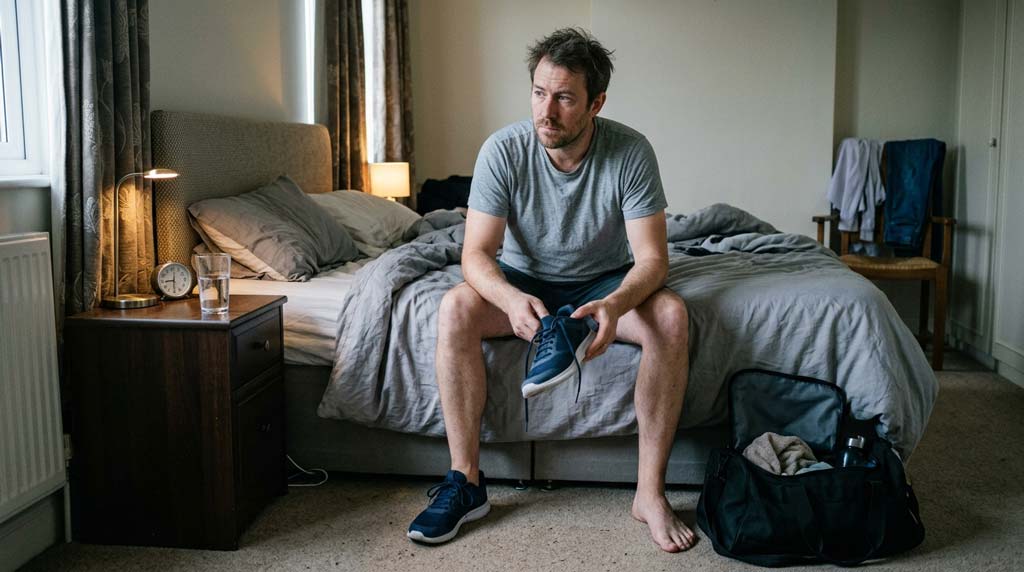
The advice on exercise after a bad night’s sleep now pulls in two directions. One side says to cut the session, drop the weight, or skip it. By contrast, the other side promises that a short, hard workout reverses the damage. Both cannot be right.
Underneath that argument sits a quieter assumption: that sleep is simply time not spent doing things. Yet sleep is an active regulatory state, not a pause in the day. It is a reversible condition of reduced sensory and motor activity that works continuously. Brain function, hormones, appetite and metabolism all depend on what happens during it.
Two processes decide when sleep arrives and how long it lasts. Pressure builds steadily during waking hours, while an internal clock sets when sleep comes easily. A third process then alternates the brain between two very different kinds of sleep.
Those kinds repeat in cycles of roughly 90 minutes across the night. Each cycle passes through one rapid-eye-movement (REM) phase and three non-REM phases. Brainwave patterns, muscle tone, heart rhythm and arousal thresholds all differ across them.
During those hours, the body repairs and replaces what waking has depleted. Muscle repair, tissue growth, protein synthesis and hormone release happen largely while you sleep. So a bad night is not lost idleness. It is lost work.
That is why the decision about exercise after a bad night’s sleep resists one answer. It depends on how the night failed, what the session demands, and whether the pattern repeats. Those three questions turn an argument into something a person can actually decide.
Why does sleep matter before exercise?
Sleep isn’t one uniform state, and that detail determines what a bad night actually costs. The two halves of the night do different jobs. Deep non-REM sleep dominates the first half, while REM sleep becomes more common later.
During non-REM sleep, brainwaves slow and move in a synchronised rhythm. That phase supports nervous system regeneration and energy conservation. It also releases anabolic hormones that drive protein synthesis for muscle recovery. Meanwhile, free fatty acids are mobilised to make adenosine triphosphate (ATP), the fuel cells use.
Growth hormone follows the same schedule. Around 70% of its overnight pulses occur during N3, the deepest non-REM stage. More N3 therefore means more growth hormone released in those pulses. An early alarm removes proportionally more REM sleep than deep sleep.
This matters before training because sleep’s hormonal work supports the training itself. Growth hormone, testosterone and insulin-like growth factors all shape how the body adapts to exercise. Sleep is where much of that signalling is scheduled.
This is the ground the argument about exercise after a bad night’s sleep usually skips. People debate the workout, then treat the night as a single number on a screen. Sleep health, however, depends on duration, quality and timing together. Any honest view of exercise after a bad night’s sleep has to start there. So the first question is not whether to train. It is what kind of night it actually was.
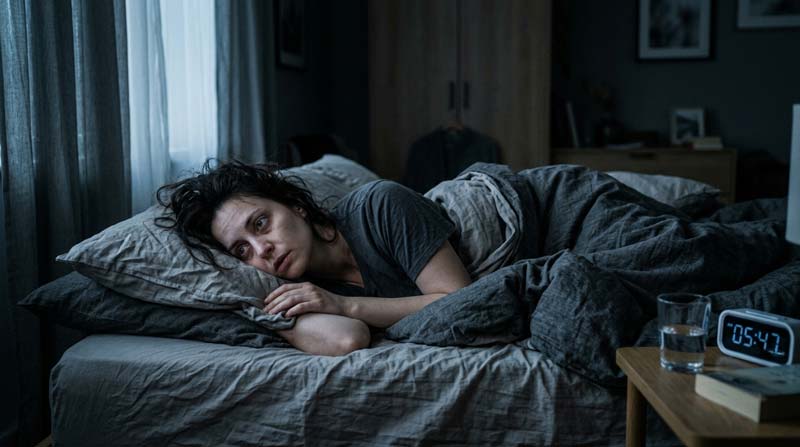
Was your sleep short or was it poor?
Short sleep and poor sleep are different failures, and they do not always occur together. Most advice fixes on duration alone. Adults are generally advised to obtain seven to nine hours each night.
Duration, though, is only one of several measurable qualities. Sleep onset latency describes how long it takes to fall asleep. Wake after sleep onset (WASO) counts the minutes spent awake once sleep has begun. Sleep efficiency describes the share of time in bed that is actually spent asleep.
Reference points exist for each. Falling asleep within 15 minutes, waking fewer than four times, and being awake for under 50 minutes afterwards all suggest good quality. Sleep efficiency of 85% or more sits in the same range. Around 25% of total sleep should be slow-wave sleep, the deepest stage. REM should occupy roughly 20% to 25%.
This is why six solid hours can beat eight broken ones. A person who wakes repeatedly may spend eight hours in bed and sleep far less. Fragmentation, not just short duration, is independently linked to daytime dysfunction. So the question before exercise after a bad night’s sleep is not only how long. It is how continuous, how efficient, and how well timed that sleep was.
Some people meet every number and still wake unrefreshed. That experience has its own name, non-restorative sleep, and it deserves to be taken seriously. Poor sleep health also includes patterns misaligned with the body clock or with social obligations. Shift work and a newborn both produce that mismatch, without any choice being involved.
One difficult night also differs from a run of restricted ones. Under repeated restriction, performance deteriorates progressively rather than settling at a new normal. Deficits show up most sharply during the morning hours. Recovery is slow too, needing several adequate nights rather than one long lie-in. Judging exercise after a bad night’s sleep therefore depends on the situation.
Which parts of your workout suffer first?
Performance is not a single score that rises or falls together. It is a set of separate capacities, and sleep loss reaches them at different speeds. That is why one bad night can leave an easy run untouched and a heavy lift ruined.
The physical cost appears quickly. A single night of reduced sleep can lower aerobic output by 10% to 30%. Muscle strength falls as well. Athletes who obtain more sleep, by contrast, show better speed, accuracy and reaction times.
Reaction time and motor skill are affected early too. Those two capacities matter far more in some sessions than in others. A missed repetition on a machine costs very little. A missed foot placement under a barbell costs a great deal more.
Attention behaves differently again. Attentional control weakens with sleep loss, separately from other mental functions. Adapting when conditions change mid-task also becomes harder. Sport, traffic and busy gyms all change conditions constantly.
Complex decisions suffer more than simple ones. Tasks depending on the prefrontal cortex, the brain’s planning and judgement centre, are hit hardest. That evidence comes partly from surgical trainees working fatigued, rather than from athletes. After one poor night, adults commonly report brain fog and confused thinking. Performance in that state can be worse than after two alcoholic drinks.
Taken together, sleep loss affects physical output, mental performance, recovery and injury risk. Much of this evidence comes from athletes, which is worth stating plainly. Still, the pattern explains why exercise after a bad night’s sleep needs sorting by type. Walking, easy cycling and steady movement carry a low cost when attention slips. Heavy maximal lifting, sprinting, technical skill work and contact sport do not. The question about exercise after a bad night’s sleep is really about consequences.
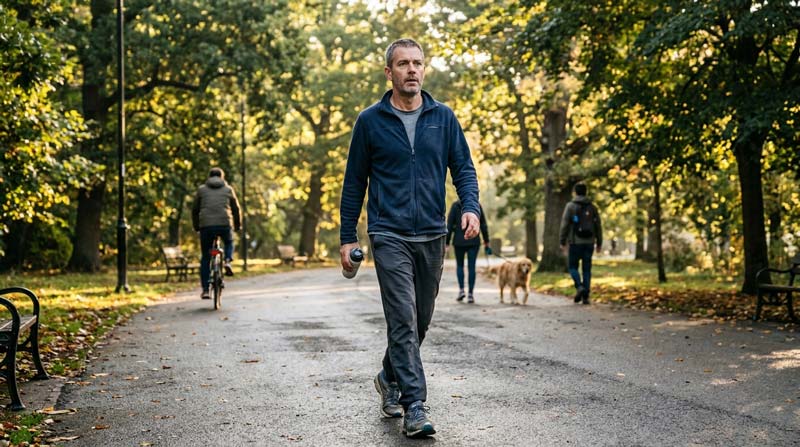
Is exercise after a bad night’s sleep still worthwhile?
Often, yes, though not always for the reason people expect. The clearest benefit is metabolic, and it has little to do with feeling sharp.
Sleep restriction disrupts how the body handles glucose. Insulin secretion becomes inadequate, insulin sensitivity falls, and appetite hormones shift. Leptin and ghrelin, which signal fullness and hunger, are both affected. Breakfast the following morning then produces a larger blood glucose rise than usual. Going to bed later than usual produces a similar effect.
Movement acts on the same system through a different door. Contracting muscle takes up glucose without needing insulin to open the way. A single session can raise that uptake as much as fivefold. The effect then fades, and improved insulin sensitivity replaces it for a time afterwards.
So exercise after a bad night’s sleep can do genuine work on the day itself. A walk after a broken night is not a wasted gesture. Even so, handling glucose better is not the same as being ready to perform. The metabolic benefit arrives while reaction time and judgement remain impaired.
The relationship also runs in the other direction. Regular activity over months supports sleep more reliably than any single hard session. One trial in Parkinson’s disease found chronic exercise improved sleep efficiency more than acute exercise. That population is specific, so the finding should not be stretched too far.
None of this makes exercise after a bad night’s sleep compulsory. A benefit that exists is not a benefit that must be taken today. What it does remove is the idea that a poor night makes movement pointless.
How should exercise after a bad night’s sleep change?
No trial has tested how to modify a session after one broken night. What exists instead is a set of principles that already handle uncertainty well. You can assemble them into a decision, provided nobody pretends it was tested directly.
Exercise screening already works this way. It asks about current activity levels, symptoms or known disease, and the intended intensity. Three inputs, weighed together, produce a decision without needing a rule for every case. Poor sleep can be added as a fourth input.
Four things then decide how much should change:
- How the night failed, whether by length, fragmentation or timing.
- How hard the session was meant to be.
- How much skill, speed or coordination it demands.
- What a mistake would actually cost.
That last input carries the most weight, because injury risk is not spread evenly. Walking and moderate activity carry very low injury risk. Contact with other people or with the ground raises it considerably. Intensity and type matter more than almost anything else.
The warm-up then becomes the test rather than a formality. Rating of perceived exertion (RPE) gives a usable reading during it. The scale tracks exercise intensity, although individuals vary considerably. It works best when anchored, meaning each rating is matched to a known feeling. If easy work feels unusually hard, that reading is information, not weakness.
From there, exercise after a bad night’s sleep has more than two outcomes. Proceeding as planned is one. Lowering intensity, cutting volume, reducing complexity, or swapping the activity are others. Stopping is also a legitimate result, not a failure of discipline.
Adaptation depends on balancing training load against adequate recovery. Sleep is part of that recovery, not a separate concern. Training hard on a depleted base therefore adds load without the matching repair. This framework for exercise after a bad night’s sleep is an evidence-informed synthesis. No study has ranked these options against each other in a head-to-head trial.
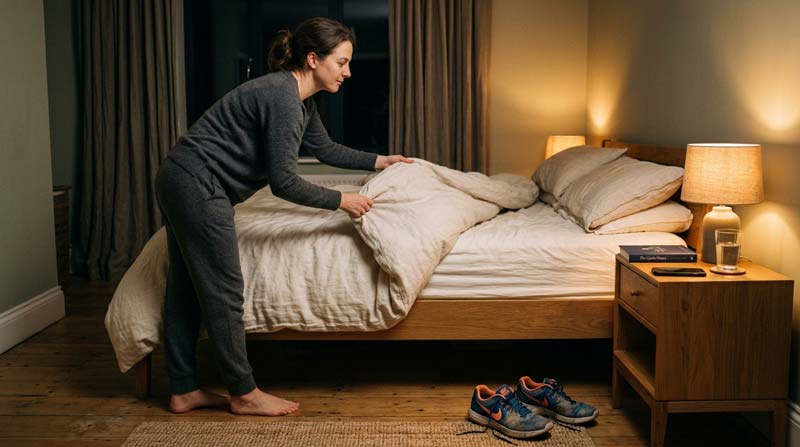
Can exercise after a bad night’s sleep undo the loss?
The word “doing the damage” in this argument is reversed. Reversal implies the debt has been cleared, which no countermeasure achieves. What countermeasures actually do is lift some outcomes while leaving others untouched.
Caffeine is the most studied of them. It can offset the high sleep pressure that builds during insufficient sleep. That effect is real and measurable across cognitive, physical and driving tasks.
The detail matters more than the headline. In one controlled trial, runners took repeated low doses of caffeine through a sleepless night. Endurance measures improved, including time to exhaustion and maximal oxygen uptake (VO2max). Repeated sprint performance, however, did not improve. The same substance, in the same people, produced mixed results.
That split is the honest answer to the reversal claim. Selected outcomes respond, while the underlying deficit stays the same. Feeling restored and being restored are not the same state.
Caffeine also carries a cost that lands after the workout. It can interfere with the following night’s sleep, which starts a loop. Poor sleep leads to caffeine, and caffeine then leads to more poor sleep. For someone already sleeping badly, that loop is the actual problem.
Naps occupy a narrower place than the discussion suggests. Short naps can support performance, although the evidence assumes decent night-time sleep alongside them. They supplement good sleep rather than substitute for missing sleep. The same limit applies to exercise after a bad night’s sleep.
One rough night and a repeated pattern are different problems with different exits. Recovery from sustained sleep restriction is remarkably slow compared with recovery from one sleepless night. Several adequate nights are needed, and the deficit does not clear on demand. For anyone sleeping in fragments most nights, exercise after a bad night’s sleep is the smaller question. The sleep itself is the larger one.
Movement still earns its place on a tired morning, for reasons the evidence supports. It handles glucose, supports sleep over time, and keeps a routine intact. What it does not do is settle the account. Exercise works best beside sleep, rather than in place of it.
Sources
- Amara AW, Wood KH, Joop A, et al. Randomized, Controlled Trial of Exercise on Objective and Subjective Sleep in Parkinson’s Disease. Mov Disord. 2020 Jun;35(6):947-958.
- Banks S, Dinges DF. Behavioral and physiological consequences of sleep restriction. J Clin Sleep Med 2007;3:519-28.
- Banks S, Van Dongen HPA, Maislin G, Dinges DF. Neurobehavioral dynamics following chronic sleep restriction: dose-response effects of one night for recovery. Sleep. 2010;33:1013-26.
- Belenky G, Wesensten N, Thorne DR, Thomas ML, Sing HC, Redmond DP, et al. Patterns of performance degradation and restoration during sleep restriction and subsequent recovery: a sleep dose-response study. J Sleep Res. 2003;12:1-12.
- Borbely A.A., Achermann P. Sleep homeostasis and models of sleep regulation. J. Biol. Rhythms. 1999;14:557-568.
- Borg GA. Psychophysical bases of perceived exertion. Med Sci Sports Exerc. 1982;14(5):377-81.
- Buysse D.J. Sleep Health: Can We Define It? Does It Matter? Sleep. 2014;37:9-17.
- Charest J., Grandner M.A. Sleep and Athletic Performance: Impacts on Physical Performance, Mental Performance, Injury Risk and Recovery, and Mental Health. Sleep Med. Clin. 2020;15:41-57.
- Fullagar H.H.K., Skorski S., Duffield R., Hammes D., Coutts A.J., Meyer T. Sleep and Athletic Performance: The Effects of Sleep Loss on Exercise Performance, and Physiological and Cognitive Responses to Exercise. Sports Med. 2015;45:161-186.
- Garber CE, Blissmer B, Deschenes MR, et al. American College of Sports Medicine position stand. The quantity and quality of exercise for developing and maintaining cardiorespiratory, musculoskeletal, and neuromotor fitness in apparently healthy adults: guidance for prescribing exercise. Med Sci Sports Exerc. 2011;43(7):1334-559.
- Goel N, Rao H, Durmer JS, et al. Neurocognitive consequences of sleep deprivation. Semin Neurol 2009;29(4):320-39.
- Halson S.L., Juliff L.E. Sleep, Sport, and the Brain. Prog. Brain Res. 2017;234:13-31.
- Institute of Medicine (US) Committee on Sleep Medicine and Research. Sleep Disorders and Sleep Deprivation: An Unmet Public Health Problem. Colten HR, Altevogt BM, editors. National Academies Press (US); Washington (DC): 2006.
- Irwin C, Khalesi S, Desbrow B, McCartney D. Effects of acute caffeine consumption following sleep loss on cognitive, physical, occupational and driving performance: a systematic review and meta-analysis. Neurosci Biobehav Rev. 2020;108:877-888.
- Khcharem A., Souissi W., Masmoudi L., Sahnoun Z. Repeated low-dose caffeine ingestion during a night of total sleep deprivation improves endurance performance and cognitive function in young recreational runners: a randomized, double-blind, placebo-controlled study. Chronobiology Int. 2022;39:1268-1276.
- Kierlin L, Olmstead R, Yokomizo M, Nicassio P, Irwin MR. Diagnostic and Statistical Manual criteria for insomnia related impairment in daytime functioning: Polysomnographic correlates in older adults. Sleep Med. 2012;13:958-60.
- Kraemer W.J., Ratamess N.A., Hymer W.C., Nindl B.C., Fragala M.S. Growth Hormone(s), Testosterone, Insulin-Like Growth Factors, and Cortisol: Roles and Integration for Cellular Development and Growth with Exercise. Front. Endocrinol. 2020;11:33.
- Magkos F, Tsekouras Y, Kavouras SA, Mittendorfer B, Sidossis LS. Improved insulin sensitivity after a single bout of exercise is curvilinearly related to exercise energy expenditure. Clin Sci (Lond) 2008;114:59-64.
- Ohayon M, Wickwire EM, Hirshkowitz M, et al. National Sleep Foundation’s sleep quality recommendations: first report. Sleep Health. Feb 2017;3(1):6-19.
- Riebe D, Franklin BA, Thompson PD, et al. Updating ACSM’s recommendations for exercise preparticipation health screening. Med Sci Sports Exerc. 2015;47(8):2473-9.
- Smith D.J. A Framework for Understanding the Training Process Leading to Elite Performance. Sports Med. 2003;33:1103-1126.
- Snel J, Lorist MM. Effects of caffeine on sleep and cognition. Prog Brain Res. 2011;190:105-117.
- Tsafrir Z, Korianski J, Almog B, et al. Effects of fatigue on residents’ performance in laparoscopy. J Am Coll Surg 2015;221:564-70.
- Tsereteli N, Vallat R, Fernandez-Tajes J, et al. Impact of insufficient sleep on dysregulated blood glucose control under standardised meal conditions. Diabetologia. 2022;65:356-365.
- Van Cauter E., Plat L. Physiology of growth hormone secretion during sleep. J. Pediatr. 1996;128:S32-S37.
- Venter R.E. Role of Sleep in Performance and Recovery of Athletes: A Review Article. S. Afr. J. Res. Sport Phys. Educ. Recreat. 2012;34:167-184.
- Watson N.F., Badr M.S., Belenky G., Bliwise D.L., Buxton O.M., Buysse D., Dinges D.F., Gangwisch J., Grandner M.A., Kushida C., et al. Joint consensus statement of the American Academy of Sleep Medicine and Sleep Research Society on the recommended amount of sleep for a healthy adult: Methodology and discussion. J. Clin. Sleep Med. 2015;11:931-952.
- Whitney P, Hinson JM, Satterfield BC, Grant DA, Honn KA, Van Dongen HPA. Sleep deprivation diminishes attentional control effectiveness and impairs flexible adaptation to changing conditions. Sci Rep. 2017;7:16020.