


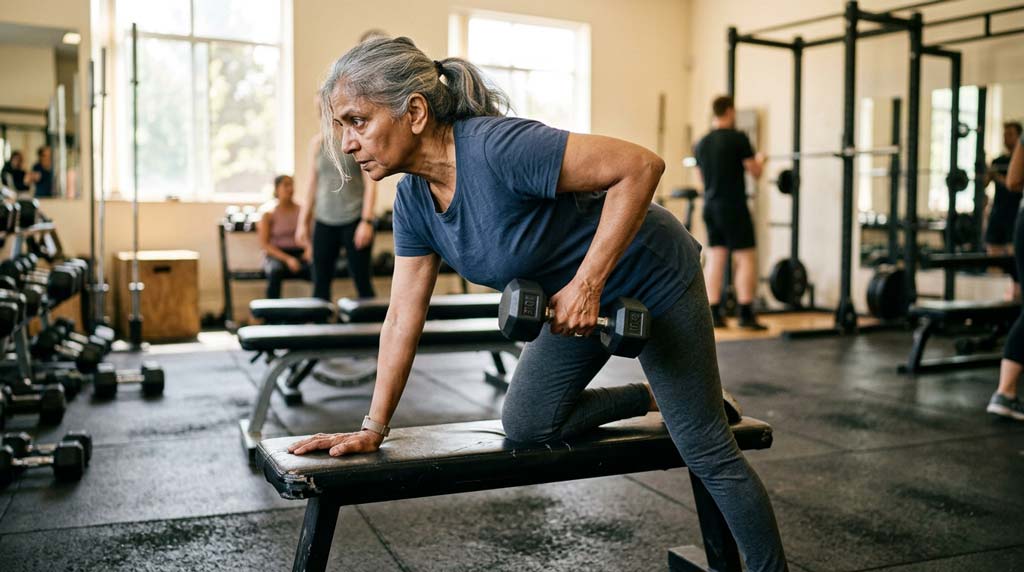
The promise of strength training to live longer has rarely rested on numbers this large. For years, lifting was framed as a young person’s pursuit, all mirrors and vanity. A piece of research now reframes it as something closer to medicine.
That research, published in the British Journal of Sports Medicine, followed 147,374 adults for up to 30 years. It logged 35,798 deaths along the way. It asked a sharper question than usual, not just whether people lifted, but how much.
The answer is oddly reassuring. The benefit climbs with each weekly session, then settles. Past a point, more effort buys nothing extra. There is a sweet spot, and it sits lower than gym lore suggests.
Underneath that headline sit three quieter puzzles. Why trust a single study at all? Why does cancer, alone among the big killers, reward less rather than more? And when time is short, should the hour go to cardio or to the weights rack? The replies are not the ones the headlines gave.
What 147,000 People and 30 Years of Data Actually Show
Big numbers can still mislead. The strength of this one lies in how it was built, not just how far it grew.
The figures come from three long-running American studies. Two followed nurses; one followed male health professionals. Each enrolled person was trained to report health with care, and then tracked for decades.
Most research asks about exercise once, then assumes nothing changed for twenty years. Habits do not work like that. So this study asked every two years again. It then averaged each person’s answers over time.
That rolling average matters. It captures the lasting habit, not a single good fortnight. The questionnaire on resistance training (working your muscles against a load) scored highly against detailed activity diaries.
The team also set traps for error. Anyone already living with heart disease, stroke or cancer was removed before counting began. A two-year gap sat between reporting and death. That guards against reverse causation, where illness quietly cuts activity, rather than the reverse.
Then came the adjustments. Age, smoking, diet, alcohol, weight, family history and aerobic activity were all accounted for. What remains is the contribution of strength training to live longer, stripped of the usual noise.
Deaths were checked against national records, not left to memory. With more than 98% traced, the ledger is nearly complete. That care is why strength training to live longer here reads as evidence, not opinion.
The Sweet Spot of Strength Training to Live Longer
Here is the figure that reframes the gym. Ninety minutes to two hours a week. That narrow band is where the risk of an early death sat lowest.
Below it, the benefit grew in steps. Each rise in weekly minutes shaved a little more off the risk. At ninety to one hundred and nineteen minutes, deaths from any cause fell by 13%.
Then the curve went flat. Pushing past two hours, the figure did not improve. It even crept back up. The body, for once, says enough and means it.
A wider body of research had hinted at this shape: strong gains at modest doses, fading returns at higher doses. Lifting earns its place on its own, reducing the odds of death even after accounting for cardio.
min
min
min
min
min
The promise of strength training to live longer is not a single number. The chart above tracks death from any cause. Yet the same dose moved three separate needles, each worth naming:
- Death from any cause, down 13%. The bluntest measure there is, folding in every other risk.
- Heart-related death, down 19%. A large fall for the body’s most common way of failing.
- Neurological death, down 27%. The steepest drop of the three, covering conditions like dementia (a loss of memory and thinking).
Why should lifting reach so far? Part of the reply is muscle itself. Working muscle calms the body’s background inflammation, the slow burn (raised TNF-alpha and CRP) of ageing.
The brain seems to listen as well. Hard effort boosts growth factors such as BDNF (a protein that helps brain cells survive and connect). One week of effort, it appears, pays out across very different organs.
None of this rewards excess. The case for strength training to live longer rests on reaching the band, not beating it. Sweat past the ceiling is effort the body files away unused.
Why More Is Not Better, and the Surprise with Cancer
Every rule keeps an outlier. In this study, cancer is it.
For heart and brain, the pattern stayed tidy. More lifting, up to the sweet spot, meant lower risk. Cancer broke ranks completely.
Here only the smaller doses helped. Between one and fifty-nine minutes a week, the risk of dying from cancer fell by roughly 9 to 12%. Then the benefit vanished. Higher doses brought no protection at all.
One group of cancers tied to activity responded more strongly, with falls near 20%. Bowel, bladder and breast cancer drove much of it. The case numbers there were small, so the finding asks for caution.
So why would extra lifting stop helping, perhaps even fall short? The prime suspect is a growth signal called IGF-1 (insulin-like growth factor 1), which muscle work tends to raise.
The same signal that builds muscle may, at higher levels, hand certain cancer cells an advantage. It is an honest wrinkle in the story of strength training to live longer.
Underneath sits a web of biology. Activity, body fat and cancer share routes through the body, insulin, sex hormones and inflammation among them. Strength work tugs several of these at once, and not always the same way.
The thread running through strength training to live longer is not that lifting fails against cancer. It is that the right dose shifts with the illness you hope to avoid.
Why Strength Training to Live Longer Works Best Alongside Cardio
Weights rarely work alone, and the credit should not either.
When the researchers grouped people by what they truly did, an order of merit appeared. Aerobic activity (cardio, the kind that leaves you breathing hard) shifted the odds far more than lifting by itself.
The figures are plain. Strength work alone lowered the risk of an early death by up to 11%. Cardio alone reached up to 43%. Together they did best, close to 47%.
A ceiling appeared here too. Once aerobic activity rose high enough, adding weights stopped cutting the death figure further. The body finds its limit again.
The two do separate jobs. Cardio trains the heart, lungs and vessels, the plumbing that keeps you upright. Weights build muscle, stabilise blood sugar, and strengthen bone. One cannot stand in for the other.
Why does cardio pull the bigger lever? Stiff arteries are among the surest signs of trouble ahead, and a firm predictor of death. Steady aerobic work keeps them supple.
Lifting plays differently. Heavy effort, held and strained, can briefly stiffen arteries, though regular training softens that effect over time. Cardio also drives changes in the vessels that weights do not match.
This is where strength training to live longer finds its true place. Not as the headlining act, but as the partner filling the gaps cardio leaves behind.
The pairing does more than add up. In people with heart disease, strength work added to cardio improved fitness and shape more than cardio alone.
So the wisest reading of strength training to live longer is a duet. Cardio leads, and weights make the result hold.

How to Build This Into a Normal Week
Knowing the number is the easy part. Threading it through a week of work, family and tiredness is the real task.
Strength training need not mean a barbell or a gym card. It is any effort where muscles push against resistance, weights, bands, or your own body weight.
The target for strength training to live longer is about 90 minutes to 2 hours a week. Split well, that is two or three short sessions, each touching the main muscle groups.
Where you begin depends on where you stand today. So match the entry point to the body you have, not the one you want:
- The time-poor: the shape of the week counts more than finding spare hours. Two compact sessions of pushes, pulls and squats already do real work.
- The older or out of practice: lighter loads with more repetitions bring their own reward, at less risk of strain. Resistance work stays safe even into frailty.
- The already active: the missing piece is often muscle, not more miles. A weekly bout or two of lifting reaches ground that running never touches.
If you are starting cold, patience comes before weight. A first month can look this simple:
- Begin light. One set of ten to fifteen easy repetitions, with form ahead of load.
- Add slowly. Nudge the time or weight up every couple of weeks, never in jumps.
- Rest the muscle. Leave a day between sessions for the same muscles to recover.
- Breathe through it. Let the air out on the effort, and never hold your breath, which can spike blood pressure.
- Two quiet bonuses come free. Loading the muscles loads the skeleton, so bone answers by growing stronger against the breaks age brings.
- Muscle, once built, needs feeding. Enough protein turns the effort into tissue that lasts. The work and the plate belong together.
All of this is the everyday face of the science, stripped of mystique. It asks for less time than most fear, and more care than most expect.
Consistency outscores intensity here. The reward of strength training for living longer goes to the habit you keep, not to the session you crush once and drop.
In the end, the figures say something gentler than the headlines did. Strength built across a life is not about chasing the heaviest weight or the longest hour. It is about the right amount, held steady, year after quiet year.
Ninety minutes to two hours a week, paired with the cardio that carries it, is the heart of it. That pairing buys more living than almost anything sold in a bottle. The body asks for less than we feared, and rewards it for longer than we hoped.
Not a miracle, and not a punishment. Just a dose within reach of an ordinary week. The return is measured in the years we get to keep.
Sources
- American College of Sports Medicine, Chodzko-Zajko WJ, Proctor DN, et al. American College of Sports Medicine Position Stand. Exercise and physical activity for older adults. Med Sci Sports Exerc 2009;41(7):1510-30.
- Cassilhas RC, Antunes HKM, Tufik S, de Mello MT. Mood, anxiety, and serum IGF-1 in elderly men given 24 weeks of high resistance exercise. Percept Mot Skills 2010;110:265-276.
- Chasan-Taber S, Rimm EB, Stampfer MJ, et al. Reproducibility and validity of a self-administered physical activity questionnaire for male health professionals. Epidemiology (Sunnyvale) 1996;7:81-6.
- Garber CE, Blissmer B, Deschenes MR, et al. American College of Sports Medicine position stand. Quantity and quality of exercise for developing and maintaining cardiorespiratory, musculoskeletal, and neuromotor fitness in apparently healthy adults: guidance for prescribing exercise. Med Sci Sports Exerc 2011;43(7):1334-59.
- Giovannucci E. A framework to understand diet, physical activity, body weight, and cancer risk. Cancer Causes Control 2018;29:1-6.
- Jurik R, Zebrowska A, Stastny P. Effect of an Acute Resistance Training Bout and Long-Term Resistance Training Program on Arterial Stiffness: A Systematic Review and Meta-Analysis. J Clin Med 2021;10:3492.
- Ketelhut RG, Franz IW, Scholze J. Regular exercise as an effective approach in antihypertensive therapy. Med Sci Sports Exerc 2004;36:4-8.
- Lee DH, Rezende LFM, Ferrari G, et al. Physical activity and all-cause and cause-specific mortality: assessing the impact of reverse causation and measurement error in two large prospective cohorts. Eur J Epidemiol 2021;36:275-85.
- Liguori G, American College of Sports Medicine. ACSM’s Guidelines for Exercise Testing and Prescription. 11th ed. Wolters Kluwer; 2022.
- Momma H, Kawakami R, Honda T, et al. Muscle-strengthening activities are associated with lower risk and mortality in major non-communicable diseases: a systematic review and meta-analysis of cohort studies. Br J Sports Med 2022;56:755-63.
- Morton RW, Murphy KT, McKellar SR, et al. A systematic review, meta-analysis and meta-regression of the effect of protein supplementation on resistance training-induced gains in muscle mass and strength in healthy adults. Br J Sports Med 2018;52(6):376-384.
- Nascimento W, Ferrari G, Martins CB, et al. Muscle-strengthening activities and cancer incidence and mortality: a systematic review and meta-analysis of observational studies. Int J Behav Nutr Phys Act 2021;18:69.
- Piepoli MF, Hoes AW, Agewall S, Albus C, Brotons C, Catapano AL, Cooney MT, Corra U, Cosyns B, Deaton C, Graham I, Hall MS, Hobbs FD, Lochen ML, Lollgen H, Marques-Vidal P, Perk J, Prescott E, Redon J, Richter DJ, Sattar N, Smulders Y, Tiberi M, van der Worp HB, van Dis I, Verschuren WM. 2016 European guidelines on cardiovascular disease prevention in clinical practice. Eur Heart J 2016;37:2315-2381.
- Renehan AG, Zwahlen M, Minder C, et al. Insulin-like growth factor (IGF)-I, IGF binding protein-3, and cancer risk: systematic review and meta-regression analysis. Lancet 2004;363:1346-53.
- Rich-Edwards JW, Corsano KA, Stampfer MJ. Test of the National Death Index and Equifax Nationwide Death Search. Am J Epidemiol 1994;140:1016-9.
- Santiago L, Neto L, Pereira G, Leite R, Mostarda C, De Oliveira Brito Monzani J, Sousa W, Pinheiro A, Navarro F. Effects of resistance training on immunoinflammatory response, TNF-alpha gene expression, and body composition in elderly women. J Aging Res 2018:1467025.
- Shailendra P, Baldock KL, Li LSK, et al. Resistance Training and Mortality Risk: A Systematic Review and Meta-Analysis. Am J Prev Med 2022;63:277-85.
- Terada T, Pap R, Thomas A, et al. Effects of muscle strength training combined with aerobic training versus aerobic training alone on cardiovascular disease risk indicators in patients with coronary artery disease: a systematic review and meta-analysis of randomised clinical trials. Br J Sports Med 2024;58:1225-34.
- Vlachopoulos C, Aznaouridis K, Stefanadis C. Prediction of cardiovascular events and all-cause mortality with arterial stiffness: a systematic review and meta-analysis. J Am Coll Cardiol 2010;55:1318-27.