


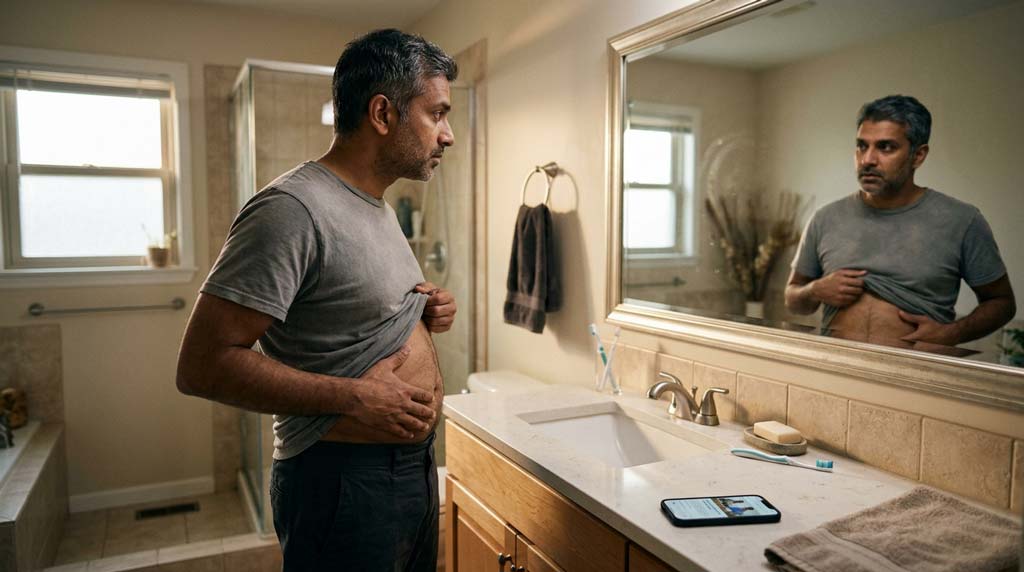
You exercise, you eat reasonably well, yet your belly keeps growing, and social media blames cortisol belly. This worry now appears everywhere in health and fitness content. The term refers to abdominal fat, or sometimes bloating, that people link to high cortisol levels. However, it is public language, not a formal medical diagnosis.
Cortisol itself is not a villain. In fact, your body needs it to regulate energy, blood sugar, and alertness. Adrenaline, the immediate fight-or-flight hormone, reacts first to a threat. Cortisol then follows, keeping you alert for longer. Problems begin only when its levels stay high for too long.
Even so, abdominal fat genuinely matters for health. Fat around the abdomen carries more risk than fat on the hips and thighs. Chronic stress can influence where the body stores fat, including the visceral depot. Visceral fat means the deep fat wrapped around your internal organs. This deep fat is metabolically active and tied to heart and metabolic disease. Severe cortisol excess can also reshape the body, as seen in Cushing’s syndrome, a rare disorder characterised by prolonged high cortisol levels.
The real question is harder than the slogans admit. Does belly fat prove a hormone problem, or is something simpler happening? This article treats cortisol belly as a doorway, not a conclusion. It examines what the phrase gets right, where it misleads, and what truly shapes fat around the waist.
What People Mean by Cortisol Belly
The phrase means different things to different people. For some, it is a softer, rounder stomach that resists dieting. Some call it a stress belly, or a hormonal belly. For others, it covers bloating, food cravings, poor sleep, or stalled weight loss. Some even include a puffier face under the same label.
These experiences are not the same thing. Mixing them is where confusion begins. Abdominal fat itself comes in two main forms. Subcutaneous fat sits just under the skin, where you can pinch it. Visceral fat lies deeper, around the internal organs. Visceral fat is the type most strongly linked to metabolic risk, including conditions such as high blood sugar and high blood pressure.
Bloating is different again. It usually reflects gas in the digestive tract or water retention, not stored fat. A bloated stomach can change within hours, whereas fat shifts slowly. So the same label can describe two very different things. The table below sets these forms apart at a glance.
| Type | What It Is | Where It Sits | How Fast It Changes | Health Link |
|---|---|---|---|---|
| Subcutaneous fat | Fat you can pinch | Just under the skin | Slowly, over weeks | Lower risk than visceral fat |
| Visceral fat | Deep fat around organs | Around the internal organs | Slowly, over weeks | Strongly tied to heart and metabolic risk |
| Bloating | Gas or water, not fat | Within the digestive tract | Within hours | Usually harmless, not stored fat |
Waist measurement helps cut through this confusion. Waist size captures both types of fat around the middle. A larger waist mostly reflects more visceral fat, not just skin-level fat. When people say cortisol belly, they usually mean this central, stubborn fat.
Body mass index, or BMI, adds further confusion. BMI compares weight to height but ignores where the fat is stored. Roughly a third of people in a healthy BMI range carry hidden metabolic risk. So cortisol belly is less a single condition than a bundle of different worries.
What Cortisol Belly Gets Right About Stress and Weight
The trend is not entirely wrong, which is why it spreads. Stress sets off a genuine biological cascade. The HPA axis, meaning the hypothalamic-pituitary-adrenal system, controls cortisol release. It works through feedback loops that keep the body in balance. Short bursts of cortisol are healthy and necessary.
Prolonged elevation is the real concern. Long-term cortisol excess is linked with obesity and depression. Stress also changes how people eat. It shifts the brain towards reward-driven, high-calorie food choices. Under pressure, many people eat later and pick energy-dense foods.
This is where the cortisol belly idea holds real truth. Stress can also disturb sleep and blood sugar regulation. Chronic stress can therefore nudge weight upward through several indirect routes. However, it rarely explains body changes entirely on its own. So cortisol belly captures a real mechanism, yet exaggerates its power.

What Cortisol Belly Gets Wrong About Belly Fat
The trend goes wrong when it treats one hormone as the whole story. Belly fat alone cannot diagnose a hormone problem. Many people with abdominal fat have entirely normal cortisol levels. Their fat pattern reflects genetics, diet, activity, and age.
Weight still follows energy balance over time. Fat changes when energy intake and expenditure fall out of balance. Roughly 3,500 calories equal about one pound of body fat. You also cannot target fat loss from one area. Lowering cortisol will not melt belly fat on its own. Cortisol detoxes and similar quick fixes have no sound basis.
Bodies also differ in how they respond to the same habits. In supervised exercise studies, weight loss varies widely between people. Some compensate by eating more, often without realising it.
Genes shape where fat sits and how easily it gathers. Your body also defends a genetic weight range, known as a set point. Twin studies show large individual differences in response to overfeeding. This is not about willpower or blame.
Genuine cortisol disease does exist, but it is rare. Cushing’s syndrome affects only about 10 to 15 people per million each year. It produces clear signs, not belly fat alone. The cortisol belly story flattens this complex picture into one cause. That makes it easy to sell, but misleading. Cortisol belly thinking overlooks the many factors that shape the waistline.
Why Sleep, Appetite, and Diet Matter
If cortisol is not the main lever, what is? Sleep, appetite, and diet do much of the real work. Poor sleep disturbs the hormones that control hunger. Short sleep lowers leptin, the fullness signal, and raises ghrelin, the hunger signal. As a result, hunger and appetite climb the next day.
The effects reach beyond appetite. Shorter sleep is consistently associated with a higher body mass index. Sleep loss also reduces glucose tolerance, meaning how well you handle blood sugar. Even partial sleep restriction impairs blood sugar control. Over time, this raises the risk of type 2 diabetes.
Tired people then lean on caffeine to keep going. Yet caffeine affects people very differently, partly because of genetics. Variants such as CYP1A2 (which clears caffeine) and ADORA2A (which sets sensitivity) matter. Late caffeine can also disrupt the next night, worsening the loop.
Disrupted sleep also shifts when and what people eat. Much of the cortisol belly experience traces back to these patterns. They are also more changeable than your hormone levels. So, the cortisol belly often reflects the effects of poor sleep and stress eating. These pathways are well documented, even when stress sits in the background.
How to Assess Belly Fat Without Guessing Your Cortisol
You do not need a cortisol test to understand your belly. Simple measurements tell you more than guesswork about hormones. Start with waist circumference, taken around the middle. Waist size strongly reflects the amount of deep abdominal fat. A raised waist measurement signals higher cardiometabolic risk, affecting the heart and metabolism.
The waist-to-hip ratio provides another simple estimate of visceral fat. Interestingly, waist and hip size respond to lifestyle and hormones. These include physical activity, smoking, and steroid hormones such as cortisol. So your measurements already reflect some hormonal influence.
BMI has clear limits as a personal measure. It cannot separate muscle from fat, or show fat location. Body fat percentage helps, but its accuracy varies by method. Home scales and callipers can mislead, while scans are costly. None of this requires you to chase a cortisol belly label. The table below compares these measures and their main limits.
| Measure | What It Shows | Main Limitation | Practical Note |
|---|---|---|---|
| Waist circumference | Deep abdominal fat | Misses overall body fat | A simple tape measure at the middle |
| Waist-to-hip ratio | Fat split between waist and hips | Needs two careful measurements | A useful estimate of visceral fat |
| BMI | Weight relative to height | Cannot separate muscle from fat | Misclassifies very muscular people |
| Body fat percentage | Proportion of fat to lean mass | Home methods can be inaccurate | Scans are accurate but costly |
Clinical assessment matters when warning signs appear. Rapid central weight gain, a rounder face, or purple stretch marks deserve medical review. Easy bruising, muscle weakness, or steroid use also warrant a check. These signs, not a cortisol belly label, are what should prompt testing.

What to Do Before Chasing Cortisol Hacks
Before buying supplements, focus on the levers with real evidence. Regular movement reduces deep abdominal fat, even without large weight loss. Aim for roughly 150 to 300 minutes of activity each week.
Building everyday steps, towards around 8,000 a day, helps too. Casual daily movement, called non-exercise activity thermogenesis (NEAT), also counts. It covers fidgeting, chores, and walking, and differs hugely between people. Resting metabolism (energy burned at rest) barely varies day to day, so movement is your main lever. Avoid overtraining, though, since too little recovery can itself raise cortisol.
Strength training deserves a place in the plan. It helps protect muscle while you lose fat. Prioritise regular, sufficient sleep on a consistent schedule. Improve food quality gradually, rather than chasing strict rules. Manage stress with methods that genuinely calm the nervous system. Meditation, breathing, time outdoors, and good company can all help.
Be cautious with supplements marketed for cortisol. They are loosely regulated, and some cause side effects like bloating. If you do use one, look for reputable third-party testing, like NSF certification, an independent quality mark. Whole foods remain a better source of nutrients than pills. Even popular minerals, like magnesium, work best from food, not as a cure-all.
There is no strong evidence supporting cortisol-blocking products for everyday weight loss. So chasing a cortisol belly cure usually wastes money. See a doctor if the red flags described earlier appear. The honest answer to cortisol belly is unglamorous but reliable. Sleep, movement, food quality, and stress care do the heavy lifting.
If your middle has changed and the internet has you worried, that concern is understandable. The honest picture is less dramatic than the trend suggests. Cortisol matters, and stress matters, but neither writes the whole story of belly fat. Far more often, sleep, food, movement, age, and genetics shape your waistline together.
So treat cortisol belly as a useful prompt, not a verdict on your body. The practical steps are measuring your waist, getting enough sleep, moving often, and seeking medical advice if you notice red flags. The cortisol belly label points at something real, yet the answer rarely sits in a single hormone.
Sources
- American College of Sports Medicine. ACSM’s Guidelines for Exercise Testing and Prescription. 10th ed. Philadelphia (PA): Lippincott Williams & Wilkins; in press.
- Bouchard C, Tremblay A, Despres JP, Nadeau A, Lupien PJ, Theriault G, Dussault J, Moorjani S, Pinault S, Fournier G. The response to long-term overfeeding in identical twins. N Engl J Med. 1990;322:1477-1482.
- Browning LM, Hsieh SD, Ashwell M. A Systematic Review of Waist-To-Height Ratio as a Screening Tool for the Prediction of Cardiovascular Disease and Diabetes: 0.5 Could Be a Suitable Global Boundary Value. Nutrition Research Reviews. 2010;23(2):247-269.
- Cameron AJ, Romaniuk H, Orellana L, Dallongeville J, Dobson AJ, Drygas W, Ferrario M, Ferrieres J, Giampaoli S, Gianfagna F, Iacoviello L, Jousilahti P, Kee F, Moitry M, Niiranen TJ, Pajak A, Palmieri L, Palosaari T, Satu M, Tamosiunas A, Thorand B, Toft U, Vanuzzo D, Veikko S, Veronesi G, Wilsgaard T, Kuulasmaa K, Soderberg S. Combined Influence of Waist and Hip Circumference on Risk of Death in a Large Cohort of European and Australian Adults. J Am Heart Assoc. 2020 Jul 7;9(13):e015189.
- Chait A, den Hartigh LJ. Adipose tissue distribution, inflammation and its metabolic consequences, including diabetes and cardiovascular disease. Front Cardiovasc Med. 2020;7:22.
- Dini I, Mancusi A. Weight Loss Supplements. Molecules. 2023;28:5357.
- Donnelly JE, Blair SN, Jakicic JM, et al. American College of Sports Medicine position stand. Appropriate physical activity intervention strategies for weight loss and prevention of weight regain for adults. Med Sci Sports Exerc. 2009;41(2):459-71.
- Fox CS, Massaro JM, Hoffmann U, et al. Abdominal visceral and subcutaneous adipose tissue compartments: association with metabolic risk factors in the Framingham Heart Study. Circulation. 2007;116(1):39-48.
- Han TS, Bijnen FC, Lean MEJ, et al. Separate associations of waist and hip circumference with lifestyle factors. Int J Epidemiol. 1998;27:422-430.
- Kyrou I, Chrousos GP, Tsigos C. Stress, visceral obesity, and metabolic complications. Ann N Y Acad Sci. 2006;1083:77-110.
- Leproult R, Van Cauter E. Role of sleep and sleep loss in hormonal release and metabolism. Endocr Dev. 2010;17:11-21.
- Lonn L, Kvist H, Ernest I, et al. Changes in body composition and adipose tissue distribution after treatment of women with Cushing’s syndrome. Metabolism. 1994;43:1517-1522.
- McEwen BS. Central effects of stress hormones in health and disease: understanding the protective and damaging effects of stress and stress mediators. Eur J Pharmacol. 2008;583:174-185.
- Melanson EL, Keadle SK, Donnelly JE, et al. Resistance to exercise-induced weight loss: compensatory behavioral adaptations. Med Sci Sports Exerc. 2013;45:1600-1609.
- Muller MJ, Baracos V, Bosy-Westphal A, et al. Functional body composition and related aspects in research on obesity and cachexia: report on the 12th Stock Conference. Obes Rev. 2014;15(8):640-56.
- Nehlig A. Interindividual differences in caffeine metabolism and factors driving caffeine consumption. Pharmacol Rev. 2018;70(2):384-411.
- Peterson MD, Sen A, Gordon PM. Influence of Resistance Exercise on Lean Body Mass in Aging Adults: A Meta-Analysis. Med Sci Sports Exerc. 2011;43:249-258.
- Ross R, Neeland IJ, Yamashita S, Shai I, Seidell J, Magni P, Santos RD, Arsenault B, Cuevas A, Hu FB, Griffin BA, Zambon A, Barter P, Fruchart JC, Eckel RH, Matsuzawa Y, Despres JP. Waist circumference as a vital sign in clinical practice: a consensus statement from the IAS and ICCR working group on visceral obesity. Nat Rev Endocrinol. 2020;16(3):177-189.
- Seidell JC, Perusse L, Despres JP, Bouchard C. Waist and hip circumferences have independent and opposite effects on cardiovascular disease risk factors: the Quebec Family Study. Am J Clin Nutr. 2001 Sep;74(3):315-21.
- Spiegel K, Tasali E, Penev P, Van Cauter E. Brief communication: Sleep curtailment in healthy young men is associated with decreased leptin levels, elevated ghrelin levels, and increased hunger and appetite. Ann Intern Med. 2004;141:846-850.
- Taheri S, Lin L, Austin D, Young T, Mignot E. Short sleep duration is associated with reduced leptin, elevated ghrelin, and increased body mass index. PLoS Med. 2004 Dec;1(3):e62.
- Thompson JL, Manore MM, Vaughan LA. The Science of Nutrition. 4th ed. Upper Saddle River, NJ: Pearson; 2017. 773 p.
- Tomiyama AJ, Hunger JM, Nguyen-Cuu J, Wells C. Misclassification of cardiometabolic health when using body mass index categories in NHANES 2005-2012. Int J Obes. 2016;40(5):883-6.
- Tryon MS, Carter CS, Decant R, Laugero KD. Chronic stress exposure may affect the brain’s response to high-calorie food cues and predispose to obesogenic eating habits. Physiology & Behavior. 2013;120:233-242.
- Ulrich-Lai YM, Herman JP. Neural regulation of endocrine and autonomic stress responses. Nat Rev Neurosci. 2009;10(6):397-409.
- Verheggen RJHM, Maessen MFH, Green DJ, Hermus ARMM, Hopman MTE, Thijssen DHT. A systematic review and meta-analysis on the effects of exercise training versus hypocaloric diet: distinct effects on body weight and visceral adipose tissue. Obes Rev. 2016;17(8):664-690.
- Yau YH, Potenza MN. Stress and eating behaviors. Minerva Endocrinol. 2013;38(3):255-267.