


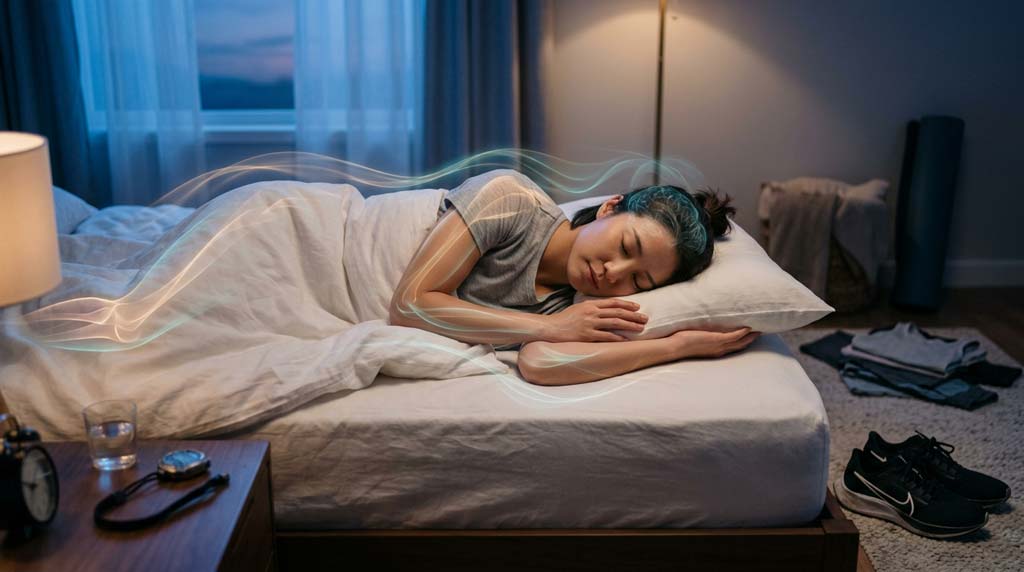
Quality sleep enhances performance across multiple dimensions of athletic capability, impacting reaction times, muscle recovery, and movement efficiency. The relationship between sleep and physical achievement involves complex biological processes that influence strength, speed, and skill development.
Athletes who consistently achieve proper sleep demonstrate remarkable improvements in their physical capabilities. Studies reveal that adequate sleep can boost speed and accuracy by significant margins. In contrast, even a single night of poor sleep can diminish aerobic output by up to 30%. These findings highlight how quality sleep enhances performance at both elite and recreational levels.
During sleep, our bodies engage in sophisticated recovery and adaptation processes. The muscles undergo vital repair work, energy stores replenish, and motor memories consolidate to improve movement patterns. This biological orchestra works in harmony through different sleep stages, each playing a crucial role in athletic development.
Sleep’s influence extends to crucial aspects of athletic safety and longevity. Research indicates that athletes who sleep fewer than 8 hours face a significantly higher injury risk, underscoring sleep’s role in physical resilience. Moreover, the timing and quality of post-performance sleep directly impact recovery rates and subsequent training adaptations.
The forthcoming sections examine sleep’s multifaceted role in athletic excellence. We’ll explore how sleep affects motor learning, muscle recovery, and reaction times, revealing practical insights about sleep’s impact on physical performance. These findings demonstrate why sleep deserves priority status in any serious training programme.
Why Quality Sleep Enhances Performance in Athletes
Athletic performance declines measurably with inadequate sleep. Studies demonstrate that even a single night of reduced sleep decreases aerobic capacity by 10-30% and significantly diminishes muscle strength. This relationship between sleep and physical capability impacts both professional and amateur athletes.
Sleep plays a vital role in reaction time and decision-making abilities. Athletes experiencing sleep loss exhibit markedly slower responses and lower performance accuracy. These impairments directly affect sports that require quick reflexes and precise movements, where quality sleep enhances performance by improving cognitive processing.
The timing of sleep also significantly influences athletic outcomes. Post-training sleep helps consolidate physical adaptations and improve subsequent performance. Studies show that proper sleep after learning new physical skills leads to greater improvement than equivalent periods of wakefulness.
Motor Learning Development Through Rest
Sleep facilitates crucial physiological recovery processes essential for athletic performance. During non-REM (rapid eye movement) sleep, the body increases cardiovagal drive (heart-nerve stimulation) while reducing sympathetic activity, maintaining stable blood pressure and heart rate. This state optimises physical recovery and adaptation.
The restoration process during sleep involves complex cellular mechanisms. Sleep deprivation studies show significant changes in inflammatory responses and cellular signalling pathways. These alterations affect the body’s ability to repair muscle tissue and adapt to training stimuli, highlighting how quality sleep enhances performance through biological recovery.
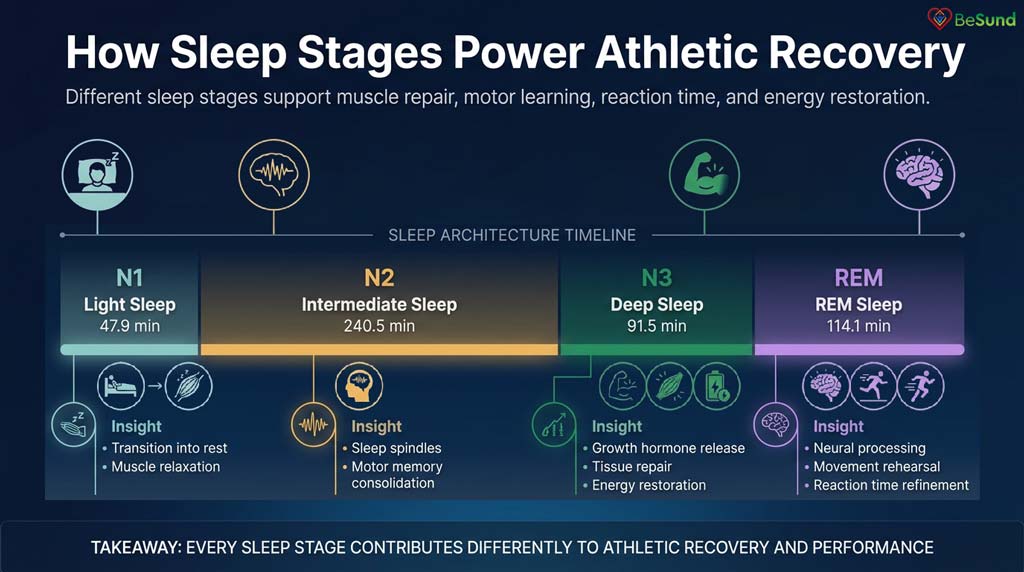
Athletic recovery depends heavily on sleep architecture (sleep stage patterns). Evidence shows that athletes typically spend 114.1 minutes in REM sleep, 47.9 minutes in N1 (light sleep), 240.5 minutes in N2 (intermediate sleep), and 91.5 minutes in N3 (deep sleep). Each stage contributes uniquely to physical restoration and performance enhancement.
Sleep’s impact on recovery extends to hormone regulation and energy restoration. During sleep, anabolic (tissue-building) hormones increase to support muscle recovery and protein synthesis. At the same time, fatty acids mobilise for ATP (energy) production. This hormonal environment optimises both recovery and subsequent performance capacity.
How Quality Sleep Enhances Performance and Recovery
Research indicates that elite athletes require approximately 8.3 hours of sleep for optimal performance. Sleep patterns vary significantly among athletes, depending on factors such as age, sport type, and training phase. Evidence shows that quality sleep enhances performance across all athletic disciplines, underscoring the need for personalised approaches to sleep management.
Higher-ranked teams consistently demonstrate better sleep duration records in competitions. Data shows that longer sleep periods correlate directly with improved athletic outcomes and final placement in multi-day tournaments. The quality of sleep particularly affects decision-making abilities and technical execution during crucial competitive moments.
Sleep requirements intensify during periods of high training demands. Athletes in pre-season or intense training blocks benefit most from getting 8-10 hours of sleep each night. This increased sleep duration supports proper recovery and enables optimal adaptation to training stimuli.
Environmental factors significantly influence sleep quality. Studies demonstrate that exposure to natural light during the day improves sleep efficiency and reduces the time to fall asleep. Athletes who optimise their sleep environment show enhanced recovery rates and sustained performance improvements.
Active individuals can improve their sleep quality through structured physical activity. Research reveals that moderate aerobic exercise enhances sleep duration, efficiency, and overall quality. These improvements translate into heightened energy levels and improved physical performance throughout training cycles.

Optimal Sleep Guidelines for Athletes
Sleep actively strengthens motor memory and skill acquisition. During REM sleep, multiple brain regions, including the hippocampus, cerebellar cortex, and red nucleus, activate through muscle twitches. Studies demonstrate how quality sleep enhances the performance of complex motor skills through this activation pattern, reinforcing newly learned movement patterns and enhancing motor development.
Research on motor learning reveals significant performance improvements after sleep. Studies examining finger sequence tapping show enhanced speed and accuracy following sleep compared to equivalent wake periods. Sleep’s influence on motor memory consolidation directly impacts skill mastery and technical proficiency.
The relationship between sleep and procedural learning varies across age groups. Studies demonstrate that even brief naps benefit locomotor task performance in developing athletes. Participants who napped showed fewer errors and required fewer attempts to master new movement patterns.
Sleep spindles (brief bursts of brain activity during N2 sleep) play a crucial role in enhancing motor skills. These spindles correlate with improvements in both speed and accuracy of procedural motor skills. Their presence indicates active neural processing of movement patterns during rest periods.
Athletes who miss adequate sleep exhibit impaired reaction times and decreased motor control. These deficits affect both simple and complex movement patterns, highlighting sleep’s fundamental role in maintaining motor performance and technical execution.
The scientific evidence confirms sleep’s vital role in athletic excellence. From cellular recovery to skill enhancement, quality sleep enhances performance at every level of athletic development. Sleep represents a powerful tool in the pursuit of athletic achievement, working silently yet effectively to optimise human physical potential.
Sources
- Backhaus J, Junghanns K. Daytime naps improve procedural motor memory. Sleep Med 7: 508–512, 2006
- Barakat M, Doyon J, Debas K, et al. Fast and slow spindle involvement in the consolidation of a new motor sequence. Behav Brain Res 217: 117–121, 2011
- Berger SE, Scher A. Naps improve new walkers’ locomotor problem solving. J Exp Child Psychol 2017;162:292–300
- Dempsey JA, Smith CA. Pathophysiology of human ventilatory control. Eur Respir J 2014;44:495–512
- Fullagar H.H.K., Skorski S., Duffield R., Hammes D., Coutts A.J., Meyer T. Sleep and Athletic Performance: The Effects of Sleep Loss on Exercise Performance, and Physiological and Cognitive Responses to Exercise. Sports Med. 2015;45:161–186
- Goel N, Rao H, Durmer JS, et al. Neurocognitive consequences of sleep deprivation. Semin Neurol 2009;29(4):320–39
- Juliff LE, Halson SL, Hebert JJ, Forsyth PL, Peiffer JJ. Longer sleep durations are positively associated with finishing place during a national multiday netball competition. J Strength Cond Res. 2018;32:189–194
- King AC, Oman RF, Brassington GS, Bliwise DL, Haskell WL. Moderate-intensity exercise and self-rated quality of sleep in older adults. Jama. 1997;277(1):32–7
- Knufinke M, Nieuwenhuys A, Maase K. Effects of natural between-days variation in sleep on elite athletes’ psychomotor vigilance and sport-specific measures of performance. J Sports Sci Med. 2018;17:515–524
- Irwin MR, Wang M, Campomayor CO, Collado-Hidalgo A, Cole S. Sleep deprivation and activation of morning levels of cellular and genomic markers of inflammation. Arch Intern Med. 2006;166:1756–62
- Malhotra R.K. Sleep, Recovery, and Performance in Sports. Neurol. Clin. 2017;35:547–557
- Marshall G.J.G., Turner A.N. The Importance of Sleep for Athletic Performance. Strength Cond. J. 2016;38:61–67
- Sargent C., Lastella M., Halson S.L., Roach G.D. How Much Sleep Does an Elite Athlete Need? J. Sports Physiol. Perform. 2021;16:1746–1757
- Sassin J.F., Parker D.C., Mace J.W., et al. Human Growth Hormone Release: Relation to Slow-Wave Sleep and Sleep-Waking Cycles. Science. 1969;165:513–515
- Series F, Cormier Y, Desmeules M. Influence of passive changes of lung volume on upper airways. J Appl Physiol 1990;68(5):2159–64
- Tiriac, A., Uitermarkt, B.D., Fanning, A.S. Rapid whisker movements in sleeping newborn rats. Curr. Biol. 2012; 22:2075-2080
- Venter R.E. Role of Sleep in Performance and Recovery of Athletes: A Review Article. S. Afr. J. Res. Sport Phys. Educ. Recreat. 2012;34:167–184
- Wallace-Guy, GM, Kripke, DF, Jean-Louis, G. Evening light exposure: implications for sleep and depression. J Am Geriatr Soc. 2002; 50:738-739
- Wall SP, Mattacola CG, Swanik CB, Levenstein S. Sleep efficiency and overreaching in swimmers. J Sport Rehabil. 2003;12:1–12