


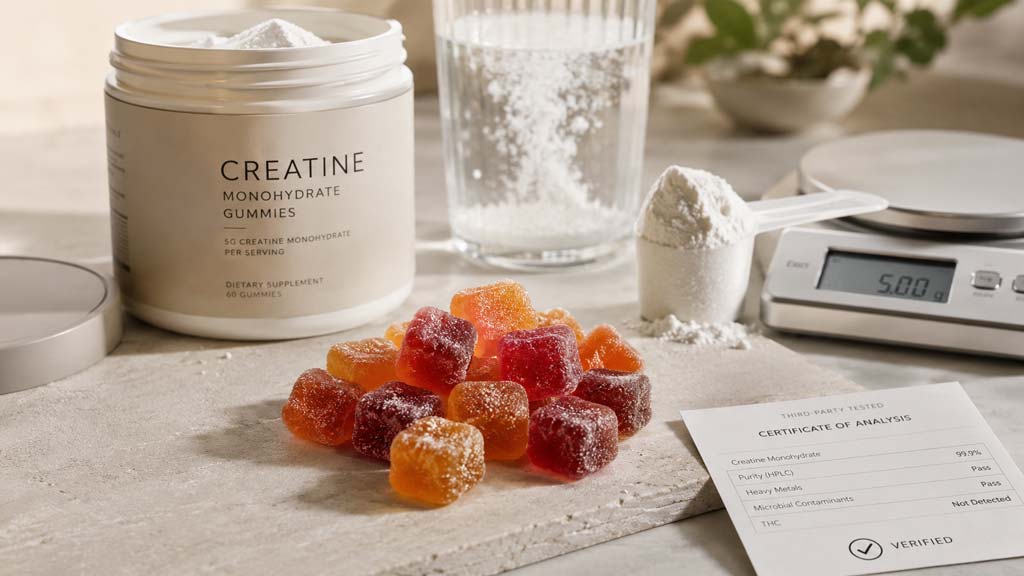
Creatine gummies have spread from gym bags into supermarket aisles, handbags, and ordinary morning routines. Their rise reflects a wider shift, as creatine moves from a niche sports aid into mainstream wellness.
That popularity, however, has outpaced the evidence for the chewable format itself. Most of what buyers read concerns the molecule creatine rather than the sweetener that now delivers it.
This matters because a delivery format and an active ingredient are not the same thing. The molecule rests on decades of research, whereas the gummy has almost none.
A gummy only earns that research if it actually contains a full, stable dose of creatine. The answer turns on two questions: whether creatine gummies contain what they claim, and when they beat powder.
What a Creatine Gummy Actually Is
A creatine gummy is best understood as a carrier rather than a new kind of supplement. Inside most of them sits creatine monohydrate, the form on which almost all research is built.
Around that active ingredient sit sweeteners, flavourings, food acids, and the gelling agents that hold the shape. Monohydrate remains the standard because it is well absorbed and inexpensive. For the underlying biology, our creatine fundamentals guide explains how the body uses it.
Manufacturers often promote newer chemical forms, such as creatine ethyl ester, citrate, gluconate, and magnesium chelate. Each promises sharper absorption or better stability, yet the evidence has never matched that of the monohydrate. Blended products follow the same pattern, mixing creatine with carbohydrate, caffeine, or herbal extracts. Such combinations have not been shown to be more effective, and the safety of some remains unproven.
None of this reveals how much creatine sits inside any particular gummy. Creatine gummies are sold on the promise of convenience, not on proof of an effective dose. Diet alone supplies only one to two grams of creatine each day, mostly from meat and fish.
That intake leaves muscle stores well below saturation, which is the gap a supplement is meant to close. A supplement, however, only closes it when the dose on the label is genuinely present. That is the assurance that creatine gummies rarely provide on the wrapper.

Do Creatine Gummies Work? What the First Study Shows
Until recently, the honest position was that no one had actually tested the gummy format. That changed in early 2026, with the first controlled trial of creatine delivered as gummies. Researchers followed thirty-two female beach volleyball athletes over ten weeks of supplementation. One group took five grams of creatine a day in gummy form, while a control group took none.
The supplemented athletes improved on the measures that matter for explosive movement. Their vertical jump rose by around two centimetres, while the control group instead declined.
They also changed direction faster, and held their body fat steady as the control group’s rose. Lean mass and reaction time, by contrast, showed no advantage from supplementation.
These results are encouraging, yet they rest on a single, modest study. Creatine gummies were tested in only thirty-two athletes, with no placebo (a dummy treatment) for comparison. Belief in the supplement could therefore have shaped part of the outcome. Diet and training were left uncontrolled, and muscle creatine itself was never measured.
The participants were athletes, which limits how far the findings stretch to everyday users. Even so, the underlying biology is not specific to sport. Creatine works by recycling cellular energy, a process common to muscle and brain alike. Women may respond particularly well, since they tend to begin with lower creatine stores.
One feature of the trial matters more than any single result. The creatine gummies used had been independently verified to contain their stated dose.
The Dose You Cannot See
A supplement can only deliver what the product genuinely contains: in this case, creatine in gummy form; that cannot be assumed. Independent testing of commercial gummies has found their creatine content varying sharply between brands. Several products contained noticeably less creatine than their labels promised.
This problem sits within a wider weakness in how supplements are governed. Because the sector is loosely regulated, products can contain less or more than the stated dose. For creatine gummies, that uncertainty turns a convenient product into something of a gamble. The dependable safeguard is third-party testing, in which an outside laboratory confirms the contents.
Certifications such as NSF Certified for Sport signal that a product has passed this scrutiny. Notably, the gummy that worked in the trial was a verified, full-dose product. That distinction is the heart of the matter for anyone weighing creatine gummies. A verified gummy can work; an unverified one is simply an unknown.

The Sugar in the Gummy
A gummy is not only a supplement; it is also a confectionery. Many are sweetened with added sugar to make a daily dose palatable. Across the diet as a whole, high-sugar, high-glycaemic eating tracks with a greater risk of type 2 diabetes and heart disease. A single gummy will not cause disease, but a daily habit quietly adds to the day’s sugar.
The sugar-free versions are not automatically the safer choice. They rely instead on sweeteners and sugar alcohols, which are low-calorie sugar substitutes. Artificial sweeteners may unsettle the gut, reduce feelings of fullness, and alter how the body manages glucose. For that reason, creatine gummies marketed as sugar-free still merit a careful look at the ingredients.
Beyond the sweetness, the format brings its own minor burdens. Colours, flavours, and gelling agents can trigger bloating, cramps, or occasional allergy in sensitive people. None of this is unique to creatine, yet creatine gummies gather several additives into one moreish sweet. For anyone watching their blood sugar, that easily forgotten total is the detail most worth weighing.

Gummies or Powder: Making the Call
Set beside plain powder, the gummy is best seen as a convenience bought at a premium. Creatine monohydrate powder remains the most proven, best absorbed, and least expensive option.
A daily three to five grams is sufficient, and the loading phase is optional rather than essential. It dissolves in water within seconds and adds nothing to your sugar intake.
Even so, creatine gummies are not a gimmick to be dismissed outright. For someone who dislikes powder, travels often, or struggles to swallow capsules, a proven gummy is a reasonable option.
The decisive condition, however, remains independent verification of the dose. A verified product behaves exactly like the creatine it claims to contain.
Cost forms the other half of the decision. Compared with powder, creatine gummies usually cost far more for each effective gram, not just each serving. The fairer comparison weighs price against the creatine that actually reaches the muscle, not the packaging. For how each form suits different goals, our brain-health guide sets out the options in depth.
In the end, the format is not what determines value. A creatine gummy is only ever as good as the dose you cannot see. Whether that dose is truly present is the question that settles everything.
Sources
- Brosnan ME, Brosnan JT. The role of dietary creatine. Amino Acids. 2016;48:1785-1791.
- Dini I, Mancusi A. Weight Loss Supplements. Molecules. 2023;28:5357.
- Fazio C, Elder CL, Harris MM. Efficacy of Alternative Forms of Creatine Supplementation on Improving Performance and Body Composition in Healthy Subjects: A Systematic Review. J Strength Cond Res. 2022;36:2663-2670.
- Hall M, Trojian TH. Creatine supplementation. Curr Sports Med Rep. 2013;12:240-244.
- Harris RC, Söderlund K, Hultman E. Elevation of creatine in resting and exercised muscle of normal subjects by creatine supplementation. Clin Sci. 1992;83:367-374.
- Huang Y, Chen Z, Chen B, et al. Dietary sugar consumption and health: umbrella review. BMJ. 2023;381:e071609.
- Kreider RB, Jäger R, Purpura M. Bioavailability, Efficacy, Safety, and Regulatory Status of Creatine and Related Compounds: A Critical Review. Nutrients. 2022;14:1035.
- Kreider RB. Effects of creatine supplementation on performance and training adaptations. Mol Cell Biochem. 2003;244:89-94.
- Kreider RB, Kalman DS, Antonio J, et al. International Society of Sports Nutrition position stand: safety and efficacy of creatine supplementation in exercise, sport, and medicine. J Int Soc Sports Nutr. 2017;14:18.
- Montemarano M. NOW reports widespread failings in creatine gummy tests. Nutraceuticals World; 2026 (accessed 24 June 2026).
- Pearlman M, Obert J, Casey L. The association between artificial sweeteners and obesity. Curr Gastroenterol Rep. 2017;19(12):64.
- Pereira F, Forbes SC, Romano V, Christopher P, Santana JC, Antonio J. Effects of Creatine Monohydrate Gummies on Performance and Body Composition in Female Beach Volleyball Athletes. J Funct Morphol Kinesiol. 2026;11(1):105.
- Sirois J, Reddy S, Nguyen T, et al. Safety Considerations for Dietary Supplement Manufacturers in the United States. Regul Toxicol Pharmacol. 2024;147:105544.
- Smith-Ryan AE, Cabre HE, Eckerson JM, Candow DG. Creatine supplementation in women’s health: a lifespan perspective. Nutrients. 2021;13:877.