


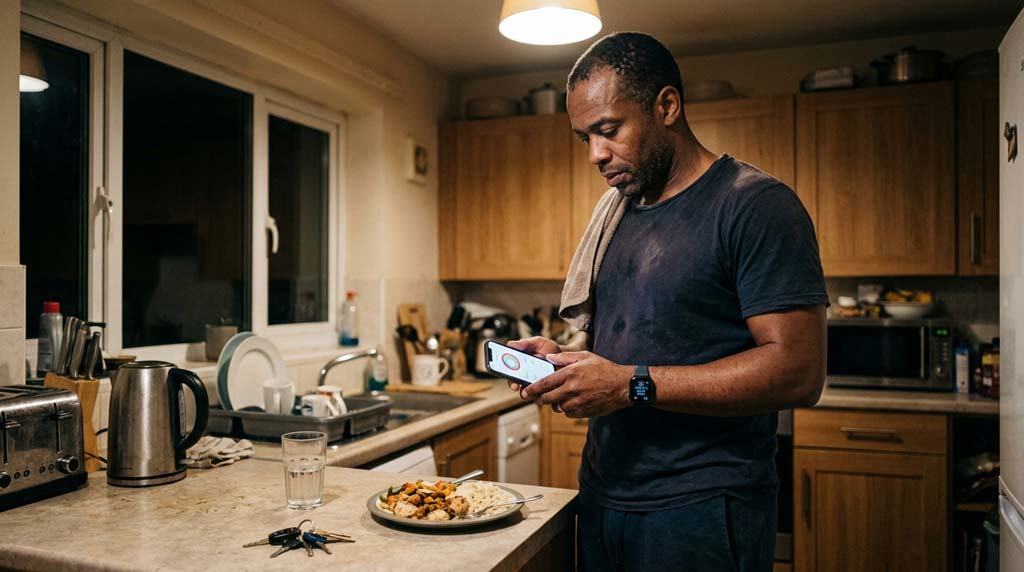
A workout syncs, the daily food budget rises, and the question of whether to eat back exercise calories arrives. The app has done something quietly significant. It has converted effort into permission. Some people spend the whole amount without hesitation. Others refuse on principle, convinced that eating afterwards cancels the work.
Both positions sound like discipline, yet both are guesses. The honest answer depends first on how the calorie target was built. A target that already assumes training is a different object from one that assumes none. Then it depends on what the training actually demands. An easy half hour and a three-hour ride are not the same event.
There is a further complication, and it sits on the wrist. The figure a device reports is an estimate rather than a measurement. Estimates carry error, and the direction of that error is not fixed. So the number that raises the food budget is softer than it appears.
None of this makes exercise pointless during weight loss. Adherence to training predicts overall energy expenditure better than the calories burned in any single session. Nor does eating more automatically signal failure. Among people who kept substantial weight off across four years, high activity often came with higher food intake.
The value of training also extends well past the figure it produces. Regular activity supports psychological well-being, cardiovascular fitness and the maintenance of lost weight. Exercise during restriction reduces lean tissue loss and blunts the fall in resting metabolism. None of that appears anywhere on a calorie display.
This article offers a way of deciding rather than a rule to obey. The decision to eat back exercise calories turns on three things. How the target was constructed, what the training demands, and how the body responds over weeks.
Individual responses to the same exercise programme vary considerably, which is why a universal percentage fails. That third element takes time, because a single day reveals almost nothing. Weight management depends on adjustments that can be sustained, rather than on one correct number.
What Does It Mean to Eat Back Exercise Calories?
Every day the body spends energy in four separate ways. Resting metabolic rate (RMR) is the energy needed to keep the body running at rest. Basal metabolic rate (BMR) is a stricter version of the same idea. It is measured after a fast, in a laboratory, while the person sits quietly. Then comes the thermic effect of food, which is the cost of digesting and storing meals.
The third component is non-exercise activity thermogenesis (NEAT), meaning all movement that is not deliberate exercise. Walking to a meeting, cooking, fidgeting and standing all belong here. The fourth is exercise energy expenditure, the part a workout produces.
These parts are not equal partners. RMR accounts for roughly 60 to 70 per cent of the daily total. Physical activity contributes about 15 to 30 per cent, and digestion around 5 to 10 per cent. The activity share swings widely between people, though. It can fall below 15 per cent in someone very sedentary. In a marathon runner it can exceed 50 per cent.
Energy balance describes the relationship between what goes in and what goes out. Intake above expenditure produces gain, intake below it produces loss, and equality produces neither. That much is arithmetic. The difficulty is that neither side can be measured precisely outside a laboratory. Daily requirements also differ with age, sex, body size, activity and health conditions.
The most striking figure belongs to incidental movement rather than the workout. NEAT usually accounts for more of the daily total than exercise does. Between two people, it can differ by as much as 2,000 kilocalories a day. That gap dwarfs almost any single training session.
Added together, these four parts make total daily energy expenditure (TDEE). This is where the confusion about whether to eat back exercise calories begins. A calorie target has to be built from that total in one of two ways. One method estimates a single figure that already assumes a given amount of training. The other starts from a sedentary base, then adds recorded activity as it happens. Both can be reasonable. However, they answer different questions, and they cannot be combined.
One further distinction matters, and it rarely appears on screen. A gross figure counts all the energy used during a session. A net figure subtracts what the body would have spent anyway, sitting still. The difference is the resting energy that was going to be spent regardless. Whether a display is showing the gross or the net figure is often unclear.
Energy spent on activity also rises with duration and intensity, in proportion to body weight. It falls as weight is lost, unless the activity itself increases. So the figure a person uses to eat back exercise calories is not stable. It moves as the body moves, and as the body changes.

Has Your Calorie Target Already Counted Exercise?
Double counting is the most common error in this whole area. It happens when exercise sits inside the target already, then gets added again afterwards. A target built from TDEE contains an allowance for training. Adding the session on top counts the same effort twice. The deficit shrinks, and nothing on the screen reveals it.
A sedentary base budget behaves differently, and the logic reverses. Here the target assumes almost no activity beyond daily living. Recorded exercise is genuinely additional, because it was never included in the first place. In that system, refusing every earned calorie creates a deficit nobody designed.
Targets are constructed rather than observed. One approach calculates RMR, then adds digestion and activity on top. A worked example makes the structure visible. If RMR is 2,300 kilocalories and exercise adds 700, the daily total is 3,000. The exercise sits inside the total. It is not an extra line beneath it.
Simpler methods exist, and they trade accuracy for speed. The crudest multiplies body weight by a figure chosen from an activity category. That method should be treated as a rough estimation and nothing more. Exercise interventions also tend to produce less weight loss than the calories expended would predict.
BMR is sometimes used as the target itself, which is a structural error. It describes the resting cost alone, ignoring digestion, daily movement and training. A target set there is far lower than the body actually requires.
There is a second problem with treating any target as permanent. Intake and expenditure are not independent of each other, or of body weight. Weight loss lowers resting energy expenditure, an adaptation known as adaptive thermogenesis. Because resting metabolism is the largest single component, that reduction matters. Modelling suggests that each kilogram lost lowers expenditure by about 25 kilocalories a day. So a decision to eat back exercise calories rests on a target that is already moving.
RMR tracks lean body mass more closely than anything else. When weight is lost, the fall in resting rate is proportional to the lean tissue lost. Gaining muscle through training raises it in the same proportion. Composition of the loss, not simply its size, therefore shapes the next target.
Fear of a permanently damaged metabolism sits behind a good deal of this anxiety. Very low intake does lower RMR, by around 15 per cent in early work. Most researchers agree it returns when intake is restored, unless lean mass has been lost. Whether severe and prolonged restriction causes lasting reduction remains unresolved. Maintaining training during weight loss, and avoiding extreme restriction, are the recommended responses.
The practical response is not to abandon targets. It is to know which kind you are using before you spend anything. Whether to eat back exercise calories is partly an accounting question, answered before it becomes a physiological one. The method of restriction matters less than finding one that can be maintained comfortably.
Why Calories Burned Are Not an Exact Food Budget
The console on a treadmill knows very little about the person using it. Unless age, weight and sex are entered, it applies the characteristics of an average adult. Hold the side rails while walking, and the figure breaks further. Body weight is then partly supported, which the calculation never assumed.
Wrist devices face a harder problem than a machine does. An accelerometer, which is a motion sensor, infers energy cost from movement. It therefore needs movement to infer from. Cycling, swimming and upper-body resistance work are poorly captured as a result. Placement matters too, because the wrist sits far from the body’s centre of mass. Devices worn at different sites produce different patterns, and different calorie figures.
Heart rate seems like a better signal, and in some respects it is. The relationship between heart rate and oxygen use allows intensity to be classified. That relationship differs between upper-body and lower-body work, however. It also differs between individuals, which is why personal calibration improves estimates. Adding a heart rate sensor does not simply make a device accurate. Instead, it changes where the error lands.
Judging a device requires something to judge it against. In laboratories, that reference is usually calorimetry, which measures energy use from breath or heat. Outside, it is doubly labelled water, a tracer method that reveals true daily expenditure. The reference itself therefore changes between studies, which complicates every comparison.
The size of the error is now well documented, and it is larger than most users assume. Across 36 laboratory studies producing 312 comparisons, only 9.2 per cent fell within 3 per cent. More than nine in ten calorie estimates missed by a wider margin than that. Outside the laboratory, the threshold is loosened to 10 per cent. Even then, only 18 per cent of comparisons met it.
A meta-analysis of 64 studies found a small overall tendency to underestimate. Error in the underlying research ranged from minus 21.27 per cent to 14.76 per cent. That range is the important part, not the average. An average close to correct can conceal two large errors pointing in opposite directions.
This is why the popular claim that trackers always overestimate is wrong. The direction of the error depends partly on which brand is on the wrist. Garmin devices underestimated beyond the threshold 69 per cent of the time. Apple devices overestimated 58 per cent of the time, and Polar devices 69 per cent. Fitbit devices were simply inconsistent, underestimating and overestimating in similar proportions. Models within a single brand also diverge from one another.
Accuracy shifts again according to what the person is actually doing. Fitbit devices carried a mean bias of minus 3 kilocalories per minute. Limits of agreement, the range covering most individual results, ran from minus 13 to plus 7. Pooled across 23 comparisons, devices significantly underestimated during cycling. Across 38 running comparisons, the pooled estimate did not differ from criterion measures. Walking and stair climbing produced a pooled result that looked reassuring. Yet within that same activity, one device overestimated sharply while another underestimated sharply.
A single device does not deserve a single verdict. In controlled settings, 56.5 per cent of heart rate comparisons fell within 3 per cent. For step counts, the figure was 45.2 per cent. Energy expenditure was the weakest of the three by a wide margin. So the same wrist can report a trustworthy pulse and an unreliable calorie figure.
Consistency is also mistaken for correctness more often than it should be. Two identical devices worn together agree closely with each other. They can still be wrong together, because agreement between devices is not accuracy.
There is also the matter of what a device never sees. It records a session, not the remaining hours of the day. After weight loss, non-resting energy expenditure dropped to about 76 per cent of predicted values. Resting expenditure, by contrast, held near 97 per cent. The quiet hours moved, even though the workout did not. Energy use also stays raised after harder sessions, and that after-effect resists prediction.
It matters, too, who these figures actually describe. Pooled estimates rest on 1,946 people with a mean age of 35. Mean body mass index sat at 24.9, so most participants were of healthy weight. Findings do not extend to conditions that alter gait, such as Parkinson’s disease or limb amputation.
Most testing has also happened in laboratories rather than daily life. Of 169 studies, 130 examined controlled environments and only 48 examined free-living conditions. Researchers there set the devices up correctly and checked height, weight, sex and age. Ordinary use is less careful, which probably widens the error further.
Paying more does not solve the problem. Research-grade monitors were no better than commercial ones overall. For walking and household tasks, the commercial devices sat closer to the criterion.
The deepest problem is not the size of the error. It is that most devices have never been tested at all. Of 310 consumer wearables released since 2003, only 34 had been validated for any single measure. That is 11 per cent. Because each device reports several measures, full coverage would require about 1,550 studies. Only 54 have been carried out.
Quality varies sharply among the studies that do exist. Of the primary research, only 71 per cent used an accepted gold standard comparison. Of those, 40 per cent followed best-practice statistical analysis. Published findings also describe hardware that no longer exists. Most reviews appeared in 2022, and the most recent primary study was published that August. Every device analysed has since been retired or superseded.
Firmware and algorithms can change whenever a device syncs, without announcement. Validation of one model therefore does not transfer to the next. Some of the newest numbers have never been examined at all. Stress, readiness and body battery scores combine several signals into one figure. None of these composite scores has undergone formal validation.
The evidence does not support a blanket verdict in either direction. It shows variability across devices, outcomes, users and reference standards. Accuracy is device-specific, activity-specific and context-specific, rather than a property of wearables in general. So the number offered when someone decides whether to eat back exercise calories is an estimate. It is not a fabrication, and it is not a measurement.
Treating an estimate as an entitlement is where the difficulty starts. A more reasonable use of these figures is comparative rather than absolute. The same device, worn consistently, tracks change in effort reasonably well. Choosing to eat back exercise calories means spending against a figure with unknown error. The error is unknown for that person, on that day, wearing that device.
How Hunger and Compensation Change the Calculation
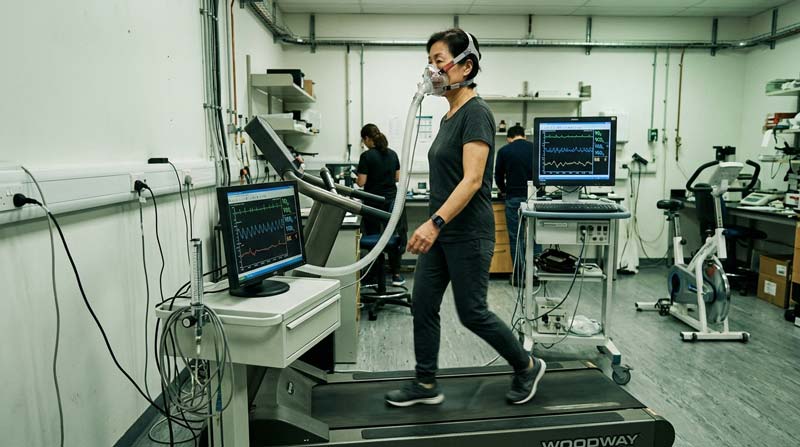
Even a perfect calorie figure would not settle the question. The body responds to training, and that response is not neutral. Some of the response is conscious, and some of it is not. Conscious compensation is a decision, such as a larger portion after a hard session. Automatic compensation happens without any decision at all. Metabolic rate shifts. Movement outside training quietly falls.
On average, people replace about half of what they expend through exercise. That averaged roughly 1,000 kilocalories a week in one analysis. The proportion held regardless of how much exercise was prescribed. Frequency, duration and intensity did not change it a great deal. Larger volumes appear necessary to outpace it, approaching 3,000 kilocalories of exercise weekly.
An average of half is not a rule for any individual. Some people compensate almost completely, while others barely compensate at all. Across exercise trials, average intake rose by only about 100 kilocalories against non-exercising controls. In one study of 162 adults with overweight or obesity, training was combined with dietary advice. Energy intake did not rise in compensation.
Appetite does not respond to exercise in a single direction either. Hard sessions can suppress hunger for a day or two afterwards. Hormones that regulate appetite, such as ghrelin and peptide YY, shift after intense work. Regular training may also sharpen the brain’s sensitivity to satiety signals. So hunger after training is real information, but it is not a calorie readout. Anyone using appetite alone to decide whether to eat back exercise calories is reading a noisy signal.
Appetite does not stay still during weight loss either. Modelling suggests it rises by about 95 kilocalories a day for every kilogram lost. That is a larger movement than the fall in expenditure across the same loss. Loss of fat-free mass appears to drive eating in its own right. Restoring that tissue can bring additional fat with it, a pattern termed collateral fattening.
There is a further possibility, and it concerns the whole day rather than the meal. The constrained total energy expenditure model proposes that daily burn is partly regulated. Increases in activity may be offset by reductions elsewhere in the day. If correct, this helps explain why exercise alone often produces modest weight loss. It also means the daily total responds less to a session than arithmetic suggests.
None of this makes compensation a reason to fear food after training. It makes a fixed percentage indefensible. Half is an average across groups, not an instruction for one person. A person deciding to eat back exercise calories cannot know their own compensation in advance. It becomes visible later, in weight, in hunger, and in how the training itself feels.
When It May Make Sense to Eat Back Exercise Calories
Not all training makes the same demand, so the answer should not be uniform. A 30-minute walk and a three-hour endurance session are different physiological events. Ordinary sessions rarely require any adjustment to a well-built target. Long, intense, repeated or newly added training is a different case entirely.
Prolonged exercise depletes muscle glycogen, which is the stored form of carbohydrate in muscle. The body then leans more heavily on blood glucose supplied by the liver. As liver stores fall, blood glucose can drop into hypoglycaemia, meaning abnormally low blood sugar. Anxiety, tremor and impaired concentration can follow. Intensity then has to fall, and performance falls with it. Carbohydrate taken during sessions lasting over an hour delays the onset of fatigue.
Persistent under-fuelling produces a different set of problems. Inadequate intake raises injury risk and impairs performance. It also encourages the breakdown of lean tissue for energy. Chronic energy deficiency depletes muscle mass, muscle strength and bone density. Under those conditions, choosing to eat back exercise calories is not indulgence. It is the correction of a deficit that has grown too large.
Weight loss is not a single outcome, and its composition matters. Roughly 20 to 30 per cent of weight lost in adults comes from non-fat tissue. Losing that tissue costs strength and function, and lowers RMR. Exercise shifts the balance, favouring fat loss and preserving fat-free mass. Moderate-to-high intensity resistance training preserves lean mass most effectively. It does not, however, prevent the metabolic slowing that accompanies weight loss. Resistance work alone also produces no clinically significant weight loss. Its value sits in strength, physical function and several disease risk factors instead.
Practical intake floors exist for people training hard during a deficit. Protein of 1.6 to 2.2 grams per kilogram of body weight helps protect lean tissue. Carbohydrate is generally not dropped below 3 to 4 grams per kilogram. Heavy endurance schedules may require 6 to 10 grams per kilogram instead. Fat intake is often the lever used to create the deficit itself. A loss of 0.5 to 1 kilogram a week is a commonly recommended rate.
Timing becomes relevant when sessions sit close together. With less than six hours between them, rapid refuelling is recommended. Carbohydrate within the first 30 minutes, then every two hours, supports glycogen replacement. For a single daily session, that urgency largely disappears.
What is eaten immediately beforehand changes little for recreational exercisers. Meeting daily protein and carbohydrate needs appears to matter more than strict timing. So the case to eat back exercise calories is strongest where training is heavy or repeated. It is weakest where an ordinary session has simply been logged.

How to Decide Whether to Eat Back Exercise Calories
The first decision is structural, and it removes most of the confusion. Choose one method of setting the target, then stay inside its logic. If the target already includes training, exercise is not added afterwards.
If the target assumes a sedentary base, recorded activity is genuinely additional. Mixing the two systems produces a number that means very little. That single choice settles whether to eat back exercise calories at all.
The second decision is evidential, and it takes weeks rather than days. Self-monitoring of intake and activity is associated with better weight outcomes. What matters, though, is the trend rather than any single day. Five signals are worth reading together.
- Weight trend across several weeks, rather than daily readings.
- Actual intake, including the days that were never logged.
- Training load, including sessions recently added or dropped.
- Hunger, and particularly whether it is climbing steadily.
- Performance and recovery, including sleep and how sessions feel.
Consistency of behaviour across the whole week predicts long-term success better than precision on any day. Adjustments should be small, and made one at a time. Large corrections make it impossible to know what caused the change.
Long-term maintainers show a recognisable pattern in registry data. They eat consistently across the week, weigh themselves regularly and act on what they see. Many also accumulate 60 to 90 minutes of moderate activity daily. That is a substantial volume of training, sustained alongside a steady intake.
Two patterns are worth learning to read. If weight is stable and hunger is climbing, the deficit may be too aggressive. If weight is stable and hunger is settled, intake is probably higher than recorded. Deciding to eat back exercise calories is a hypothesis, tested over weeks. The trend answers it, not the app.
There is a point at which none of this arithmetic is worth doing. Tracking encourages people to trust numbers over what their own body reports. For some, the counting itself becomes the problem. In a survey of young app users, almost half reported a negative experience.
Obsessive logging was the most common, alongside guilt, restriction and anxiety. Reaching a limit by mid-afternoon left some feeling unable to eat again that day. In one weight-loss app community, users described purging after exceeding a target. Around 7 per cent of female users had set weight goals below a healthy range.
Doctors working in eating-disorder care often discourage these apps and wrist monitors. The quantification can sustain rigid and restrictive behaviour. Where tracking has become punitive, the correct response is to stop tracking. Structured eating without numbers remains entirely possible.
The question that opened this has no universal answer, and that is the finding. All, some or none depends on how the target was built. It depends on what the training genuinely demands. It also depends on how one body responds over weeks, which no device can predict. Food is not a reward that has to be earned through movement. It is the input to a system that adjusts continuously, in both directions.
Sources
- Black AE, Coward WA, Cole TJ, Prentice AM. Human energy expenditure in affluent societies: an analysis of 574 doubly-labelled water measurements. Eur J Clin Nutr. 1996;50(2):72–92.
- Blair SN, Kohl HW, Gordon NF, Paffenbarger RS. How much physical activity is good for health? Annu Rev Public Health. 1992; 13: 99-126.
- Burke LE, Wang J, Sevick MA. Self-monitoring in weight loss: a systematic review of the literature. J Am Diet Assoc. 2011;111(1):92–102.
- Cabre HE, Moore SR, Smith-Ryan AE, et al. Relative energy deficiency in sport (RED-S): scientific, clinical, and practical implications for the female athlete. Dtsch Z Sportmed. 2022;73(7):225–234.
- Castro EA, Carraça EV, Cupeiro R, López-Plaza B, Teixeira PJ, González-Lamuño D, Peinado AB. The Effects of the Type of Exercise and Physical Activity on Eating Behavior and Body Composition in Overweight and Obese Subjects. Nutrients. 2020;12:557.
- Chevance G, Golaszewski NM, Tipton E, Hekler EB, Buman M, Welk GJ, et al. Accuracy and precision of energy expenditure, heart rate, and steps measured by combined-sensing fitbits against reference measures: systematic review and meta-analysis. JMIR Mhealth Uhealth. 2022;10(4):e35626.
- Donnelly JE, Blair SN, Jakicic JM, et al. American College of Sports Medicine position stand. Appropriate physical activity intervention strategies for weight loss and prevention of weight regain for adults. Med Sci Sports Exerc. 2009;41:459–471.
- Flack KD, Ufholz K, Johnson L, Fitzgerald JS, Roemmich JN. Energy compensation in response to aerobic exercise training in overweight adults. Am J Physiol Regul Integr Comp Physiol. 2018;315(4):R619–26.
- Garrow JS, Summerbell CD. Meta-analysis: effect of exercise, with or without dieting, on the body composition of overweight subjects. Eur J Clin Nutr. 1995;49(1):1-10.
- Gorin AA, Phelan S, Wing RR, Hill JO. Promoting long-term weight control: does dieting consistency matter? Int J Obes Relat Metab Disord. 2004;28(2):278–281.
- Hall KD, Heymsfield SB, Kemnitz JW, et al. Energy balance and its components: implications for body weight regulation. Am J Clin Nutr. 2012;95:989–994.
- Honary M, Bell BT, Clinch S, Wild SE, McNaney R. Understanding the Role of Healthy Eating and Fitness Mobile Apps in the Formation of Maladaptive Eating and Exercise Behaviors in Young People. JMIR Mhealth Uhealth. 2019;7(6):e14239.
- King NA, Hopkins M, Caudwell P, Stubbs RJ, Blundell JE. Individual variability following 12 weeks of supervised exercise: identification and characterization of compensation for exercise-induced weight loss. Int J Obes (Lond). 2008;32(1):177-184.
- King NA, Caudwell P, Hopkins M, et al. Metabolic and behavioral compensatory responses to exercise interventions: barriers to weight loss. Obesity. 2007;15(6):1373–83.
- Leibel RL, Rosenbaum M, Hirsch J. Changes in energy expenditure resulting from altered body weight. The New England Journal of Medicine. 1995;332(10):621–628.
- Levine JA. Non-exercise activity thermogenesis: liberating the life-force. J Intern Med. 2007;262(3):273–87.
- Lupton D. Quantifying the body: monitoring and measuring health in the age of mHealth technologies. Critic Pub Health. 2013;23(4):393–403.
- MacLean PS, Wing RR, Davidson T, et al. NIH working group report: innovative research to improve maintenance of weight loss. Obesity (Silver Spring). 2015;23(1):7–15.
- Mühlen JM, Stang J, Lykke Skovgaard E, Judice PB, Molina-Garcia P, Johnston W, et al. Recommendations for determining the validity of consumer wearable heart rate devices: expert statement and checklist of the INTERLIVE Network. Br J Sports Med. 2021;55(14):767–79.
- Muller MJ, Enderle J, Bosy-Westphal A. Changes in Energy Expenditure with Weight Gain and Weight Loss in Humans. Curr Obes Rep. 2016;5:413–423.
- National Institute for Health Care and Excellence. Obesity: identification, assessment and management. 2014.
- O’Driscoll R, Turicchi J, Beaulieu K, Scott S, Matu J, Deighton K, et al. How well do activity monitors estimate energy expenditure? A systematic review and meta-analysis of the validity of current technologies. Br J Sports Med. 2020;54(6):332–40.
- Pontzer H. Constrained total energy expenditure and the evolutionary biology of energy balance. Exerc Sport Sci Rev. 2015;43:110–116.
- Strath SJ, Kaminsky LA, Ainsworth BE, et al. Guide to the assessment of physical activity: clinical and research applications: a scientific statement from the American Heart Association. Circulation. 2013;128(20):2259–79.
- Thompson JL, Manore MM, Vaughan LA. The Science of Nutrition. 4th ed. Upper Saddle River, NJ: Pearson; 2017. 773 p.
- Van Baak M, Pramono A, Battista F, Beaulieu K, Blundell JE, Busetto L, et al. Effect of different types of regular exercise on physical fitness in adults with overweight or obesity: systematic review and meta-analyses. Obes Rev. 2021;22(Suppl 4):e13239.
- Wadden TA, Neiberg RH, Wing RR, Clark JM, Delahanty LM, Hill JO, Krakoff J, Otto A, Ryan DH, Vitolins MZ, et al. Four-year weight losses in the Look AHEAD study: Factors associated with long-term success. Obesity. 2011;19:1987–1998.